How Is Nastaliq Made?
From Reed Pen and Ink to Paper and Page
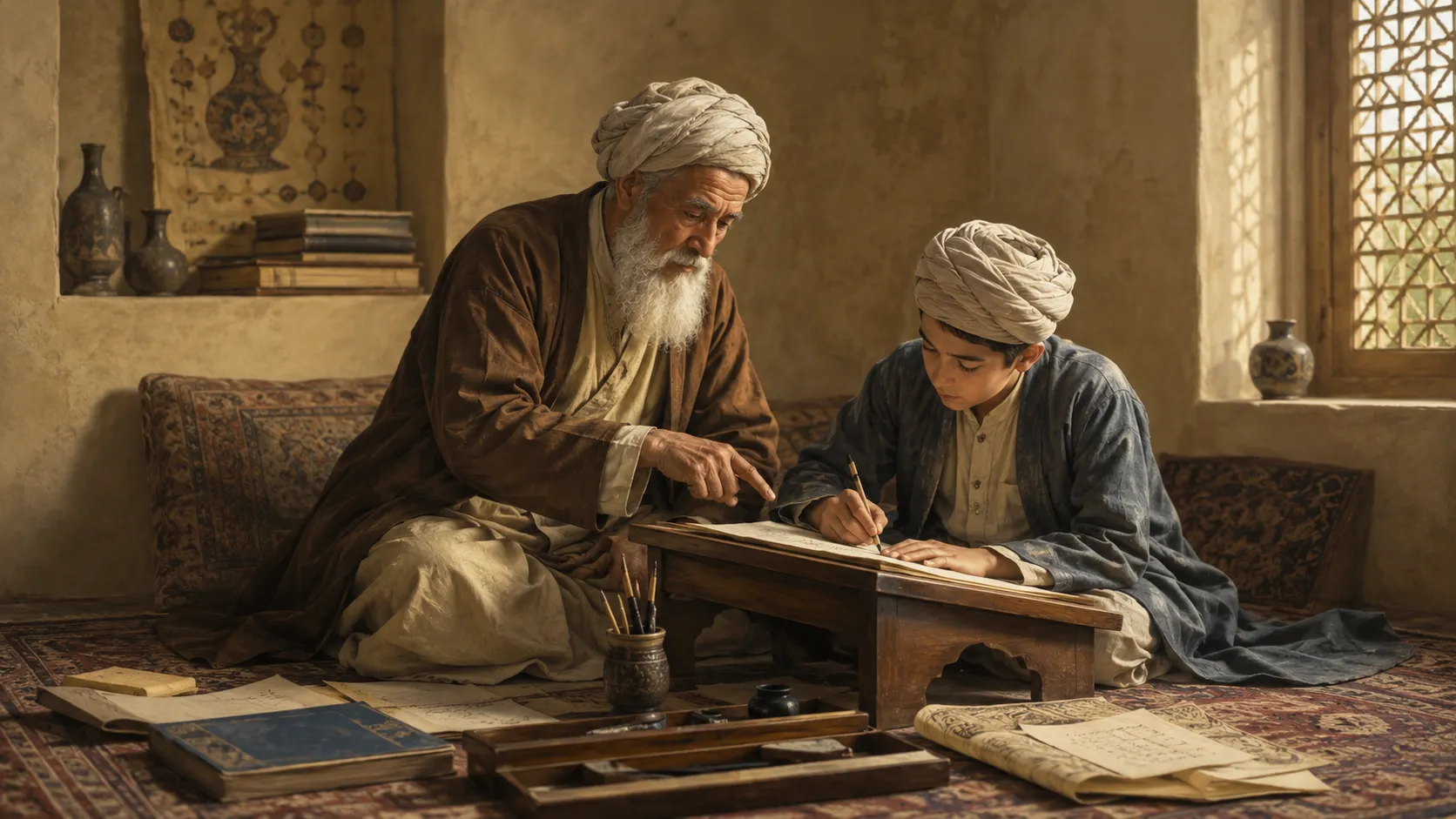
When we look at a piece of Nastaliq, our attention is usually drawn first to the shapes of the letters, the elongated strokes, the slope of the lines, and the balance between black ink and white space. But before any of these forms become visible, something else has already happened: the pen has moved across the paper, transferred ink, and the paper’s surface has responded to that contact.
Every stroke in Nastaliq is the result of this physical encounter between hand, tool, and material.
The pen tip can record one part of a movement as thin and another as broad. The ink has to keep pace with the rhythm of the movement so that the stroke forms fully and continuously. Paper, depending on its roughness, absorbency, and surface finish, can also alter the movement of the pen and the way the ink settles.
But none of these factors creates Nastaliq on its own.
The same pen in the hands of two calligraphers will not produce the same result, and even the finest paper will not become a work of calligraphy without an understanding of form, rhythm, and composition. What we finally see emerges from a relationship between hand, tool, material, and artistic decision.
Before Form, There Is Material
In calligraphy, a tool is not merely an instrument that carries out a decision already fully formed in the mind. The tool itself affects what can be done.
Tools and materials create the conditions of movement. They make some movements easier, others more difficult, and some almost unsuitable. It is the calligrapher who must understand and regulate their behaviour.
This becomes even more important when examining historical works. What we see today in a museum or a digital image is not necessarily what the work looked like on its first day.
Light, humidity, abrasion, oxidation of materials, conservation treatment, or even later remounting and bordering can alter the colour of the paper, the darkness of the ink, and the sharpness of edges. Images are extremely useful for studying form, but they do not allow us to speak with certainty about every material in a work.
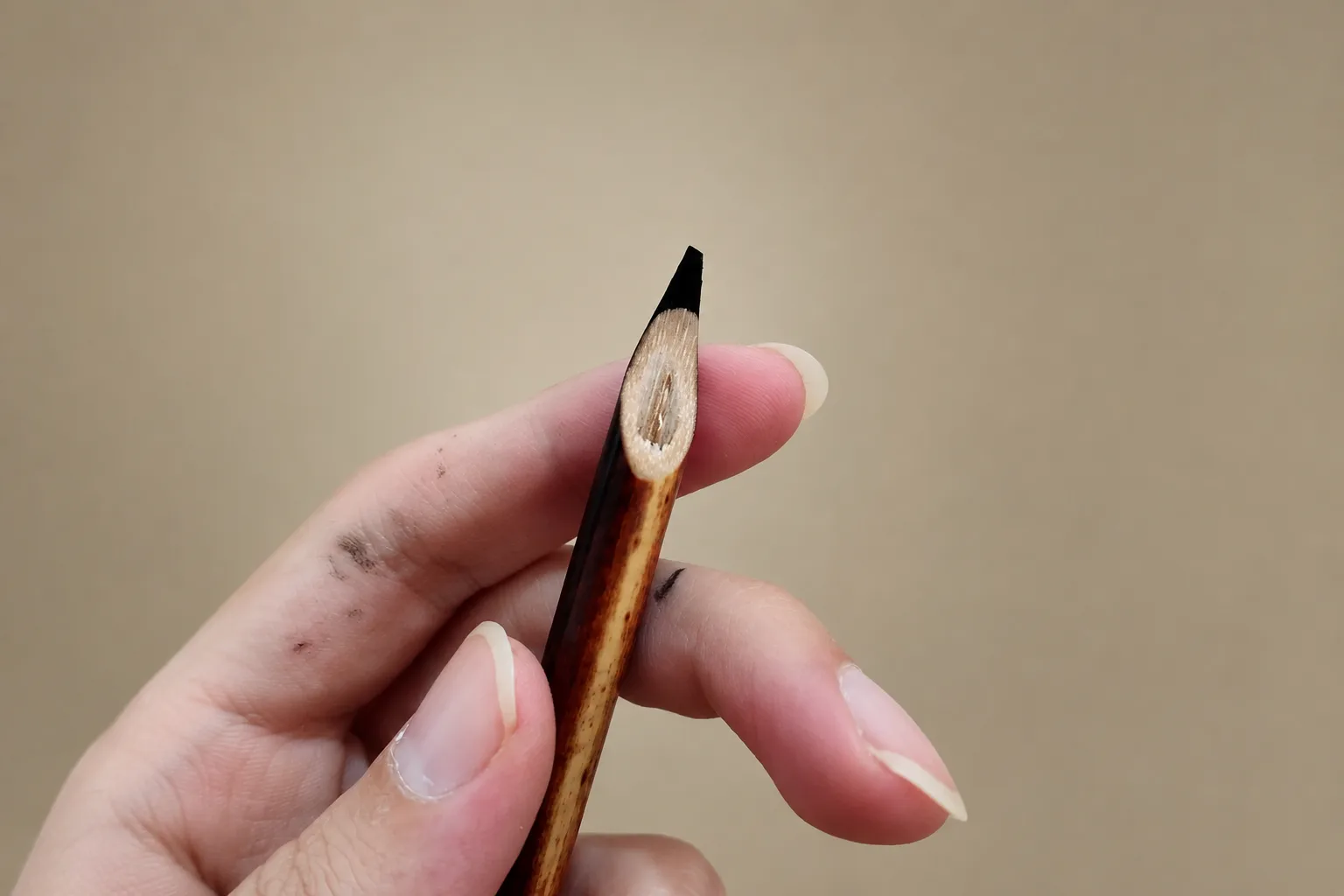
The Reed Pen: When Hand Movement Becomes Line
The reed pen has been one of the principal tools of calligraphy in Iranian and Islamic traditions.
But when we speak of the reed pen, its material alone is not what matters. The diameter of the reed, the thickness of its wall, its hardness or flexibility, the width of the nib, the shape of the cut, and even the degree of wear can all affect the way it behaves.
How Is Line Thickness Formed?
One of the most visible characteristics of Nastaliq is the continuous change between thin and broad passages.
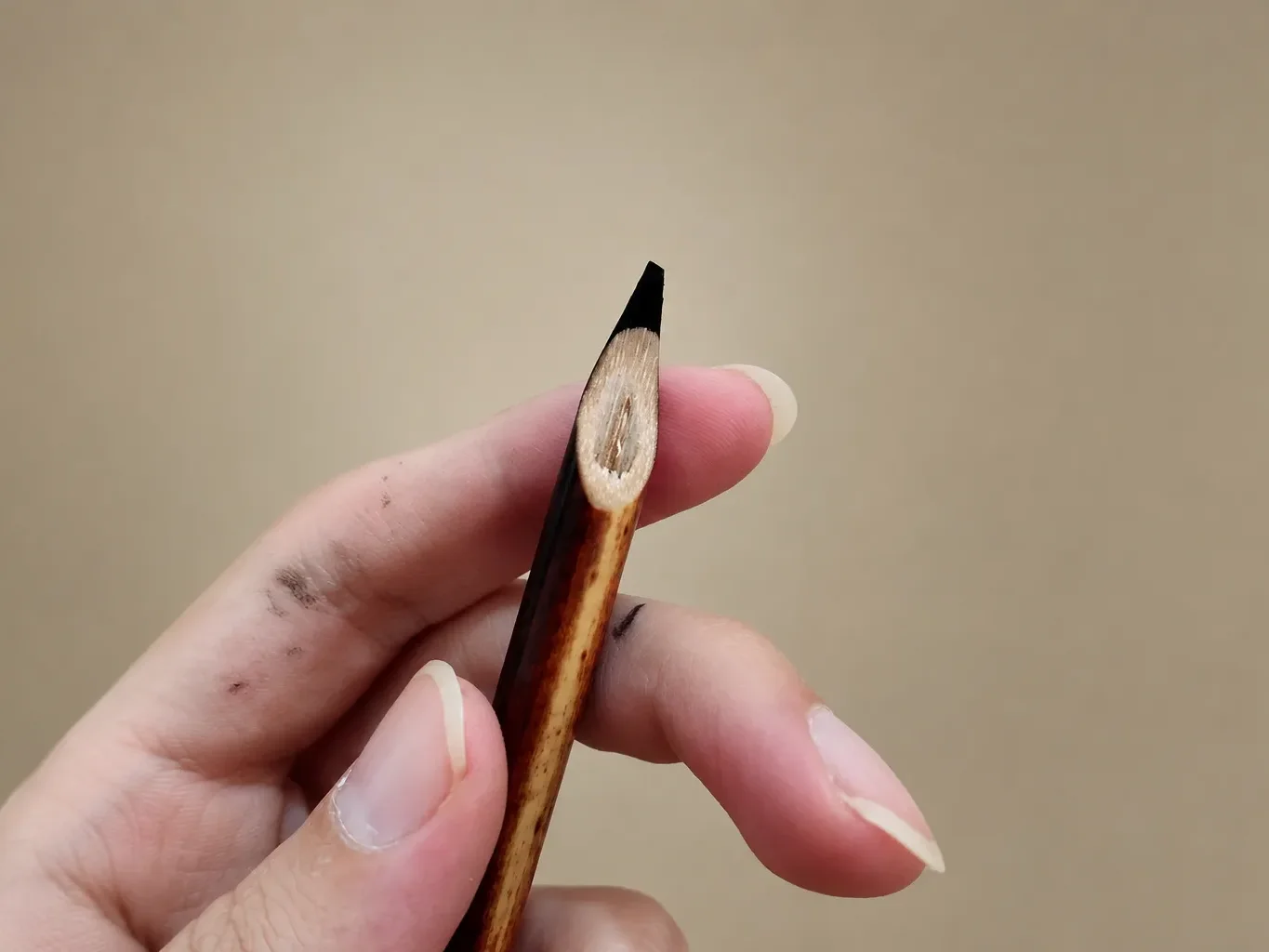
Part of this variation comes from the shape of the nib. As the direction of the hand changes in relation to the angled edge of the pen, the amount of surface touching the paper changes as well. A stroke can therefore move from thin to broad within a single motion.
But again, the geometry of the nib is only part of the story. Hand pressure, speed, slight rotation of the pen, and the amount of ink carried on the nib all contribute to the result.
What we ultimately see is therefore the product of several interacting factors.
Ink: How Movement Remains on the Page
The pen creates the movement, but ink is what records that movement on paper.
Ink is usually kept in an inkwell. Inside the inkwell there may be liqeh, an absorbent material that holds the ink and helps deliver it to the pen tip in a more controlled quantity.
These details may seem minor at first, but in practice they affect the consistency of ink flow.
If the ink reaches the nib unevenly, even a correct hand movement may produce a broken or incomplete stroke.
There Was No Single Formula for Traditional Ink
Traditional ink is sometimes discussed as though the same fixed recipe had been used in every period. Historical sources do not support such a picture.
Different treatises mention mixtures containing soot and other carbon materials, gums, gallnuts, vitriol, and other substances.
Technical studies also distinguish between carbon inks, iron-gall inks, and other formulations.
These differences are not only chemical. The behaviour of the ink can also vary.
Some inks remain more on the surface. Some materials can penetrate into the paper, and certain formulations, such as iron-gall inks under particular conditions, may damage paper over time.
However, the type of ink used in a historical work cannot be identified simply from its black colour.
A simple museum description such as “ink on paper” does not mean that the chemical type of ink has been identified. That kind of identification requires technical examination of the work itself. A more detailed article on the chemistry of ink will be published in the future.
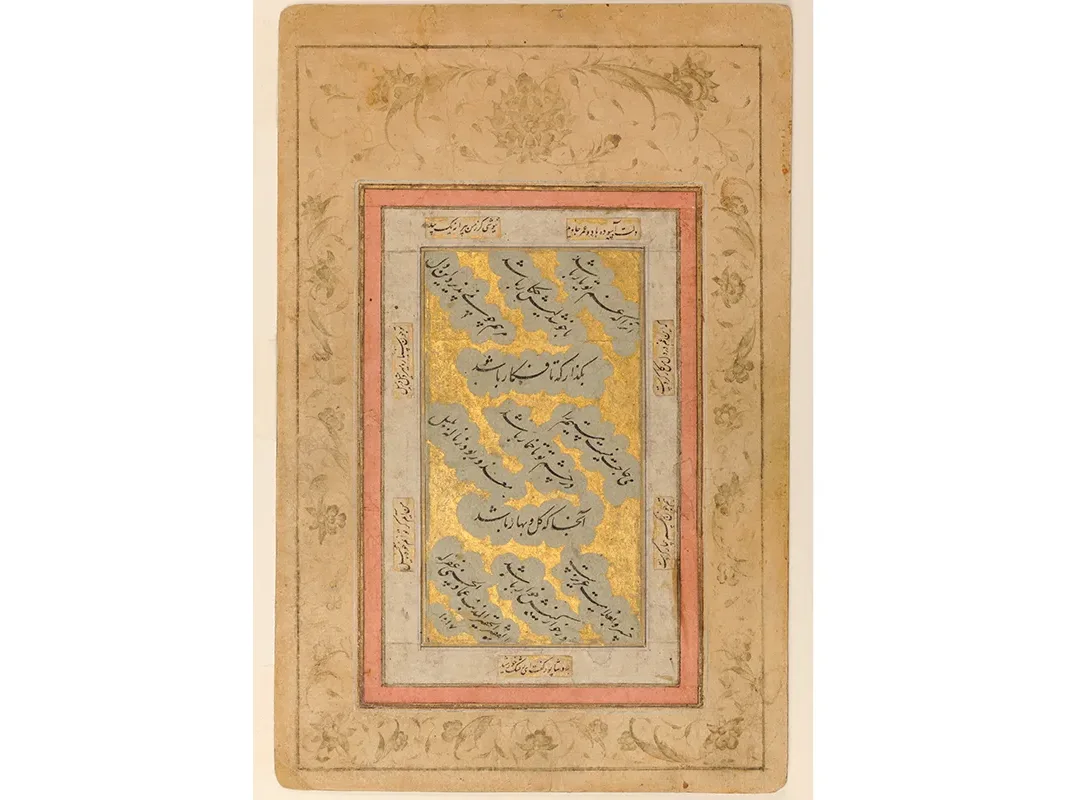
Mir Emad Hassani; 1017 AH / 1608–1609 CE; ink, opaque watercolour, and gold on paper; The Metropolitan Museum of Art; accession no. 46.126.3; Public Domain.
Leaf of poetry in the hand of Mir Emad Hassani, 1017 AH / 1608–1609 CE, The Metropolitan Museum of Art.
Paper: More Than a Background
Paper is often seen simply as the background for calligraphy, even though it is itself part of the process through which the work takes form.
Fibre structure, absorbency, roughness, colour, and surface treatment can all affect the movement of the pen and the way ink is recorded.
Research into the history of paper in the Islamic world shows that many premodern papers were made from plant and textile fibres rather than from the industrial wood pulp common today.
The Colour of Paper Is Also Part of the Work
The colour of historical paper is not always the result of ageing.
In the Iranian arts of the book, the use of coloured papers was a deliberate choice. Colour can alter the degree of contrast between writing and ground and influence how the empty space of the composition is perceived.
In a piece by Sayyid Amir Ali on marbled paper, the marbled ground is not merely a neutral background. Its coloured veins remain visually active beside the writing and affect the relationship between the blackness of the script and the surrounding space. The museum record likewise describes the work as “black ink on marbled paper.”
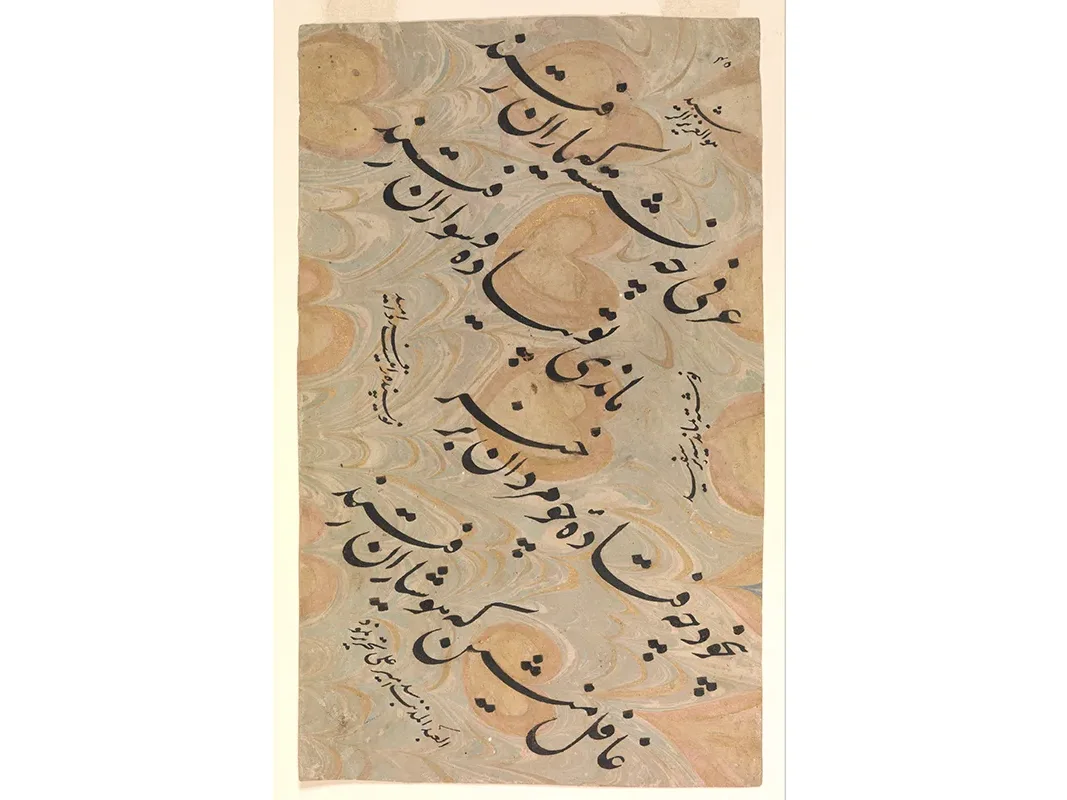
Sayyid Amir Ali; mid-17th century; India; black ink on marbled paper; The Metropolitan Museum of Art; accession no. 1999.356; Public Domain.
Sizing and Burnishing: Preparing the Surface for the Pen
In many papers used for calligraphy, the surface was prepared before writing.
Sizing is a material or process used to alter the behaviour of the paper surface. It can reduce liquid absorption, strengthen the surface, and change the way ink sits on the paper.
Burnishing is the process of smoothing and polishing the surface. It reduces roughness and limits the pen’s contact with raised fibres.
When we speak of ahar-mohreh, or sized and burnished paper, we should not imagine a single historical product made according to one completely fixed formula.
Sources and laboratory research have shown that starch was not the only material used for sizing. Other plant-based substances such as gums, and even materials such as egg white, appear in some sources and examined examples.
When Several Artists Work on One Page
In illustrated manuscripts, the production of a work could involve collaboration between a scribe, painter, illuminator, and other members of a workshop.
This means that the page, even before the calligrapher completed the writing, could already be part of a larger structure.
The positions of lines, columns, headings, and illustrations sometimes had to be arranged so that later stages of work could also be carried out.
This matters for understanding Nastaliq because it shows that writing was not always created as an isolated and independent element on the page.
Within a manuscript, the movement of the pen formed part of the overall organisation of the book. The many Shahnameh manuscripts produced at different points in history provide examples of this, among them the celebrated Baysunghur Shahnameh.
The muraqqa', or album, is also important in this respect. Pieces made at different times and in different places could later be assembled together in a single album.
For this reason, the paper and borders that we see around a piece today are not necessarily the same ones that surrounded it when it was originally written.
History, Museum Records, Laboratory Analysis, and Contemporary Experience Are Not the Same Thing
We have several types of evidence for understanding the materials and tools of historical calligraphy, but each provides a different kind of information.
A historical treatise can tell us which method a master of that period considered correct or desirable.
A museum object can show what forms and materials have been recorded for one specific work.
Laboratory analysis may identify those materials more precisely.
The experience of a contemporary calligrapher can also clarify how a method behaves in practice today.
The problem begins when these four kinds of evidence are treated as though they were the same.
If a calligrapher today cuts a pen in a particular way to achieve a certain quality, that experience alone does not prove that calligraphers in Herat or Isfahan did exactly the same thing.
Likewise, if a treatise recommends a method, we cannot conclude that every master of the period followed that instruction.
This distinction may sound scholarly, but its practical result is simple: we should speak precisely about what we know and avoid inventing stories about what we do not know.
How Does Material Become Form?
So far, we have discussed pen, ink, and paper separately, but in an actual work these factors are not separate.
They become form through a shared process.
Thickness and Delicacy
Changes in thickness begin with the shape of the pen tip. The direction and pressure of the hand alter them. The ink must record the contact fully.
The paper must also allow the edge of the stroke to remain appropriately defined.
A broad passage in Nastaliq is therefore the result of the pen, the movement of the hand, the ink, and the surface on which that movement is recorded.
Rhythm
The rhythm of Nastaliq is not created only by the spacing between letters and words.
Pauses of the hand, lifting and placing the pen, the timing of re-inking, the speed of movement, and even the resistance of the paper surface all contribute to the experience of rhythm.
An uneven surface can interrupt movement. A worn pen or poorly balanced ink can also cause unintended changes in the stroke.
An experienced calligrapher anticipates and compensates for some of these behaviours.
For this reason, skill and material cannot be placed in opposition to each other. Both are present in the formation of the work.
Savad and Bayaz
In calligraphy, savad refers to the written, dark area of the page, while bayaz refers to the white space between and around it.
In Nastaliq, the relationship between the two is organised through elongated strokes, spacing between lines, the density of words, and the movement of the kursi, the notional baseline.
Material qualities, however, also affect how this relationship is perceived.
Very dark and dense writing carries greater visual weight. The colour of the paper can also increase or reduce the intensity of the contrast.
These factors do not replace the calligrapher’s compositional decisions. They simply change the conditions under which those decisions are seen.
Is Nastaliq the Work of the Hand or the Tool?
If the whole discussion were to be reduced to one simple question, it might be this:
Does the quality of Nastaliq come from the calligrapher’s hand or from the tools?
The two cannot be separated.
The pen provides a range of movement. Ink records that movement. Paper changes the conditions of contact. Preparation of the page determines where the writing is placed.
But it is the calligrapher who must understand all of these factors, establish a balance among them, and place them in the service of form.
Nastaliq, then, is neither solely “the work of the pen” nor simply “the skill of the hand.”
The work emerges where hand, pen, ink, paper, page, and tradition enter into relationship with one another.
This way of looking helps us see the beauty of Nastaliq with greater precision.
Behind a flowing elongated stroke there is more than the skill of the hand. Behind a clean edge there is more than the quality of the paper. Behind an even field of black there is more than the formula of the ink.
Each is the result of a process in which several factors are present at the same time.
And perhaps understanding this process is what brings us closer to moving beyond simply seeing “beautiful writing” toward understanding how it is made.
Sources
Sheila S. Blair. Islamic Calligraphy. Edinburgh University Press, 2006.
Sultan Ali Mashhadi. Sirat al-Sutur, 920 AH / 1514 CE.
Penley Knipe, Georgina Rayner, Katherine Eremin, Marc Walton, Agnese Babini, et al. “Materials and Techniques of Islamic Manuscripts.” Heritage Science 6, 55 (2018).
Mandana Barkeshli. “Material Technology and Science in Manuscripts of Persian Mystical Literature.” Manuscript Cultures 8 (2015): 187–214.
National Museum of Asian Art, Smithsonian. Nastaʿlīq: The Genius of Persian Calligraphy, 2014.
Encyclopaedia Iranica. Entries “CALLIGRAPHY,” “QALAM,” “ĀDĀB AL-MAŠQ,” and “KALHOR.”
Sadra Zekrgoo. “Methods of Creating, Testing and Identifying Traditional Black Persian Inks.” Restaurator 35, no. 2 (2014): 133–158.
François Déroche et al. Islamic Codicology: An Introduction to the Study of Manuscripts in Arabic Script. Al-Furqan Islamic Heritage Foundation, 2006.
Mandana Barkeshli. “Historical and Scientific Analysis on Sizing Material Used in Iranian Manuscripts and Miniature Paintings.” Book and Paper Group Annual 22 (2003): 9–16.
Alireza Koochakzaei and Tahereh Ghaffari. “Identification of Traditional Black Persian Inks by Spectroscopic and Spectral Imaging Techniques.” Vibrational Spectroscopy 127 (2023): 103545.
Mandana Barkeshli et al. “European Ink Recipes Found in ‘Ali Hosseini’s 19th-Century Kashf al-Sanaye.” Restaurator (2022).
Bodleian Libraries. Persian Recipes: From Dyeing Paper to Black Inks.
Jonathan M. Bloom. Paper Before Print: The History and Impact of Paper in the Islamic World. Yale University Press, 2001.
Jonathan M. Bloom. “PAPER i. Paper in the Iranian World Prior to Printing.” Encyclopaedia Iranica.
Mandana Barkeshli. “Historical and Scientific Analysis on Sizing Material Used in Iranian Manuscripts and Miniature Paintings.” 2003.
Mandana Barkeshli. “Material Technology and Science in Manuscripts of Persian Mystical Literature.” 2015.
Penley Knipe et al. “Materials and Techniques of Islamic Manuscripts.” 2018.
Adam Gacek. Arabic Manuscripts: A Vademecum for Readers. Brill, 2009.
Elaine Wright. The Look of the Book: Manuscript Production in Shiraz, 1303–1452. 2012.
Marianna Shreve Simpson. Sultan Ibrahim Mirza’s Haft Awrang. Freer Gallery of Art, 1997.
David J. Roxburgh. Prefacing the Image: The Writing of Art History in Sixteenth-Century Iran. Brill, 2001.
Encyclopaedia Iranica. “KALHOR.”
Mandana Barkeshli et al. “European Ink Recipes…” 2022.

Discussion · article
0