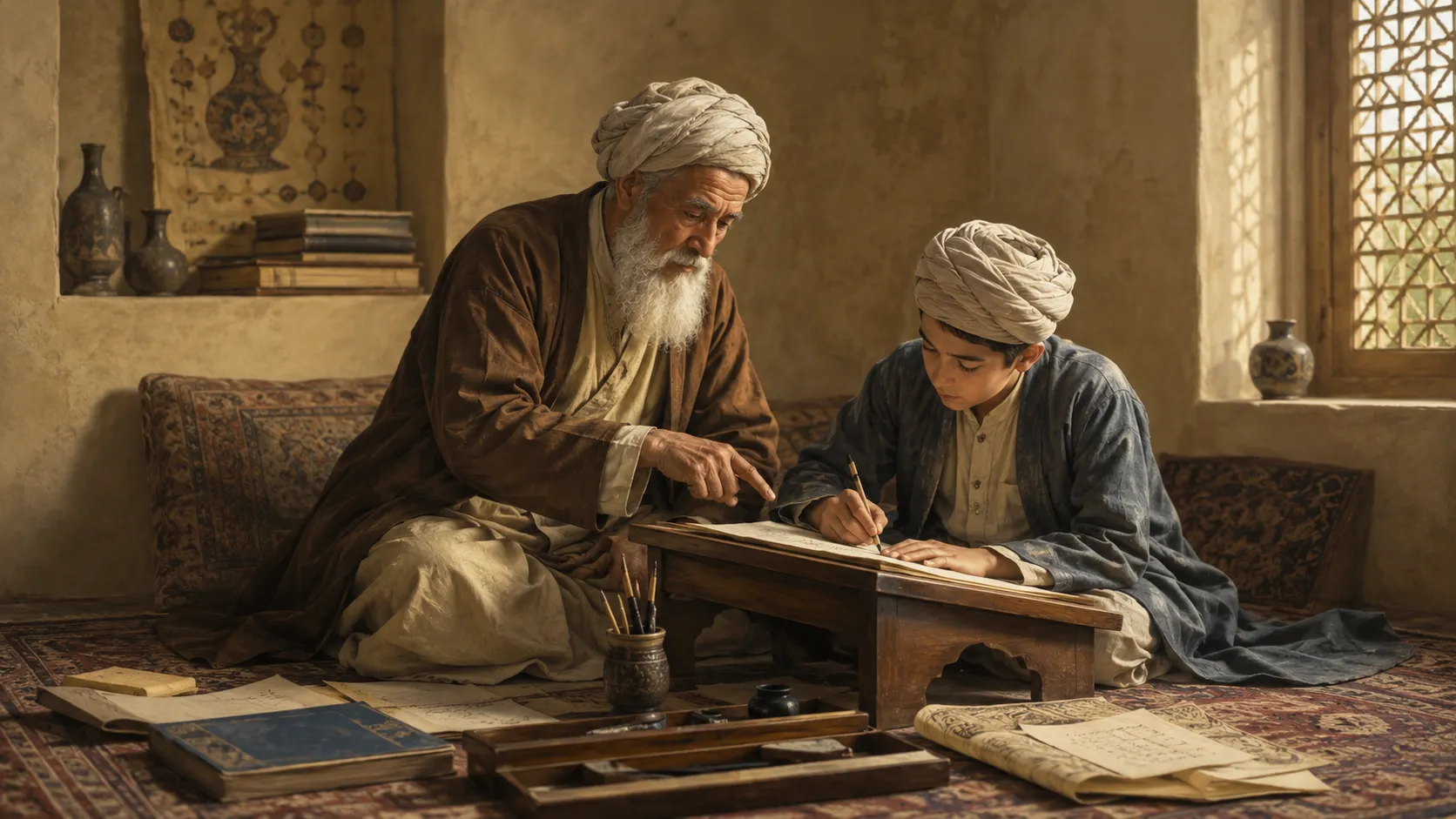
From Master to Student: How Was Nastaliq Taught?
A student of Nastaliq today usually encounters a relatively clear path: classes, instructional books, visual study of masters’ works, more advanced exercises, and sometimes a programme that begins with individual letterforms and moves toward combinations and lines, along with other methods.
This familiar experience can make us imagine the past in the same way, as though several centuries ago every master also followed a defined programme, students passed through fixed stages, and at the end received a certificate confirming completion of their training.
Historical sources do not give us such a uniform and orderly picture.
What we can see more clearly is a range of ways in which skill was transmitted: the relationship between master and student, observing the master’s works, practising from a model, repetition and rewriting, studying works by masters of earlier generations, and recording part of the rules in calligraphic treatises.
For some of these methods, we have relatively good information. For others, such as the precise way a master corrected a student’s exercises or whether there was a fixed system of written authorisation, we know much less.
So the question of this article is not “What was the traditional method of teaching Nastaliq?” Such a question assumes from the outset that there was one fixed method.
A more precise question is:
Before classes, printed instructional books, and modern educational structures, how was Nastaliq transmitted from one generation to the next?
How Do We Know How Calligraphy Was Learned Centuries Ago?
To answer this question, we rely on several different kinds of sources.
Calligraphic treatises discuss preferred methods of writing and practice.
Biographical anthologies and biographies record some relationships between masters and students.
Practice sheets and calligraphic pieces sometimes preserve the physical act of practice itself.
Modern research compares these sources and at times re-examines attributions that had been accepted for many years.
But each source shows only part of the story.
If a treatise tells us how a calligrapher “should” practise, we cannot conclude that every master in every city followed exactly the same method.
Likewise, knowing that one calligrapher studied under a particular master still does not tell us how a lesson unfolded, how the master corrected the student’s writing, or when the student was allowed to move to the next stage.
Even so, the master-student relationship is clearly documented in the history of Nastaliq.
For example, sources on Sultan Ali Mashhadi describe his presence in the library and workshop environment of Herat and his connections with various students. Albums later preserved works by him and his students together.
These sources do not show us a classroom, but they do show that teaching and the transmission of style through direct human relationships were real parts of calligraphic history.
At this point, we need to distinguish between several different things:
A direct student of a master, someone who practised from that master’s works, a follower of the master’s style, and someone whom later sources placed within an instructional lineage do not necessarily occupy the same historical position.
Mashq: Seeing Before Writing
One of the most important sources that allows us to move a little closer to the teaching process is Baba Shah Isfahani’s treatise Adab al-Mashq.
In some later manuscripts, the treatise was attributed to Mir Emad, but manuscript research supports its attribution to Baba Shah Isfahani.
In Carl Ernst’s study of the text, three forms of practice are distinguished:
mashq-e nazari, mashq-e qalami, and mashq-e khiyali.
These three terms already offer an interesting picture of learning.
Mashq-e Nazari: First, One Must See
In mashq-e nazari, the student looks at and assesses the master’s writing before beginning to write.
The idea is simple, but important.
Learning calligraphy is not only the result of repeated hand movement.
The eye also has to be trained. It must learn to distinguish differences in form, proportion, and quality of execution.
Mashq-e Qalami: What Has Been Seen Must Be Written
At the stage the treatise calls mashq-e qalami, observation turns into execution.
The text speaks of “copying” the master’s writing. The student has the model in front of them and rewrites it.
According to Ernst’s account, the practice could begin with large models of individual letters and then move toward shorter combinations.
This is important evidence showing that movement from individual forms toward combinations has historical precedent.
But we should not immediately turn this evidence into today’s teaching programme and claim that all students in the past went through precisely defined stages called “individual forms” and then “combinations.”
Mashq-e Khiyali: When the Model Is No Longer in Front of the Eye
In mashq-e khiyali, the writer no longer copies directly from a visible model.
This stage can be understood as a degree of distance from the example and greater reliance on what has taken shape in the mind and hand through observation and practice.
Baba Shah’s threefold division is highly important, but it is best understood for what it is: one specific treatise’s description of several forms of practice, not an official curriculum followed by every teacher of Nastaliq in every period.
Teaching Was Not Only Technical
Adab al-Mashq does not speak only about the shapes of letters or the movement of the pen.
Baba Shah combines the technical language of calligraphy with ethical and spiritual advice and sees relationships between certain qualities of writing and moral qualities of the calligrapher.
This perspective matters for understanding the intellectual world of the treatise itself.
But we should not turn it into a general claim that all Nastaliq instruction in every period was “mystical.”
The same caution needed in formal analysis is also necessary when reading the ethical language of historical sources.
Was Every Work by a Master a Teaching Model?
Today, when we speak of a sarmashq, we usually mean a model written by the master for a student to practise from.
But with historical works, we need to be more cautious.
A piece by a major master was not necessarily created for instruction simply because later generations practised from it.
An interesting example appears in the work of Sultan Ali Mashhadi.
In the signature of one of his pieces, instead of the more common word katabahu, he used mashaqahu. The National Museum of Asian Art connects this choice of wording with the act of mashq and suggests that the work may have been used for study or imitation by learners.
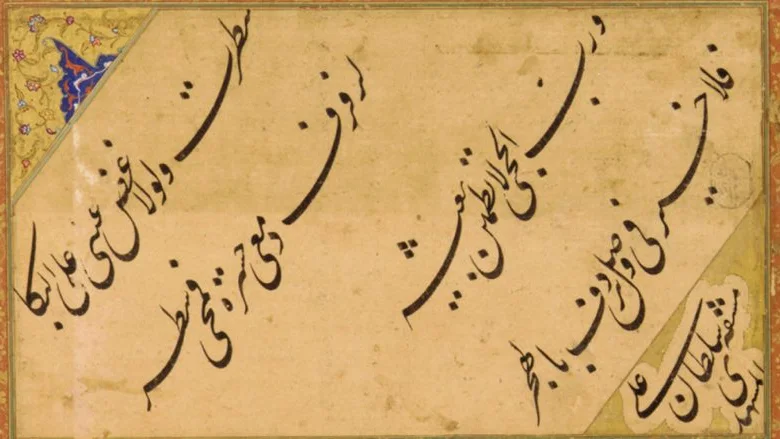
This is important evidence because the word itself survives on the work.
But we still do not know whether Sultan Ali wrote it for a specific student during a particular lesson.
So describing it as “a model associated with practice” is more precise than immediately calling it “a personal teaching exercise for one student.”
Sultan Ali Mashhadi: When Master, Student, Work, and Treatise Come Together
Sultan Ali Mashhadi is an important figure for understanding the teaching of Nastaliq because several different kinds of evidence surround him.
He worked for many years in Timurid Herat and was part of the professional environment of the court library and workshop. Sources name numerous students associated with him, and his works remained available for observation and practice by later generations.
In 920 AH / 1514 CE, he also wrote the verse treatise Sirat al-Sutur, a text that discusses calligraphy, tools, practice, and professional conduct.
Together, these materials make one point clear:
Direct teaching and instructional texts were not necessarily alternatives to one another.
A master could teach a student, provide examples for observation, and at the same time record part of his knowledge in a treatise.
Even so, we cannot reconstruct Sultan Ali’s daily teaching schedule or the complete order of his lessons.
Having recognised rules is not the same as having a “standardised curriculum.”
Nastaliq may have become increasingly regulated over time without every master in Herat, Qazvin, Isfahan, or Bukhara teaching through exactly the same programme.
What Could a Treatise Transmit?
Calligraphic treatises show that part of the knowledge of the art could be put into writing.
The names of components, proportions, recommendations for practice, preparation of pen and ink, and even the ethical language of the profession could all be recorded.
But these texts themselves often presume the presence of a master and a model.
In Adab al-Mashq, part of learning is derived from the master’s writing, and verbal instruction is also mentioned alongside observation.
So a treatise should not be imagined as a modern “self-study book.”
For a clearer understanding, we can place four elements beside one another:
The treatise recorded part of the rules and vocabulary.
The model placed the correct form before the eye.
Mashq turned observation into repeated movement of the hand.
And the master was the human relationship that connected these elements.
This division is an explanatory model for understanding the sources, not a rule that governed the entire history of Nastaliq education.
When the Treatise Itself Also Needs to Be Examined
Even in the case of treatises, we cannot simply trust the name written on a manuscript.
Sometimes an instructional text was attributed in a later period to a famous master, and that attribution can alter how we understand that master’s teaching method.
An important example is Midad al-Khutut.
In some older sources, this treatise was attributed to Mir Ali Haravi.
More recent research by Amin Iranpour and Hamidreza Gholichkhani, however, has rejected this attribution through examination of the text and manuscripts.
Iranpour considers a large part of the treatise to be derived from other writings, especially Majnun Rafiqi Haravi’s Savad al-Khatt. Gholichkhani likewise concludes through source comparison that the text attributed to Mir Ali was altered in a later period and circulated under his name.
For this reason, Midad al-Khutut cannot be used in this article as evidence for Mir Ali Haravi’s teaching method.
Mir Ali Haravi: A Closer Example of an Instructional Relationship
In the case of Mir Ali Haravi, we have information that takes us somewhat closer to the teaching relationship itself.
Priscilla Soucek reports that Qazi Ahmad describes Mir Ali’s training as beginning under Zayn al-Din Mahmud, a student of Sultan Ali Mashhadi, and later continuing under Sultan Ali himself. Mir Ali’s own statements also strengthen the connection with Sultan Ali.
For the history of teaching, another part of this account is even more interesting.
Mir Muhammad Baqir, Mir Ali’s son, is presented as one of his most important students, and the Gulshan Muraqqa' preserves examples of exercises that Mir Ali wrote for his use.
Here we reach one of the clearer examples of a relationship between master, student, and teaching model.
This kind of evidence is far more valuable for understanding education than merely knowing that someone “followed the master’s style.”
The transmission of a style does not necessarily depend on the master’s physical presence. Sometimes the work itself becomes the intermediary.
Mir Emad is an important example.
Sources are not completely consistent about his direct teachers, and some instructional relationships appear only in later sources without being confirmed with equal clarity by contemporary evidence.
Kalhor: Practising from a Master Who Had Lived Two Centuries Earlier
Mohammad Reza Kalhor first studied in the nineteenth century under Mirza Mohammad Khansari.
But as he continued his development, he chose the works of Mir Emad as a principal reference and travelled to Qazvin and Isfahan to see and copy examples and inscriptions by him.
About two centuries separated Mir Emad and Kalhor.
So this is not a direct master-student relationship.
Yet the work of a past master could still play an educational role.
Kalhor observed Mir Emad’s works, rewrote them, and used them in shaping his own standards of execution.
This example shows that in the history of teaching, we should distinguish between three forms of transmission:
The movement of the master
The movement of the work
and the transmission of standards
Sometimes the artist travels; sometimes a piece or inscription remains in place; and sometimes, even without the physical presence of the master, his style becomes an educational standard.
Ijaza: Did Training End with a Certificate?
The subject of ijaza, or authorisation, is one of the areas where it is very easy to project the practices of one tradition onto another.
In Ottoman calligraphy, written ijazatname certificates occupy a recognised place, and many examples survive.
This can create the impression that in Iranian Nastaliq instruction too, a student always received a written certificate after completing a defined sequence of stages.
The surviving evidence does not support such a conclusion.
Research by Ahad Ravanju, while emphasising the importance of a master’s approval, states that the written granting and receiving of authorisation was not a general custom in Iranian calligraphy for long periods, and reports also exist of oral approval.
By contrast, Fariba Pat examines the structure of the written ijazatname specifically within the educational tradition of Ottoman calligraphy.
The cautious conclusion, therefore, is not that there was no form of a master’s approval in Iran.
It is this:
We do not have sufficient evidence to present a fixed, universal system of written authorisation as the standard conclusion of Nastaliq training in premodern Iran.
We should not borrow the Ottoman structure to fill the gaps in Iranian history.
Siyah Mashq: When Practice Becomes an Artwork
Siyah mashq is another example showing that the boundary between instruction and artwork was not always clear or fixed.
Originally, mashq is associated with practice and repetition.
But some practice sheets were later preserved, given borders, and incorporated into collections, becoming objects to be viewed and collected.
A siyah mashq by Asadullah Shirazi dated 1258 AH / 1842–1843 CE is explicitly described by the Metropolitan Museum of Art as a calligraphic exercise.
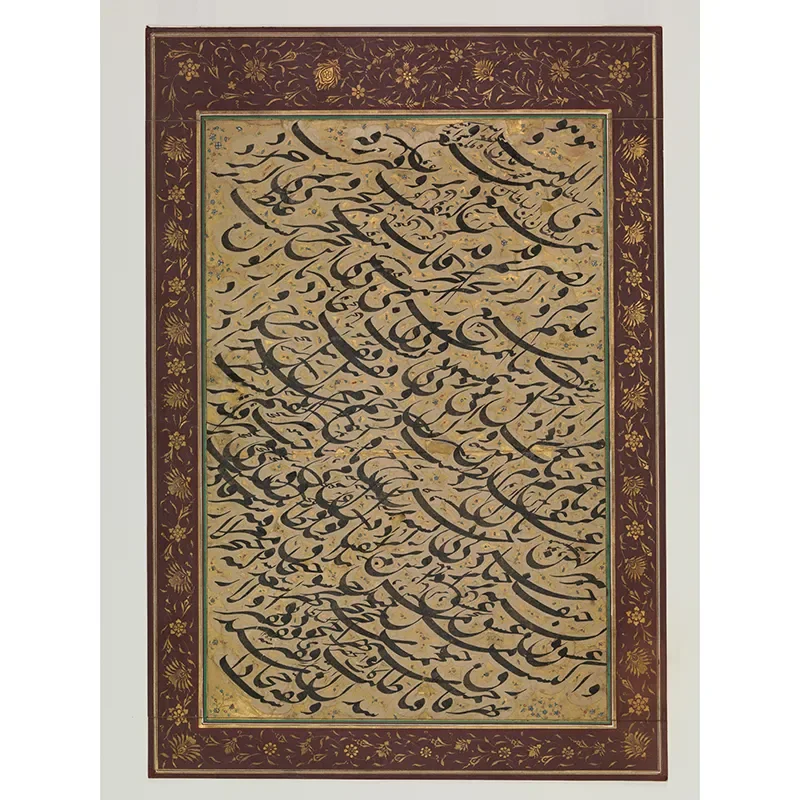
On this page, letters and combinations are repeated, and this repetition creates considerable visual density.
Another example by Muhammad Shah Qajar, dated Shawwal 1260 AH / October 1844 CE, is also recorded by the same museum as a page of calligraphic practice.
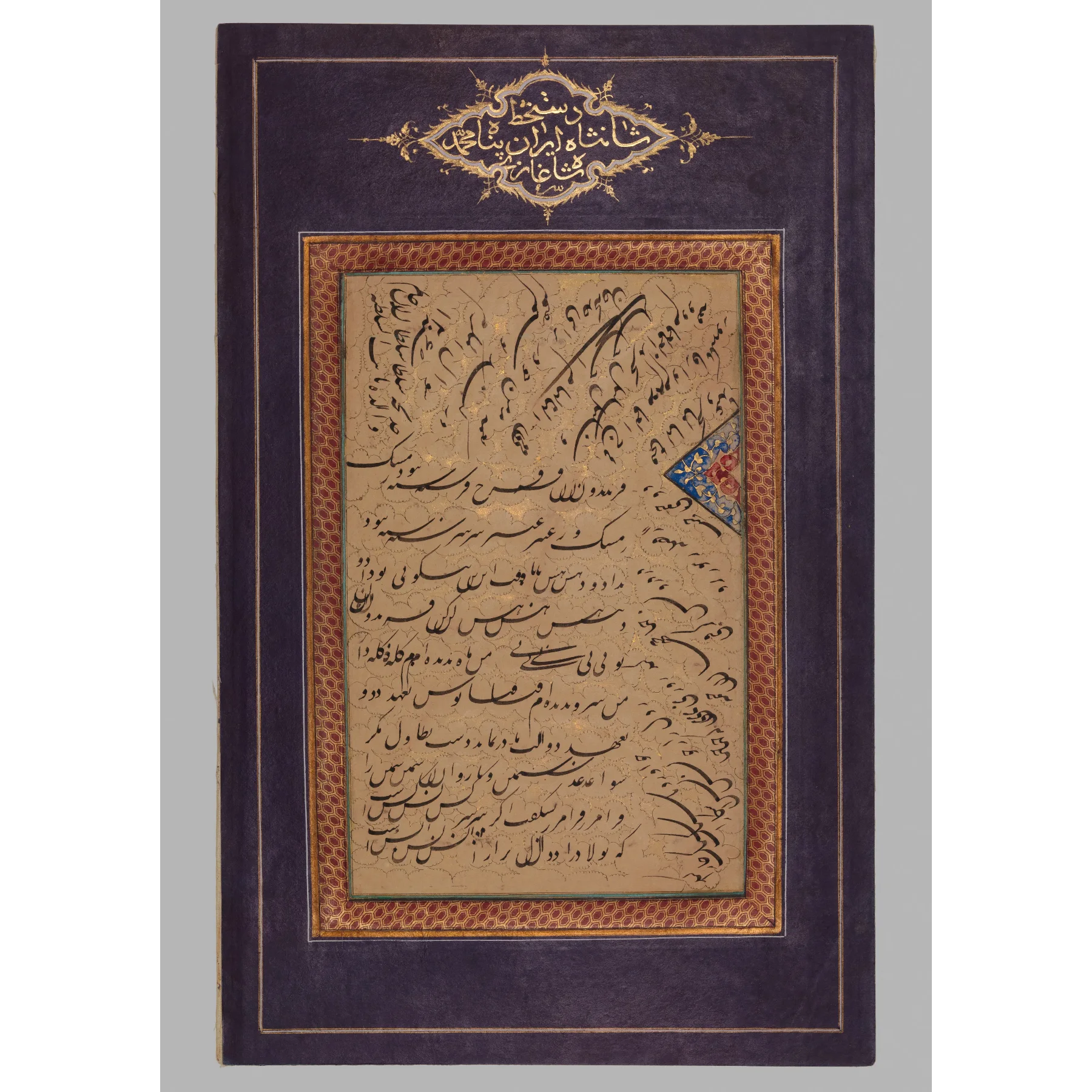
These works reveal an important point:
A page could emerge from the logic of practice and later become an object to preserve and view.
But this too should not be overgeneralised.
Not every dense historical sheet was necessarily an instructional exercise, and the present appearance of a work alone does not determine its original function.
When the Teaching Model Became Reproducible
As we approach the modern period, the medium of teaching gradually changed as well.
In Kalhor’s time, the master-student relationship and practice from works of earlier masters still mattered.
But lithography introduced a new possibility: a calligraphic model could be reproduced in larger numbers.
This shift becomes clearer in the activities of Emad al-Kottab.
Documents published by Ali Sam about his Rasm al-Mashq show that Emad al-Kottab designed printed instructional sets for beginners and school students.
These sets included educational divisions, models of letters, and even dotted forms for beginners to trace.
Here an important difference from earlier periods appears.
The teaching model no longer had to be a unique piece that a student could see only by being physically near the master or present where the work was kept.
The model could be printed, reproduced, and made available to larger numbers of students at the same time.
This development did not eliminate the master-student relationship. It simply added a new tool to teaching.
We sometimes divide the history of education into two entirely separate categories: “traditional instruction” and “modern instruction.”
But the evidence suggests a more gradual process.
The master-student relationship continued.
Mashq continued.
Seeing the works of earlier masters remained important.
But printed books, reproduced instructional models, and more organised educational structures were added alongside them.
What changed was not necessarily the foundation of learning; the media and the ways of accessing models changed.
At one time, a student might have depended mainly on a master, a single piece, or a treatise.
At another, the same student could have access to a teacher alongside a printed book and a set of reproduced images.
So how was Nastaliq learned?
The surviving evidence does not allow us to write one fixed curriculum for several centuries.
But we can identify several elements with greater confidence.
The master-student relationship was highly important, although knowing the names of master and student does not always reveal the teaching method.
Practice with individual letters followed by shorter combinations also has historical support, but we cannot use that evidence to project today’s complete educational programme back into the past.
Treatises preserved part of the rules and terminology, but they did not replace the master or practical experience.
Works by masters could themselves become learning tools, even when the master had lived years or centuries before the student.
And in later periods, printing made it possible for those same models to be reproduced on a broader scale.
So the history of Nastaliq instruction is not only the history of “the master teaching.”
It is the history of seeing, practising, repeating, comparing, reading treatises, observing earlier works, and transmitting standards.
Perhaps this point is also important for understanding tradition itself.
A tradition does not continue simply because forms are repeated.
Its continuation requires the transmission of knowledge that enables the student to see, distinguish, practise, and finally write independently without the model remaining permanently before the eye.
What the past has left us is not a single curriculum.
It is a multilayered history of master, student, model, practice, text, and work.
Sources
National Museum of Asian Art, Smithsonian Institution. Nasta‘liq: The Genius of Persian Calligraphy. Online exhibition, 2014.
Soucek, Priscilla P. “Bābā Shah Esfahāni.” Encyclopaedia Iranica, Vol. III, Fasc. 3, p. 295.
Ernst, Carl W. “The Spirit of Islamic Calligraphy: Bābā Shāh Iṣfahānī’s Ādāb al-Mashq.” Journal of the American Oriental Society 112, no. 2 (1992): 279–286.
Soucek, Priscilla P. “ʿAli Heravi.” Encyclopaedia Iranica, Vol. I, Fasc. 8, pp. 864–865.
Iranpour, Amin. “Midad al-Khutut: A Forged Treatise Attributed to Mir Ali Haravi.” Golestan-e Honar, vol. 7, no. 3, 1401 SH, pp. 13–22.
Gholichkhani, Hamidreza. “Examining the Authenticity of Midad al-Khutut Attributed to Mir Ali Haravi in Comparison with Majnun Rafiqi Haravi’s Treatises.” Pazhuhesh-e Honar, vol. 12, no. 23, 1401 SH, pp. 73–82.
Eslami, Kambiz. “ʿEmād Ḥasani, Mir.” Encyclopaedia Iranica, Vol. VIII, Fasc. 4, pp. 382–385.
Ekhtiar, Maryam. “Kalhor, Mirzā Mohammad-Reżā.” Encyclopaedia Iranica, Vol. XV, Fasc. 4, pp. 381–382.
Ravanju, Ahad. “A Study of Ijazatnameh or Permission Documents in the Field of Calligraphy.” Honarha-ye Ziba: Honarha-ye Tajassomi, no. 50, Summer 1391 SH, pp. 43–50.
Pat, Fariba. “Permission Letter (Ijazat Nameh) in the Teaching Tradition of Ottoman Calligraphy: Its Structural and Content Analysis.” Iranian Journal for the History of Islamic Civilization 49, no. 2 (2017): 143–170.
The Metropolitan Museum of Art. Album Leaf with Calligraphic Exercise (siyah mashq), Asadullah Shirazi, 1258 AH/1842–43 CE, accession no. 2016.536.
The Metropolitan Museum of Art. Album Page with Calligraphy Exercise (siyah mashq) by Muhammad Shah Qajar, Shawwal 1260 AH/October 1844 CE, accession no. 2016.535.
Sam, Ali. “Emad al-Kottab and the Concerns of Rasm al-Mashq.” Payam-e Baharestan, Autumn and Winter 1387 SH.

Discussion · article
0