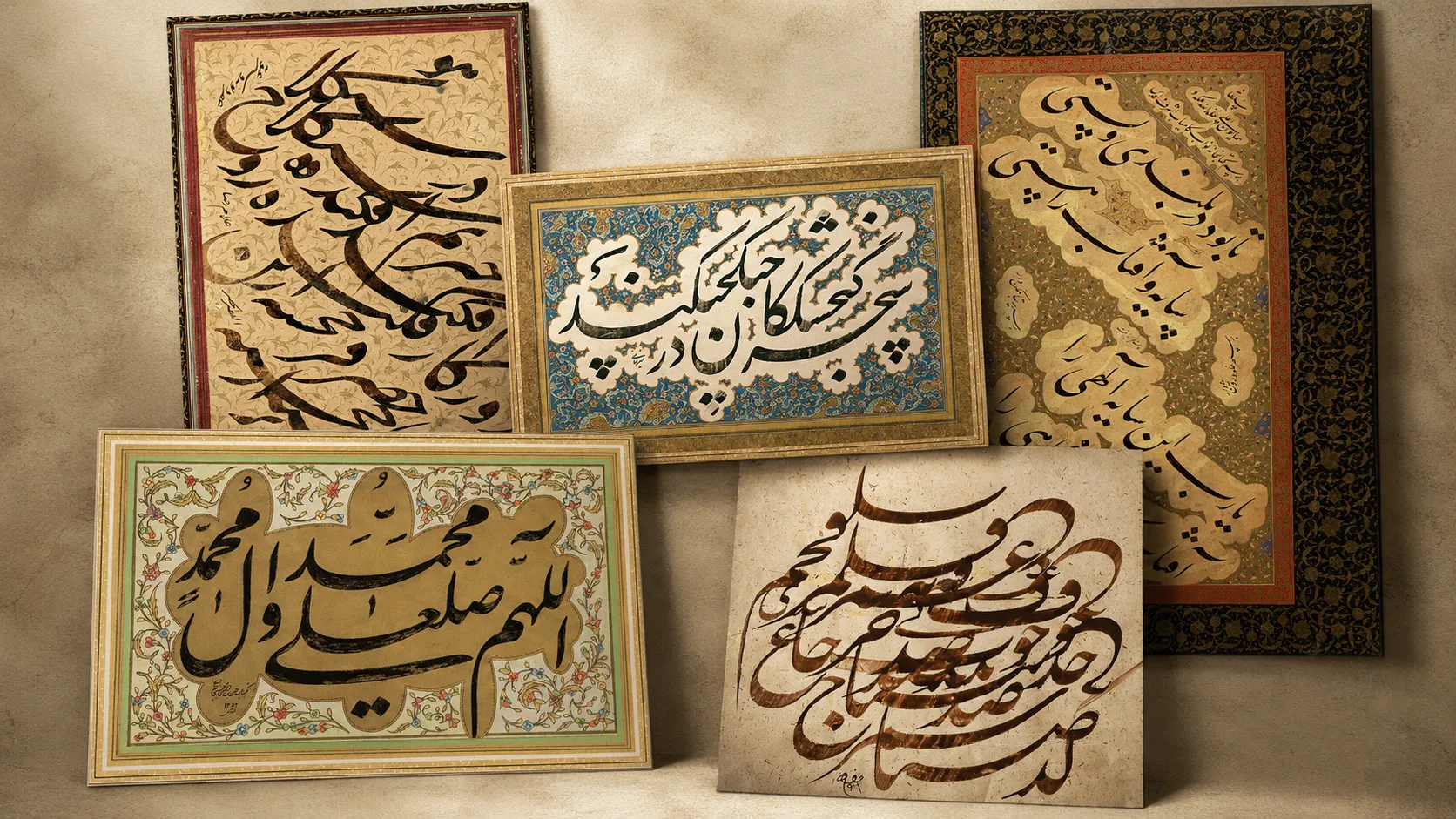
From Manuscript Copying to Siyah Mashq: The Main Formats and Forms of Nastaliq Works
When we look at a group of Nastaliq works in a museum or a book, we encounter terms such as “manuscript copying,” “qit'a,” “chalipa,” “siyah mashq,” and “muraqqa'.” At first, it may seem that these are five separate formats and that every work must belong to only one of them.
But the history of calligraphy is somewhat more complicated.
A work may be a calligraphic qit'a written in a chalipa composition and later mounted in a muraqqa'. Today, that same work may have been removed from the album and preserved in a museum as a detached folio.
So simply asking, “What format is this?” is not enough to understand a work.
It is better to consider several questions at once: How was the work written? What kind of text does it contain? How are the lines arranged on the page? What was it originally made for? Was it materially part of a book or an independent work? Was it later bordered and remounted? And how does what we see today relate to the work’s original state?
This approach helps us understand calligraphic terminology more precisely and prevents us from confusing the name currently given to an object with its actual history.
Before Naming a Work, Let Us Separate a Few Things
To understand a Nastaliq work, it is useful to distinguish at least several layers.
First is the mode of production. Did the calligrapher copy a continuous text for a book, or create a short and relatively independent unit? Is the page the result of practice and repetition of letters?
Second is the type of text. It may contain poetry, prose, a prayer, a letter, isolated letterforms, or instructional combinations. For example, “rubai” names a poetic form, not a calligraphic composition.
Third is the structure of the page. Are the lines horizontal or diagonal? Dense or widely spaced? Do four hemistichs together form an independent unit, or are they simply part of a continuous text?
Then comes the original function. Was the work made for reading, practice, presentation as a gift, display, or collecting? In many cases, we do not know the answer with certainty.
Materially, we also need to know whether we are dealing with a bound manuscript, a manuscript folio, a detached calligraphic piece, a mounted panel, or a folio from an album.
Finally, the history of the object itself matters. A piece may have been cut, bordered, or mounted in a new muraqqa' many years later.
These differences mean that the work’s present appearance does not always reflect its earliest history.
Manuscript Copying: When Calligraphy Is Part of a Continuous Text
Before it is the name of a “format,” manuscript copying is a process.
It refers to the regular and continuous writing of a text in order to produce a manuscript, notebook, treatise, or document. Here, each page forms part of a larger structure, and its relation to the preceding and following pages matters.
Many manuscripts were written with relatively small pens, but small scale alone does not define manuscript copying.
The central point is the continuity of the text.
In a manuscript, the calligrapher must consider legibility, spacing between lines, the placement of headings and columns, and the relationship between writing, illumination, and illustration.
The fact that a work was made for reading and transmitting a text does not make its artistic value less important.
In many luxury manuscripts, the order of the lines, the execution of letterforms, spacing, and the entire structure of the book were all carefully considered.
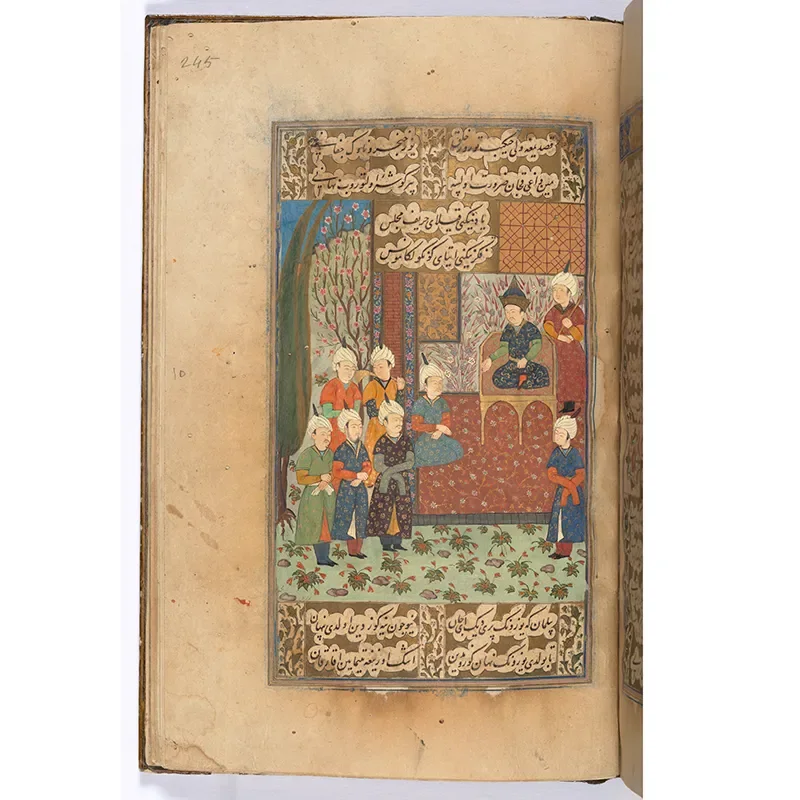
This work is a bound manuscript. Its pages are components of a continuous text and cannot each be treated as independent qit'as without considering the structure of the book.
Qit'a: A Relatively Independent Unit of Calligraphy
A “qit'a” usually refers to a limited and relatively independent unit of calligraphy that can be viewed, gifted, or collected separately.
The word “relatively” is important here.
Not every work now described as a qit'a was necessarily created from the beginning for independent display. Some may have later been separated from another context or placed within a new structure.
A qit'a may contain poetry, prose, a prayer, a Qur'anic verse, or a short sentence. The number of lines, the presence of illumination, or even a calligrapher’s signature is not the same in every qit'a.
What matters is the formation of a limited written unit that can be seen or collected separately from a longer text. But here too, we need to be cautious about the object’s present appearance.
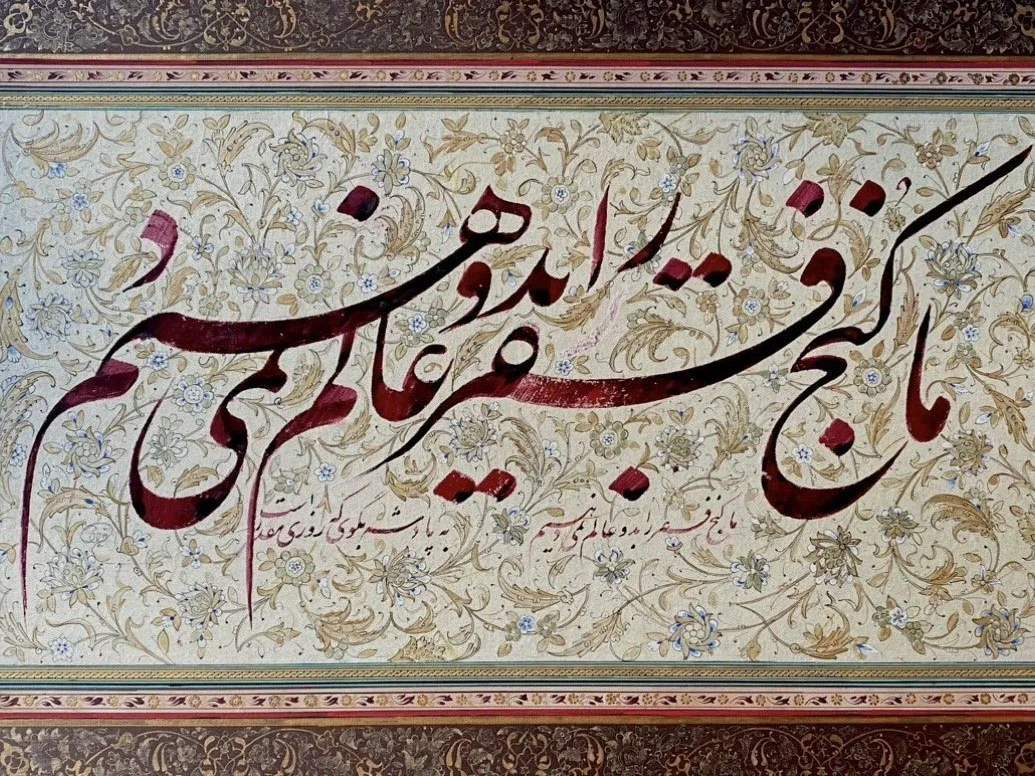
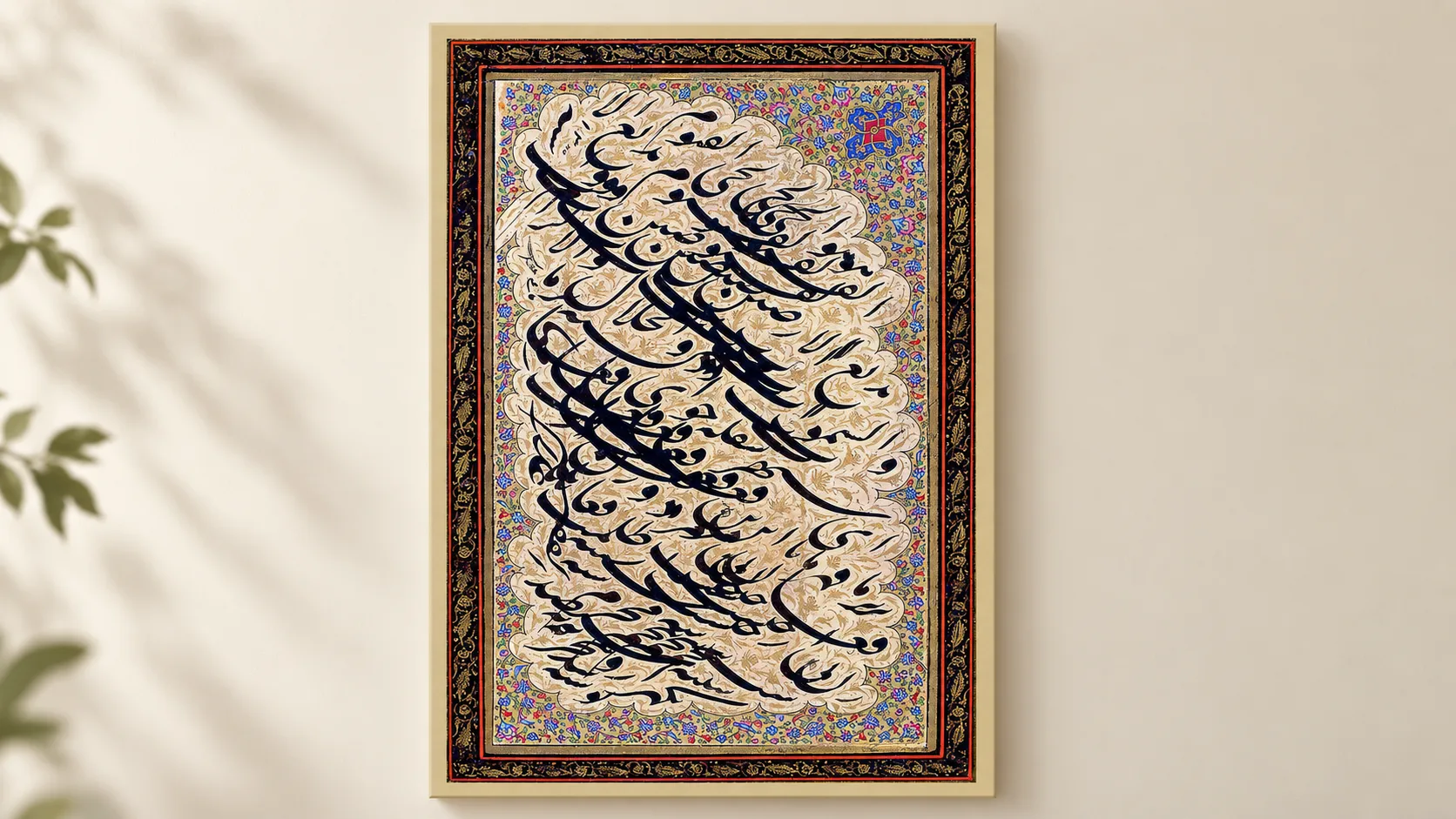
Contemporary calligraphy piece by Master Mehdi Fallah
Chalipa: When the Term Refers to the Arrangement of Lines
Chalipa is not the same kind of category as manuscript copying or qit'a.
The term primarily describes the structure and arrangement of lines on the page.
In common usage today, a chalipa generally consists of four hemistichs or four diagonal lines arranged in relation to one another within a written field.
An important distinction is necessary here:
Rubai and do-beyti are poetic forms; chalipa is a way of arranging calligraphy.
A rubai can be written in chalipa form, but not every rubai is a chalipa. Conversely, chalipa is not necessarily used only for rubai poetry.
Four diagonal lines on a manuscript page do not automatically constitute a chalipa either.
In an illustrated manuscript, lines may be placed diagonally to accommodate an image or to continue the text. To use the term chalipa, we need to ask whether the four lines form a relatively independent and intentional unit, or are simply part of the flow of manuscript copying.
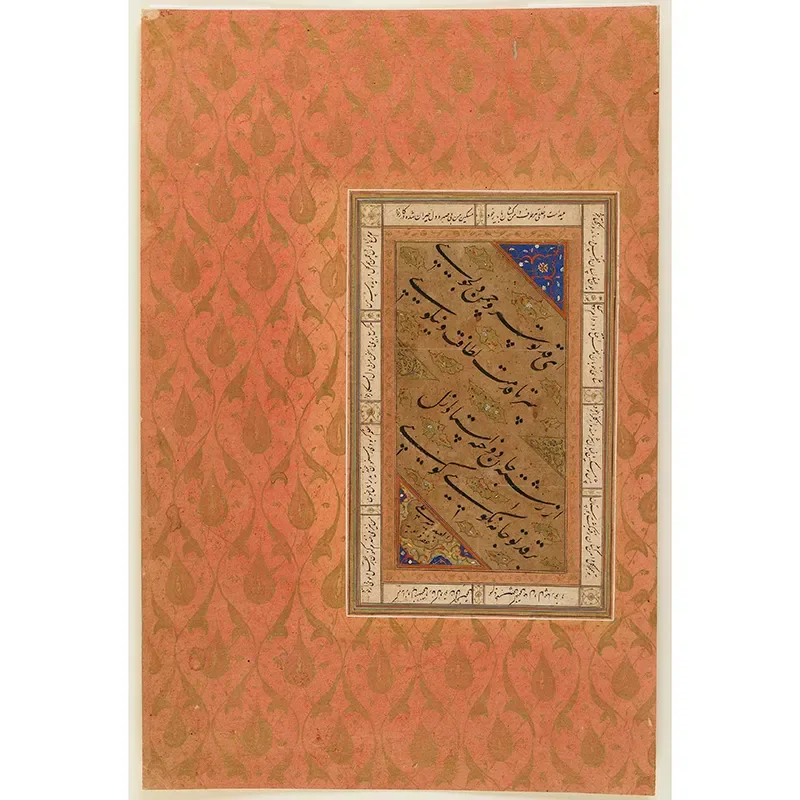
A page with four diagonal lines and a Persian rubai, signed by or attributed to Mir Ali Haravi.
This work can be described in several ways at the same time:
It is a calligraphic qit'a; its composition is chalipa; its text is a Persian rubai; and it was later placed within an album structure.
None of these descriptions cancels out the others.
As for the history of the word “chalipa” itself, we should distinguish between the antiquity of the four-diagonal-line structure and the later stabilisation of the term in its modern instructional sense. The existence of the structure in historical works is clear, but the precise history of the term’s usage still requires specialised study of earlier sources.
Siyah Mashq: From Practice to a Work Worth Viewing
To understand siyah mashq, we first need to distinguish it from mashq more broadly.
Mashq is the broader concept.
A calligrapher repeatedly practises letterforms, connections, and combinations in order to learn and stabilise them. This practice may range from isolated letters to complex combinations.
But not every mashq is a siyah mashq.
In siyah mashq, repetition of letters and words continues until the page gradually becomes dense. Forms may overlap, the direction of writing may change, and legibility may decrease.
Yet a crowded or difficult-to-read page alone is not enough to call something a siyah mashq.
The logic of repetition and practice must be present in the work’s structure.
The history of siyah mashq is not simply the history of practice sheets.
Examples survive from around the seventeenth century that were later bordered or mounted in collections. In later periods, works also appeared that deliberately used the dense and repetitive language of practice within a more consciously display-oriented structure.
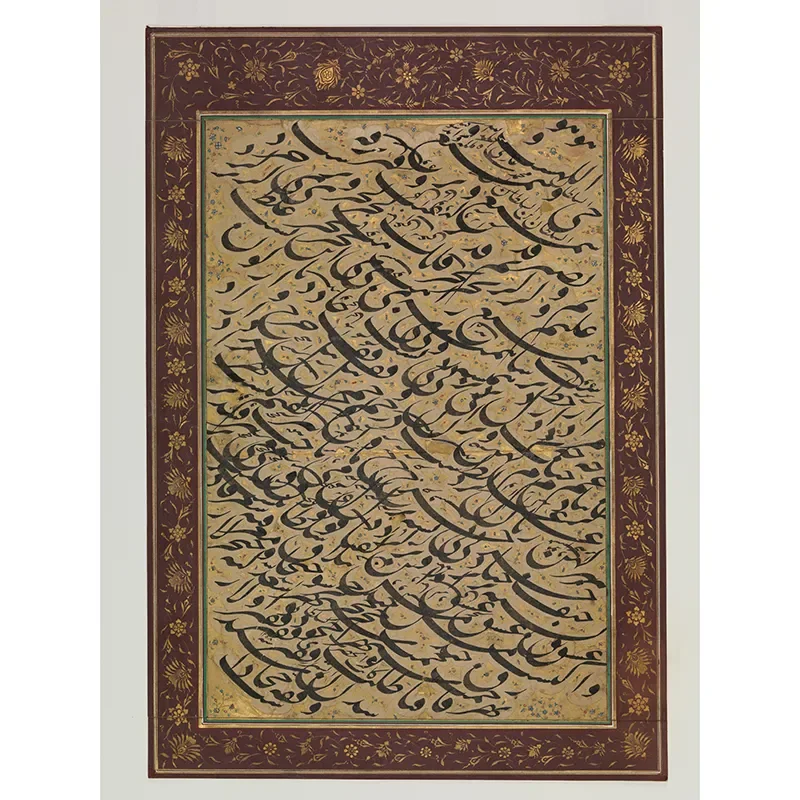
Siyah mashq by Asadullah Shirazi, 1258 AH / 1842–1843 CE.
The work is set within a decorated border and preserved as an album leaf.
The logic of repetition and practice is still present, but the final appearance is not simply the accidental result of filling a sheet of paper.
At the same time, we should not generalise the condition of this Qajar work to all siyah mashq examples from earlier periods.
Muraqqa': Where Works Are Brought Together Again
A muraqqa' is neither a type of script nor a method of writing.
It is a structure for collecting, mounting, and re-presenting works.
A muraqqa' may bring together calligraphic pieces, paintings, drawings, and other works. These components were not necessarily produced at the same time, in the same city, or even within the same culture.
An album page may also consist of several layers: a central piece, narrow frames, coloured borders, decoration, and even smaller works surrounding it.
Each layer can have a different history.
For this reason, a muraqqa' is not a neutral container.
The choices of what is placed beside what, how it is framed, and in what sequence it is seen all affect the viewer’s experience of the work.
What we see today as a single page may be the result of bringing together components made at different times and in different environments.
This is one of the important characteristics of the muraqqa'.
A page may be not the product of a single moment of creation, but the result of several stages of selection, movement, and recombination.
One Work Can Have Several Correct Names
For this reason, when looking at works, it is better not to search for one final and exclusive label. A more precise description is usually layered.
For example:
“A calligraphic qit'a in chalipa composition, containing a Persian rubai in Nastaliq, later mounted on a page of a muraqqa' and now preserved as a detached folio.”
Or:
“A Nastaliq siyah mashq with a practice-related origin, later bordered and mounted in an album.”
Or:
“A detached folio from a literary manuscript in Nastaliq, later remounted within new borders.”
These descriptions are more complicated than a single word, but they are also more accurate.
In art history, details of this kind often mark the difference between what we see today and what was originally made.
How Should We Read a Museum Label?
A museum label is a good starting point, but its terms should be read carefully.
Folio means a physical leaf with two sides.
If the label says detached folio, it means that the leaf was once part of a manuscript or album and is now kept separately. The phrase alone does not tell us when or why it was detached.
Album page or album folio means that the work formed part of an album structure.
But the term does not prove that the central piece was originally made for that particular album.
Panel is a broad term and may be used for a qit'a, part of a manuscript, or a practice example.
Mounted or remounted indicates that the work was attached, or attached again, to a supporting surface.
Attributed to means that the attribution is not certain.
And signed by simply records that a name appears on the work; the authenticity of that signature, or its relation to the calligrapher’s actual hand, may still require research.
So a catalogue title should be read alongside the image, materials, dimensions, provenance, and other research.
How Do We Distinguish Manuscript Copying, Qit'a, Chalipa, Siyah Mashq, and Muraqqa'?
If we simplify the differences, we can think of them this way:
Manuscript copying is mainly about writing a continuous text and producing a manuscript.
Qit'a is a limited and relatively independent unit of calligraphy.
Chalipa describes how lines are arranged on the page.
Siyah mashq develops from the logic of practice, repetition, and density, although some examples later became works made for display and collecting.
Muraqqa' is a structure that selects, mounts, and re-presents different works.
These terms do not answer the same question.
That may be the most important point to remember when looking at calligraphic works.
The Format of a Work Should Be Read Layer by Layer
A Nastaliq work is not simply what we see today framed in front of us.
It may have originated during the copying of a manuscript, later been removed from the book, placed in a new muraqqa', and centuries afterward entered a museum again as a detached folio.
Another piece may have been independent from the beginning, arranged in chalipa form, and later mounted in an album.
A siyah mashq may have begun as practice and later been valued highly enough to receive borders and illumination.
For this reason, understanding format in Nastaliq involves more than finding a single name.
We need to ask which part of the object’s life each term actually describes.
When we separate these layers, we are less likely to confuse manuscript with qit'a, poetry with page composition, practice with display, or the object’s present state with its original form.
And perhaps this approach allows us to see calligraphic works not only as beautiful writing, but as objects with history, movement, and material lives.
Sources
Déroche, François. Islamic Codicology: An Introduction to the Study of Manuscripts in Arabic Script. Al-Furqan Islamic Heritage Foundation, 2005.
Ekhtiar, Maryam. “Practice Makes Perfect: The Art of Calligraphy Exercises (Siyāh Mashq) in Iran.” Muqarnas 23, 2006, pp. 107–130.
Ernst, Carl W. “The Spirit of Islamic Calligraphy: Bābā Shāh Iṣfahānī’s Ādāb al-Mashq.” Journal of the American Oriental Society 112, no. 2, 1992, pp. 279–286.
Gacek, Adam. Arabic Manuscripts: A Vademecum for Readers. Brill, 2009.
Roxburgh, David J. The Persian Album, 1400–1600: From Dispersal to Collection. Yale University Press, 2005.
Thackston, Wheeler M. Album Prefaces and Other Documents on the History of Calligraphers and Painters. Brill, 2001.
Eslami, Kambiz. “Golšan Album.” Encyclopaedia Iranica.
Yūsofī, Ḡolām-Ḥosayn. “Calligraphy.” Encyclopaedia Iranica.
The Metropolitan Museum of Art. Collection records for Divan of Mir ‘Ali Shir Nava’i, Page of Calligraphy from an Anthology of Poetry by Sa‘di and Hafiz, and Album Leaf with Calligraphic Exercise (siyah mashq).
National Museum of Asian Art. Collection records for F1939.50b, S1986.343, and F1956.12.
Library of Congress. Letter Exercises, Mir ‘Imad al-Hasani, LCCN 2019714598.

Discussion · article
0