How Did Siyah Mashq Move Beyond Practice?
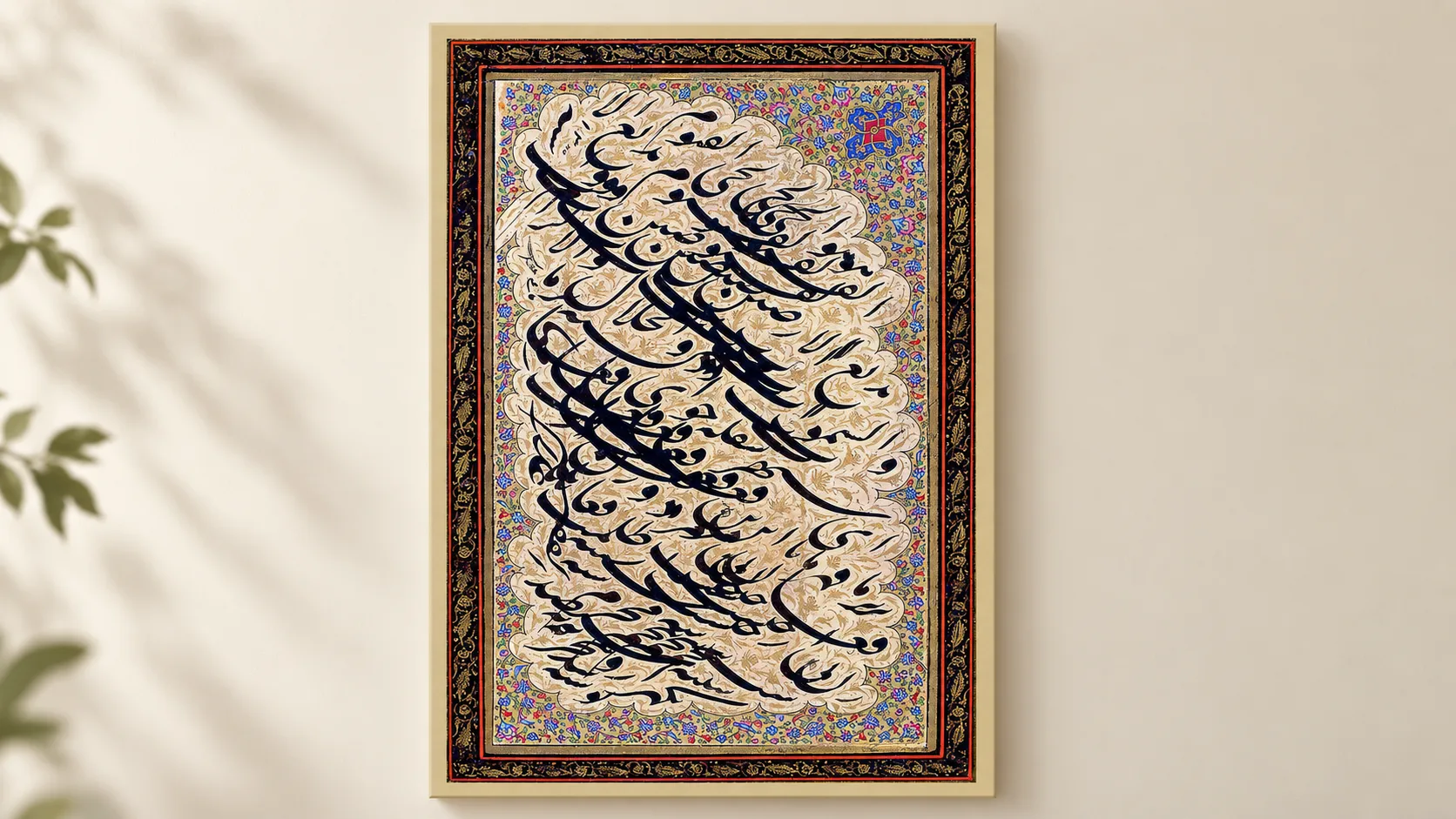
When we look at a siyah mashq today, what may first catch our attention is the density of the letters, the repetition of words, the intersections of the strokes, and the overall movement of the page.
That appearance makes it easy to construct a simple story: siyah mashq began merely as practice and gradually became an “artwork.”
But its history is not that simple.
Some pages were genuinely connected with the act of practice, but were later preserved and incorporated into albums. In some examples, repetition and density themselves became more prominent parts of the page’s composition. In other periods, we also find works that remained connected to the logic of practice while at the same time being presented as pieces to preserve, collect, or give as gifts.
So to understand siyah mashq, several questions need to be separated:
Why was the page written? How was it written? What happened to it later? And how did later generations look at it?
Before Siyah Mashq, There Was Mashq Itself
In the calligraphic tradition, mashq is a broader concept than a page densely filled with letters. In Baba Shah Isfahani’s Adab al-Mashq, three kinds of practice are distinguished: mashq-e nazari, mashq-e qalami, and mashq-e khiyali.
In mashq-e nazari, the student observes and studies the master’s writing. In mashq-e qalami, what has been seen is rewritten with the pen. And in mashq-e khiyali, the calligrapher is no longer directly dependent on a model placed before the eye.
This division should not be treated as a fixed curriculum followed by every calligrapher in every period. But it makes one point clear:
Before mashq became the name of a type of page, it was an educational and practical activity.
Within that process, repeating letters, words, and combinations could gradually make a page increasingly dense.
Maryam Ekhtiar also explains in her study of siyah mashq that practice could be used to test the pen and ink, adjust the scale of the writing, and assess the overall quality of execution.
But we should not jump from this to another conclusion. Not every dense page is necessarily an exercise, and not every exercise is necessarily a siyah mashq.
A Practice Page Can Acquire Another Life
A piece by Sultan Ali Mashhadi in the National Museum of Asian Art is a good example.
The calligraphy itself dates to around 1510–1515, but the accompanying paintings were added about eighty years later.[1]
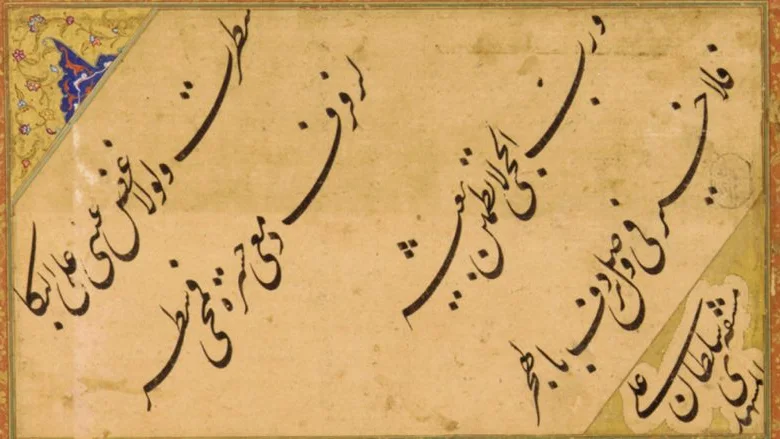
An even more interesting detail appears in Sultan Ali’s signature. Instead of the more common expression katabahu, he used mashaqahu, a word the museum associates with the act of mashq, a teaching model, or work connected with practice.
This information tells us that the calligraphy was connected to the concept of mashq and was later preserved and presented within a new structure. But it does not tell us one thing:
That Sultan Ali originally wrote it with the intention that it would be placed in an album or displayed in the form in which we see it today.
This distinction is extremely important.
A work may have been written as practice and only later acquired value as something worth preserving. It might receive a new border. It might be placed beside paintings or other calligraphic pieces.
And this change of context can also change the way the work is seen.
When Did Repetition Itself Become Part of the Composition?
Here we reach a more complicated part of the history of siyah mashq. Maryam Ekhtiar associates some of the earliest surviving examples of what she calls “artistic siyah mashq” with Mir Emad Hassani and the late sixteenth century.
This does not mean that Mir Emad invented siyah mashq, nor that nothing similar existed before him.
The importance of some of these pages lies in the way they use elements that originate in the practice of mashq:
repetition, close placement of letters, overlap, shifts in direction, and increasing density.
On such a page, the writing is no longer simply a series of lines to be read one after another. Letters and words begin to relate across the whole page, and at times the entire surface of the paper can be perceived as a single field.
Here, the eye no longer follows only the line of writing.
Sometimes we first see dark masses, directions of movement, and the spaces between them, and only then begin to read.
That is an important change, but we should be cautious when speaking about the calligrapher’s intention.
From the fact that reading becomes more difficult, we cannot conclude that the calligrapher wanted to eliminate meaning or create something resembling modern “abstract art.”
If some siyah mashq pages developed into more independent compositions, that did not mean the end of instructional practice.
The Muraqqaʿ: A Place for the Second Life of Works
One of the most important environments in which calligraphic pieces acquired new lives was the muraqqaʿ, or album.
A muraqqaʿ can bring together calligraphy, paintings, and drawings from different times and even different places.
David Roxburgh’s research on Persian albums shows that such collections played an important role in preserving and displaying works on paper.
When a piece entered a muraqqaʿ, its status changed. It might receive a new border. It might be placed beside the work of another calligrapher or painter. And it could enter a context in which it was no longer seen only for its original function, but also valued for comparison and close viewing.
A group of siyah mashq pieces associated with Mir Emad were later incorporated into the St. Petersburg album.
Did the muraqqaʿ turn siyah mashq into art? Not so simply.
The album could play a role in selecting, preserving, and re-presenting a piece.
But it cannot be considered the single cause that transformed siyah mashq into an artwork.
Sometimes the page itself had developed visual compositional qualities that drew greater attention to form.
Sometimes the value of the piece was connected to the name of the calligrapher.
Sometimes an old exercise was later selected and preserved by a collector.
And sometimes all these factors came together.
For this reason, the history of siyah mashq looks more like several intertwined paths than a single sudden transformation.
The Qajar Period: Not the Beginning, but an Important Phase
The Qajar period is highly important in the history of siyah mashq. But it cannot be said that siyah mashq began in the Qajar period. Earlier examples rule out such a view.
What becomes more visible in the nineteenth century is a larger number of examples with dates, signatures, dedications, or identifiable collection histories.
Maryam Ekhtiar describes this period as a phase of the “re-emergence and expansion” of siyah mashq.
Of course, the larger number of surviving works does not necessarily prove that production increased in the same proportion. What we have in museums today is also the result of selection, preservation, and historical survival.
Asadullah Shirazi and a Dated Siyah Mashq
Asadullah Shirazi wrote a page in 1258 AH / 1842–1843 CE that the Metropolitan Museum of Art explicitly identifies as an Album Leaf with Calligraphic Exercise (siyah mashq).
The folio is made with ink, colour, and gold on paper and has been preserved as a complete work.
The existence of such examples shows that by the mid-nineteenth century, a page operating through the logic of siyah mashq could also become an object for preservation and presentation.
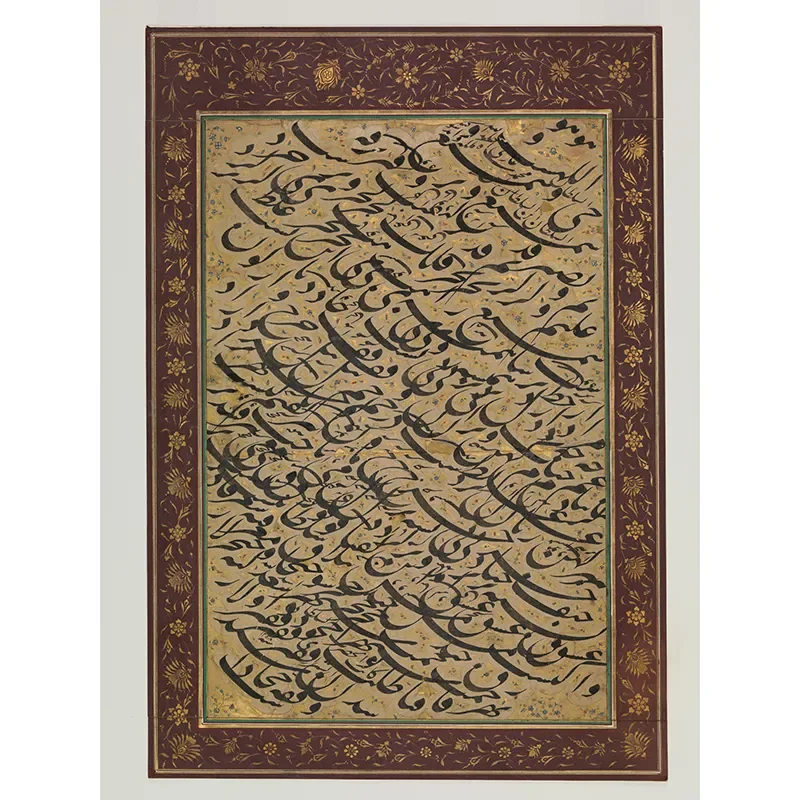
With the works of Mirza Gholamreza Isfahani, the issue becomes more complicated again.
Bahram Bayani argues that some of his pieces described as siyah mashq are not simply “practice” in the ordinary sense, and that their formal organisation reflects a more deliberate decision in structuring the page.
Sometimes the name of a format explains the appearance of a work, but not its original function.
In a dense and highly composed siyah mashq, the text can still have a real presence.
In some works by Mir Emad, visual relationships may become so prominent that continuous reading becomes more difficult.
It is more precise to say:
The relationship between reading and seeing has changed.
The script remains language, but its form and organisation take on a greater role in the experience of the work.
Is Siyah Mashq a Form of Abstract Art?
To a contemporary eye, some siyah mashq pages may recall abstract art.
Repetition, density, overlap, and reduced immediate legibility are genuinely present in them.
But visual resemblance does not create a shared history.
Modern abstract art emerged in a different intellectual, social, and artistic context.
We have no evidence that a Safavid or Qajar calligrapher worked with a concept equivalent to modern artistic “abstraction.”
So it is possible to say that some siyah mashq works have an abstract quality for today’s viewer, or that they recall certain strategies found in abstract art.
But to say that siyah mashq was “abstract art before modernism” rewrites history in today’s terminology.
Siyah mashq does not need such a comparison in order to be valuable.
So what changed?
Perhaps the question “When did siyah mashq turn from practice into art?” is not entirely the right question from the outset.
There is no single moment when this transformation occurred.
Mashq continued as an educational process.
Some products of that practice were preserved.
Some entered albums and were seen in new contexts.
In some works, repetition and density became more prominent features of the page’s organisation.
And in the Qajar period, we also find clear examples of dated, dedicated, and collected siyah mashq pages.
So what changed was not only form.
It was not only function either.
Sometimes the way of writing changed.
Sometimes the material fate of the page.
Sometimes the way it was collected and presented.
And sometimes the way viewers looked at it.
These changes did not always happen at the same time.
For that reason, perhaps the more precise question is:
How did an activity connected with calligraphic practice, under certain circumstances, become a page valued for preservation, collecting, and independent viewing?
The answer is not a single date.
The history of siyah mashq is the history of the coexistence of these possibilities: a place where practice, form, text, repetition, and the gaze of later generations repeatedly came together on the same page.
Sources
National Museum of Asian Art, Smithsonian Institution. Nasta‘liq: The Genius of Persian Calligraphy. Album folio S1986.30.
Ernst, Carl W. “The Spirit of Islamic Calligraphy: Bābā Shāh Iṣfahānī’s Ādāb al-Mashq.” Journal of the American Oriental Society 112, no. 2 (1992): 279–286.
Ekhtiar, Maryam. “Practice Makes Perfect: The Art of Calligraphy Exercises (Siyāh Mashq) in Iran.” Muqarnas 23 (2006): 107–130.
Roxburgh, David J. The Persian Album, 1400–1600: From Dispersal to Collection. Yale University Press, 2005.
The Metropolitan Museum of Art. Album Page with Calligraphy Exercise (siyah mashq) by Muhammad Shah Qajar. Shawwal 1260 AH/October 1844 CE. Object no. 2016.535.
The Metropolitan Museum of Art. Album Leaf with Calligraphic Exercise (siyah mashq), Asadullah Shirazi. 1258 AH/1842–43 CE. Object no. 2016.536.
Bayani, Bahram. “The Aesthetics of the Calligraphic Works of Mirza Gholamreza Isfahani.” Iranian Studies 48, no. 4 (2015): 601–609.

Discussion · article
0