Behind a Nastaliq Page: Who Took Part in Making a Manuscript?
When we look at a historical page of calligraphy, we usually begin by searching for the calligrapher’s name and attributing the work to that person.
For example, we might say: “This page is by Sultan Ali Mashhadi.”
As far as the calligraphy itself is concerned, that statement may be entirely correct. But if we want to understand the full history of the page, the story can be considerably more complicated.
A folio from Attar’s Mantiq al-Tayr, now held at the Metropolitan Museum of Art, is a good example. Sultan Ali Mashhadi wrote its text in 892 AH / 1486 CE. But the page we see today is not solely a product of that year.
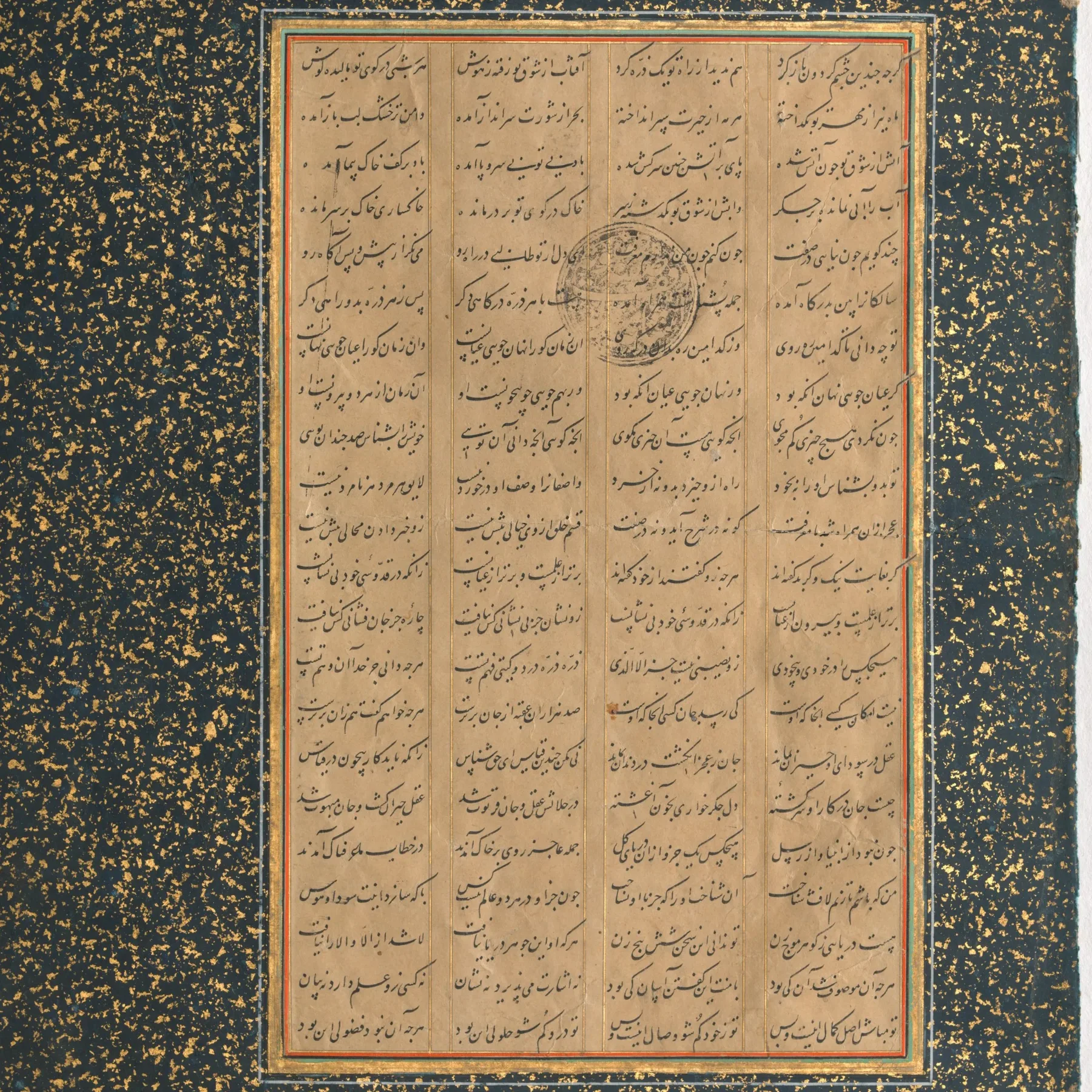
More than a century later, around 1600, the manuscript folios were remounted in new borders, many of them gold-sprinkled. A new frontispiece was added, four paintings were placed in some of the previously empty areas, and the manuscript received a new binding. This reworking had been completed before Shah Abbas I donated the book in 1609 to the Safavid dynastic shrine at Ardabil.
So the calligraphy is by Sultan Ali, but not everything we now see around it belongs to his time.
This single page raises an important question:
When we speak of the “maker” of a calligraphic work, which part of the object do we actually mean?
A Page Can Have More Than One Date
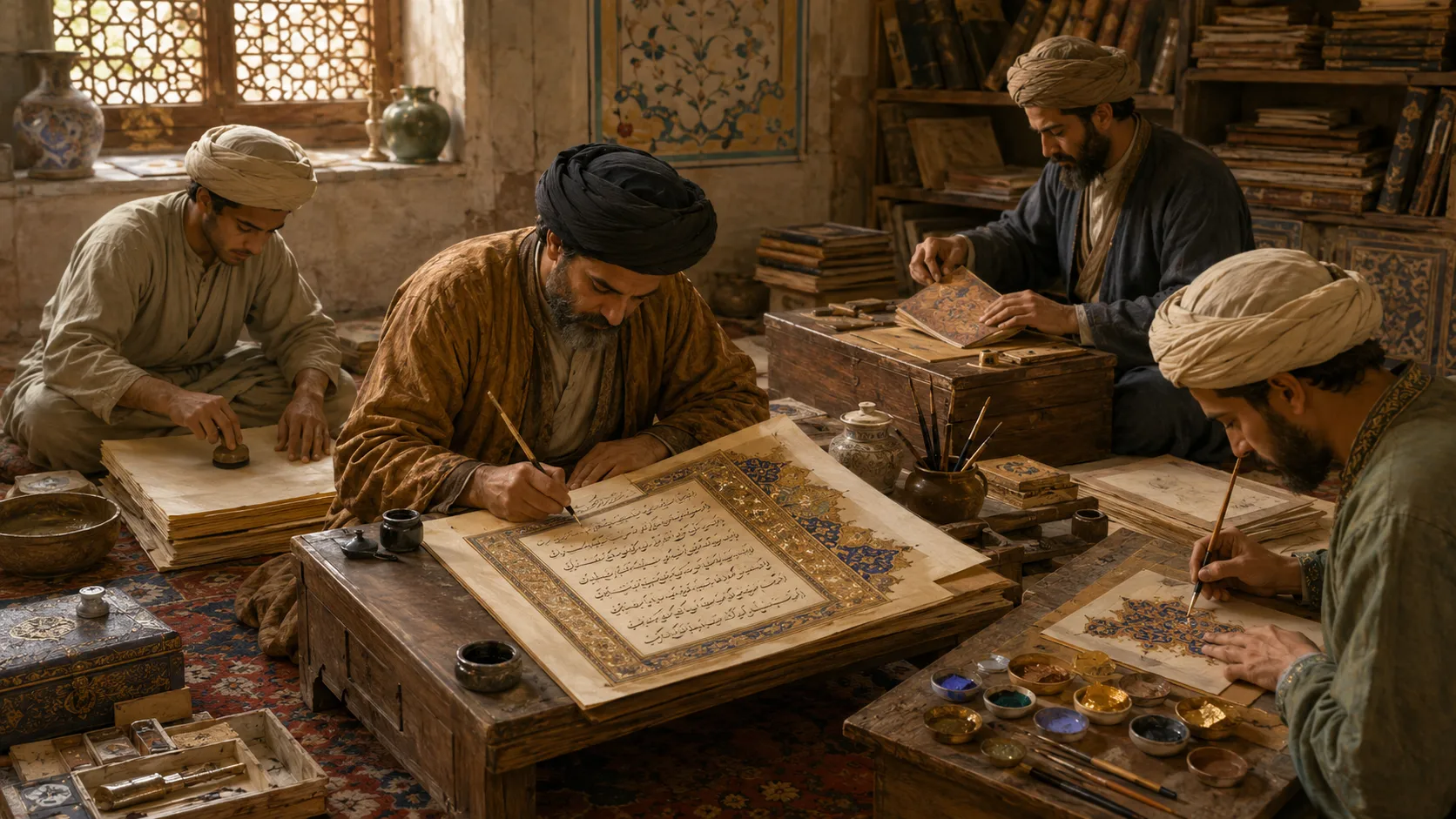
In luxury Timurid and Safavid manuscripts, copying the text was only one of the tasks that led to the book’s final form.
Before writing began, the page had to be prepared for the placement of the text. Ruling, illumination, or painting might then be added. The folios had to be gathered into the structure of a book, and the manuscript eventually had to be bound.
But these stages were not always carried out at the same time, in the same place, or even by a fixed group of people.
Sometimes several specialists worked on a single project. Sometimes one person possessed more than one skill. And sometimes what we now see as a unified page is the result of changes made decades or even centuries after the text was written.
For this reason, it is useful to distinguish between the calligraphy, the page, and the complete manuscript.
Calligraphy, Page, and Book Are Not the Same Thing
When examining a single folio, we can look at the text, illumination, frame lines, painting, and margins.
But when that same folio is considered as part of a manuscript, additional questions arise:
How were the folios assembled?
Where did the text end?
At what stage were the paintings added?
When was the manuscript bound?
Was it later trimmed or rebound?
At another level, we also need to look at the environment of production: Who commissioned the work? Within what network was the book produced? Was it connected to a court library?
These three levels should not be treated as the same thing.
The presence of different calligraphy and illumination on one page shows that more than one kind of work was involved. But by itself it does not prove that two artists belonged to an “official workshop” or worked in the same room at the same time. Such a conclusion requires additional evidence.
Even the Invisible Lines of a Page Are Part of Its History
One of the most interesting parts of manuscript studies concerns things that may not be visible at first glance.
To keep lines of text regular, a page could be ruled before the calligraphy was written. One tool encountered in codicological sources is the misṭara, used to create guides for the lines on paper.
These lines might survive not in ink, but as impressions or raised traces on the paper.
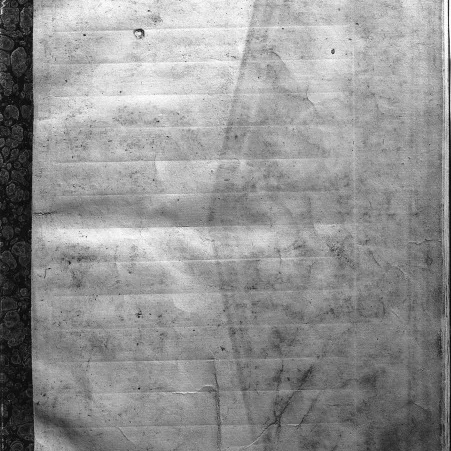
In some methods, small pinholes could also form part of page preparation.
But such evidence does not always survive intact. Trimming margins, rebinding, or remounting a folio can remove part of it.
This also helps us distinguish between guides for the written lines and decorative framing rules.
A ruling guide had to exist before the relevant stage of copying. A frame, border, or some decorative elements, however, might have been added at another time. Even this simple sequence shows that the history of making a page can be layered.
The Haft Awrang: One Manuscript, Several Calligraphers
If we want a clear example of a large, collaborative manuscript project, Jami’s Haft Awrang, made for Sultan Ibrahim Mirza, is one of the most important cases.
Production began in 1556, and over roughly nine years its copying was divided among five calligraphers.
More strikingly, not all sections were even written in the same city.
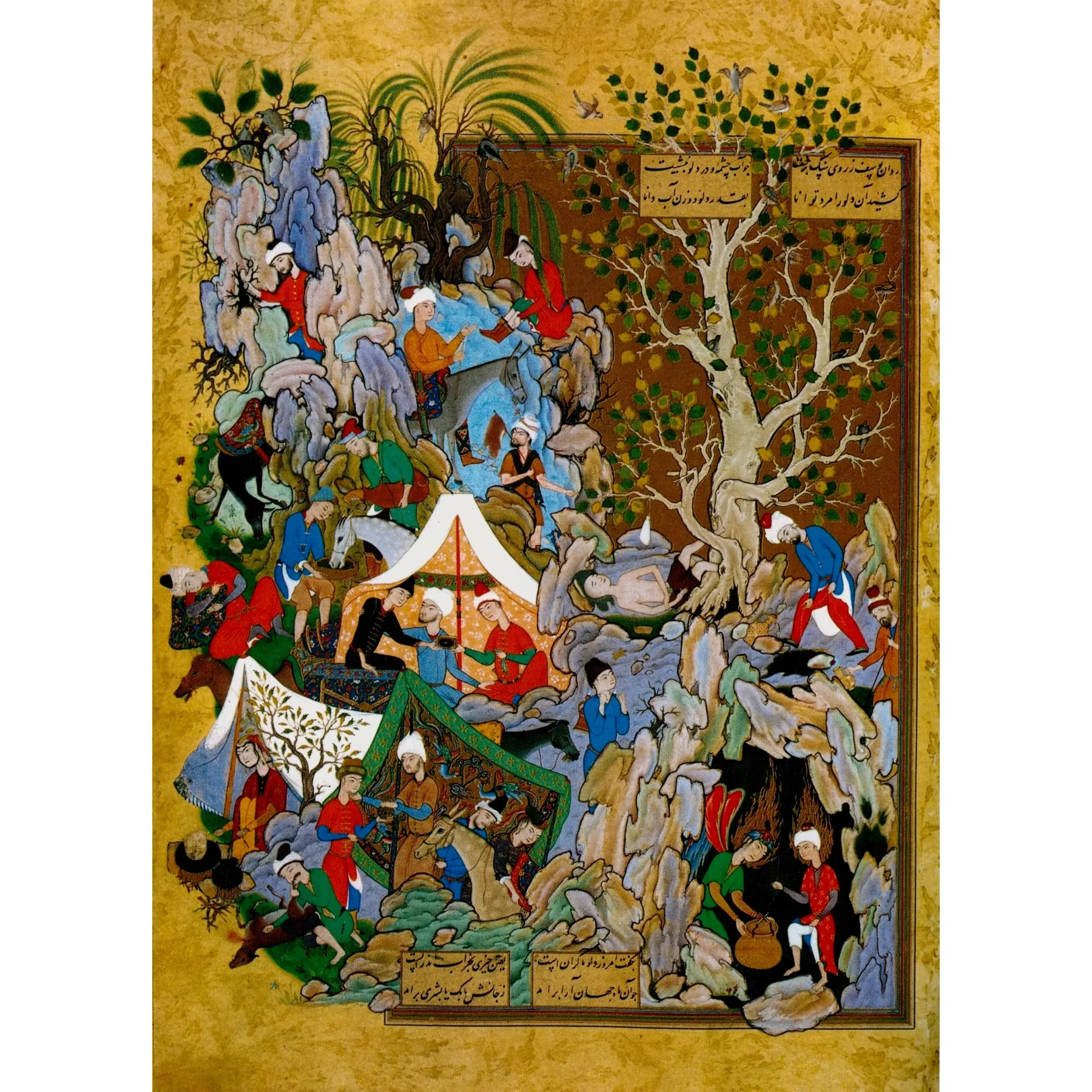
Joseph Rescued from the Well, attributed to the painter Muzaffar Ali.
So within one project, we have both several scribes and several places of copying.
This complicates the simple image of “several artists all working under one roof in a single workshop.”
The project was one, but its execution could advance at different times and in different places.
In some cases, the division of roles is even clearer.
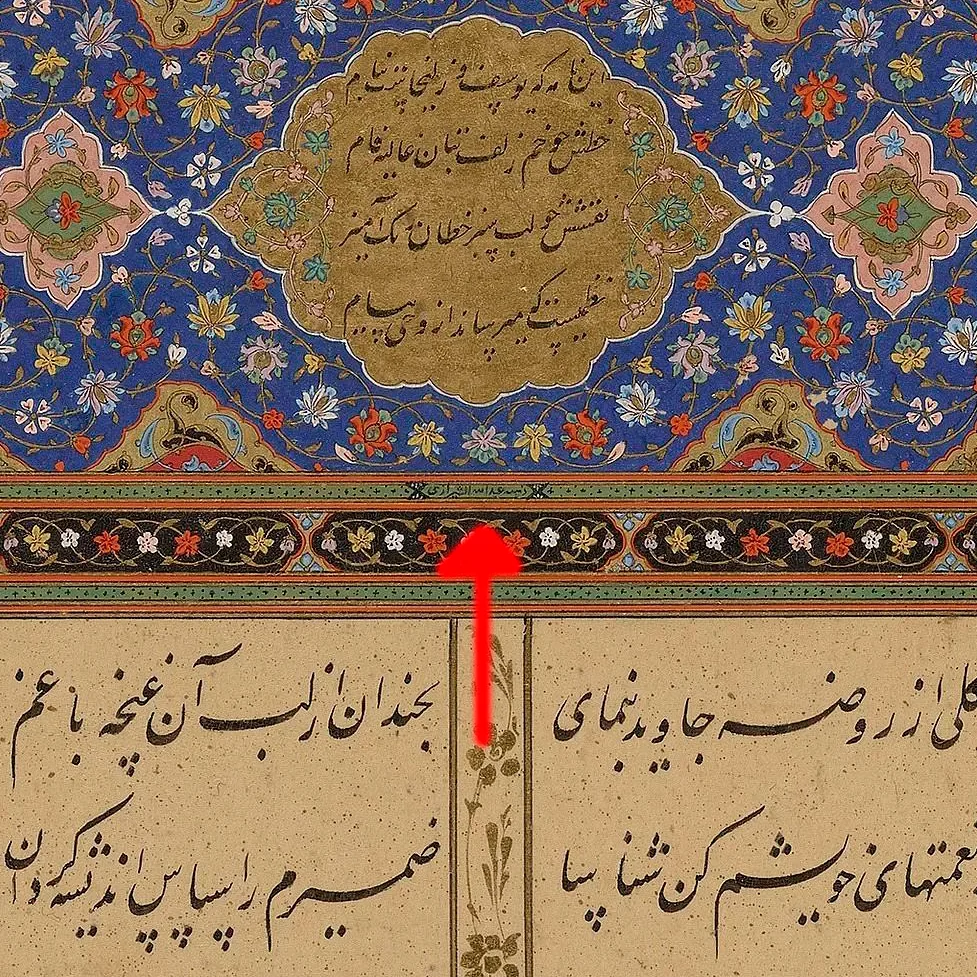
On the illuminated heading folio of Yusuf u Zulaykha from the same Haft Awrang, dated 1557, the National Museum of Asian Art identifies Muhibb Ali as the calligrapher and Abdullah Shirazi as the illuminator.
Abdullah even signed the illumination of the heading in extremely small script.
Here we are no longer merely inferring from stylistic differences that two people participated in making the page. The names of two contributors are known.
From examples like these, we might be tempted to imagine historical book production as something like a modern organisation divided into separate departments. But apparently it did not work quite that way.
One of the colophons of the Haft Awrang identifies Muhibb Ali as both scribe and kitābdār, or librarian, of Ibrahim Mirza.
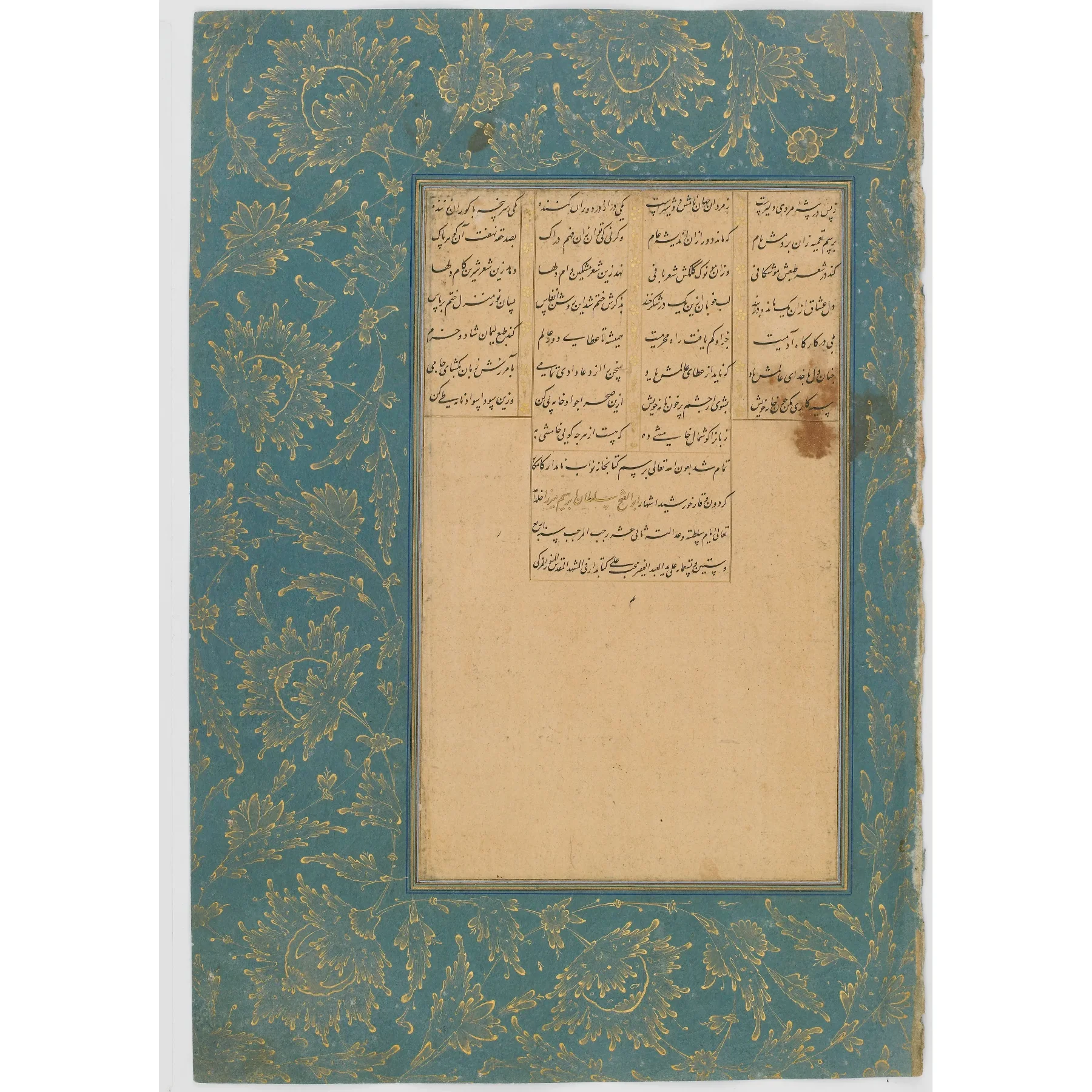
So one person could simultaneously have a practical role in making the book and hold an institutional title.
Qazi Ahmad Qumi also writes in Golestan-e Honar that Muhammad Amin Mashhadi was skilled in ruling as well as illumination, and was additionally accomplished in joining papers, gold sprinkling, and colouring paper.
In other words, specialisation existed, but its boundaries were not necessarily closed. One artist could possess several related skills.
“Division of labour” is therefore a useful expression, as long as we do not turn it into the rigid administrative divisions of a modern organisation.
A Report from a Workshop While Work Was Still in Progress
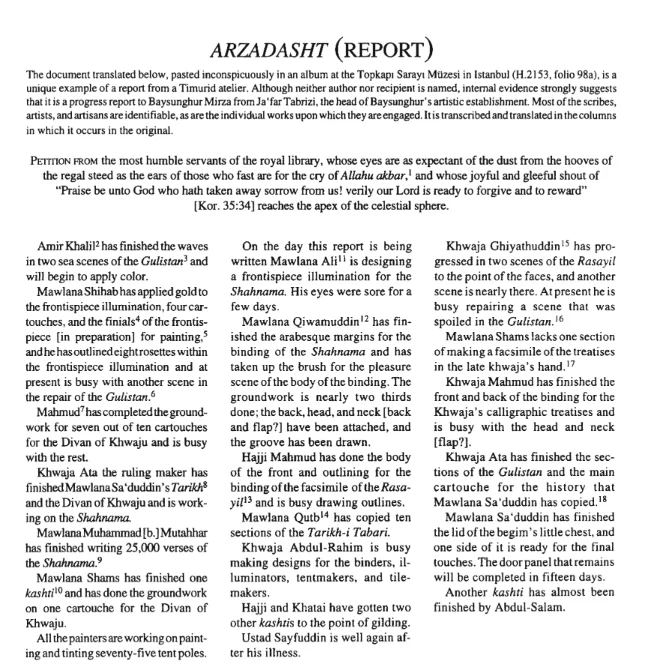
One of the most fascinating documents for understanding manuscript production is a report that survives from Baysunghur’s environment in Herat.
Known as an ʿarża-dāsht, the document is preserved in an album at the Topkapı Palace Library.
In a more recent reassessment, Shiva Mihan dates it to 830 AH / 1427 CE, whereas somewhat later dates had been proposed in earlier studies.
The importance of the document lies in more than its date.
Most historical books reach us after their production has been completed. This report, however, describes projects that were still in progress.
In some sections, ruling had been completed while painting or illumination was still underway. Elsewhere, the copying of texts had not yet been finished.
For a moment, instead of seeing only the final result, we see the working process.
Different people are involved in several projects, and not all books are at the same stage.
But this document should not be turned into a universal rule either.
What we see is a picture of Baysunghur’s environment in Herat, not an instruction manual for book production across all of historical Iran.
Was the Library More Than a Place for Storing Books?
Sources from this period use the term kitābkhāna.
Its simplest translation is “library,” but in some courtly environments the institution was not only a place where books were stored. It was also connected with their production and decoration.
In the case of Baysunghur, evidence indicates that the library was a place where scribes and painters worked and where books were produced and embellished.
In Ibrahim Mirza’s Haft Awrang, the colophons themselves also name the library in connection with patronage.
From these examples, one might conclude that the kitābkhāna was equivalent to a “royal art studio.”
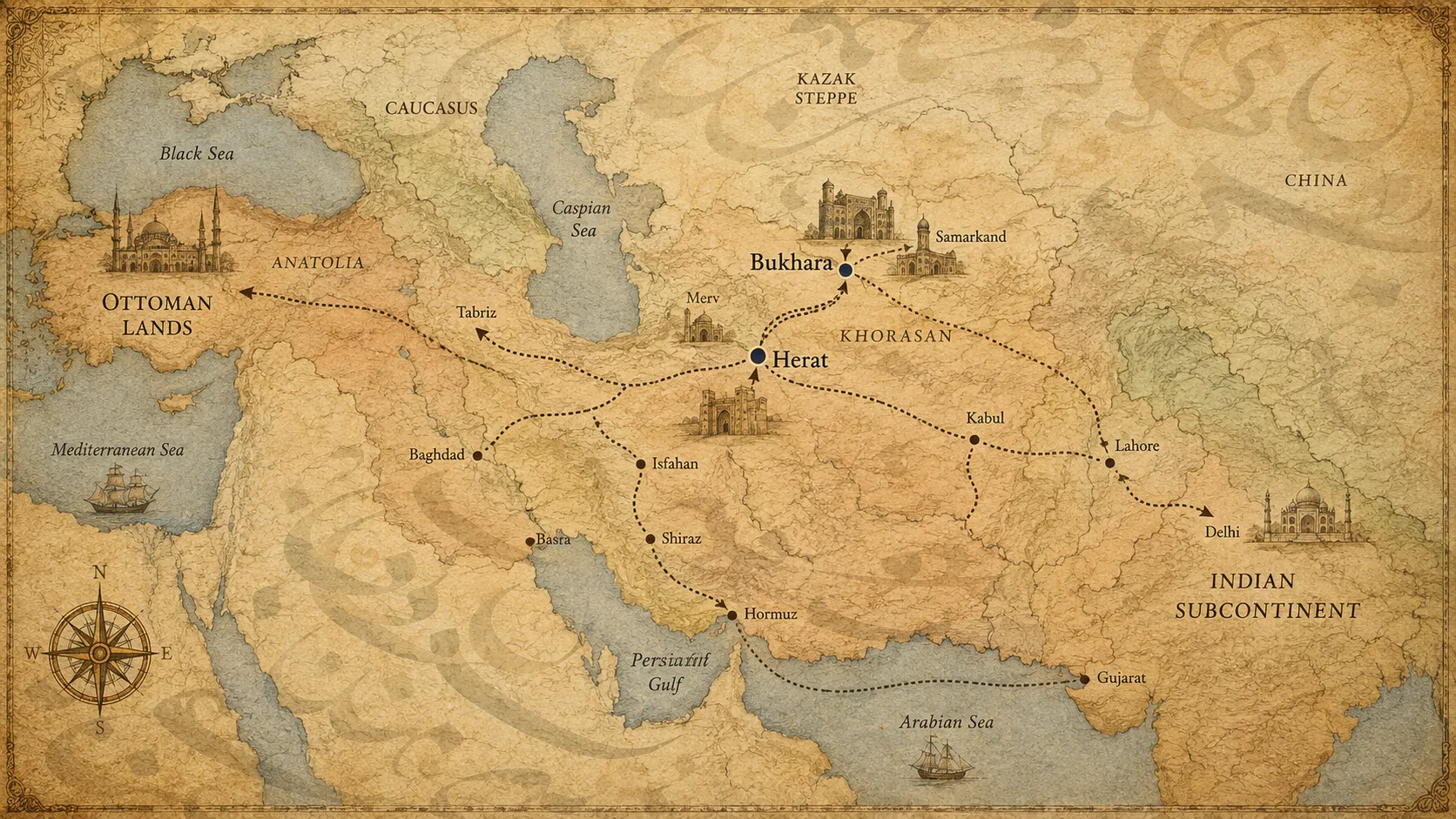
But it was not simply a single physical place for making artworks. Even in Ibrahim Mirza’s project, parts of the manuscript were written in Mashhad and others in Herat.
So a project’s connection with a library or patron does not necessarily mean that every maker was present in one location.
What Did the Patron Do?
In luxury manuscript projects, the patron’s name can be extremely important.
The colophons of the Haft Awrang connect Ibrahim Mirza directly with the manuscript. We can therefore speak with confidence of princely patronage and commissioning.
But supporting a work is not the same as making every individual decision about it.
In Sultan Ali’s Mantiq al-Tayr, the situation is clearer.
The Metropolitan Museum’s record documents a specific intervention by Shah Abbas I in the later history of the manuscript: the book was reworked before it was donated to Ardabil. Here we can speak of a defined role for the patron because the history of the object itself supports it.
Let us return to that same page from the Mantiq al-Tayr.
Sultan Ali wrote the text in 1486. But part of what we see around it today took shape around 1600. This means that some of the people who contributed to the object’s present form lived more than a century after the original calligrapher.
Did these people “collaborate” with Sultan Ali?
No, at least not in the sense in which we normally understand collaboration.
They met within the history of an object, not within a simultaneous project.
This distinction is extremely important.
In Ibrahim Mirza’s Haft Awrang, several people took part in the history of one project.
In the Mantiq al-Tayr, part of the manuscript’s present appearance resulted from a much later rearrangement.
Both objects have multiple makers, but in two very different senses.
Not Every Luxury Manuscript Was Courtly
A large part of the evidence available to us today comes from luxury books and court environments. This can easily create the impression that historical manuscript production was always dependent on princes and royal libraries.
That picture is incomplete.
Lâle Uluç’s research on late-sixteenth-century Shiraz shows that many manuscripts survive without the name of a specific patron. Scholars sometimes call them “commercial,” probably because they were produced for sale on the market.
But “commercial” here does not mean cheap, simple, or mass-produced.
Some of these manuscripts were highly luxurious and were made for wealthy buyers.
So the beauty and expense of a manuscript alone do not prove that it was a royal commission.
Likewise, the absence of a named patron does not mean there was no specialisation or organisation in its production.
So Who Made a Nastaliq Page?
We can now return to the original question.
If we ask about the calligraphy itself, the answer may be completely clear.
Sultan Ali Mashhadi wrote the text of the Mantiq al-Tayr.
Shah Mahmud Nishapuri copied part of the Haft Awrang.
Muhibb Ali wrote another section.
At this level, the individual skill of the calligrapher is central.
But if we ask about the page as we see it today, we may also need to consider the illuminator, painter, or other artists, as well as people who added new borders or paintings a century later.
If the question concerns the manuscript as a whole, the gathering of the folios, the pictorial programme, and the binding also become part of its history.
And if we ask how such a project became possible in the first place, in some cases we also need to consider the patron, the library, and the social network of production.
So the phrase “a work by Sultan Ali Mashhadi” remains correct if we mean his calligraphy.
The problem begins when we extend the calligrapher’s name to every component of the object.
A historical page can contain several makers, several stages, and even several centuries of history.
To understand such an object more precisely, perhaps the best question is not:
“Who made this page?”
But rather:
Who made which part of it, at what time, in what environment, and on the basis of what evidence?
That simple question brings us closer to understanding the actual history of how the object was made, rather than merely seeing a beautiful page.
Sources
The Metropolitan Museum of Art. “Page of Calligraphy from a Mantiq al-Tayr (Language of the Birds).” Dated 892 AH/1486 CE. Object no. 63.210.3.
Déroche, François, et al. “Ruling and Page Layout.” In Islamic Codicology: An Introduction to the Study of Manuscripts in Arabic Script. Al-Furqan Islamic Heritage Foundation, 2005, pp. 159–184.
Simpson, Marianna Shreve, and Massumeh Farhad. Sultan Ibrahim Mirza’s Haft Awrang: A Princely Manuscript from Sixteenth-Century Iran. Yale University Press and Freer Gallery of Art, 1997.
Smithsonian’s National Museum of Asian Art. “Colophon of the Subhat al-abrar in a Haft Awrang by Jami.” Shah Mahmud al-Nishapuri, 1556. F1946.12.181.
Smithsonian’s National Museum of Asian Art. “Colophon of Leyli u Majnun from a Haft Awrang by Jami.” Muhibb Ali, Herat, 1565. F1946.12.272.
Smithsonian’s National Museum of Asian Art. “Mathnavi Heading Folio from the Yusuf u Zulaykha.” Calligraphy by Muhibb Ali; illumination by Abdullah Shirazi, 1557. F1946.12.84.
Smithsonian’s National Museum of Asian Art. “Colophon of Yusuf u Zulaykha from a Haft Awrang by Jami.” Muhibb Ali, Mashhad, 1557. F1946.12.139.
Qāḍī Aḥmad. Calligraphers and Painters: A Treatise by Qāḍī Aḥmad, Son of Mīr-Munshī. Trans. Vladimir Minorsky. Smithsonian Institution, 1959.
Mihan, Shiva. “An Illuminating Scribe: The ʿArża-dāsht of Jaʿfar Bāysunghurī and Its Wealth of Information.” In Scribal Habits in Near Eastern Manuscript Traditions. Gorgias Press, 2021.
Thackston, Wheeler M. Album Prefaces and Other Documents on the History of Calligraphers and Painters. Brill, 2001.
Simpson, Marianna Shreve. “The Making of Manuscripts and the Workings of the Kitab-khana in Safavid Iran.” Studies in the History of Art 38, 1993, pp. 104–121.
Uluç, Lâle. “Selling to the Court: Late-Sixteenth-Century Manuscript Production in Shiraz.” Muqarnas 17, 2000, pp. 73–96.

Discussion · article
0