Why Is Nastaliq Called an “Iranian Script”?
Nastaliq is often called an “Iranian script” or “Persian script.” This description is not without reason, but a closer look raises several questions: Does “Iranian” refer to where Nastaliq developed? To the Persian language? To the artistic tradition that cultivated it? Or does it mean that this calligraphic style belongs only to present-day Iran?
These questions show that the answer is somewhat more complex than a simple geographical attribution.
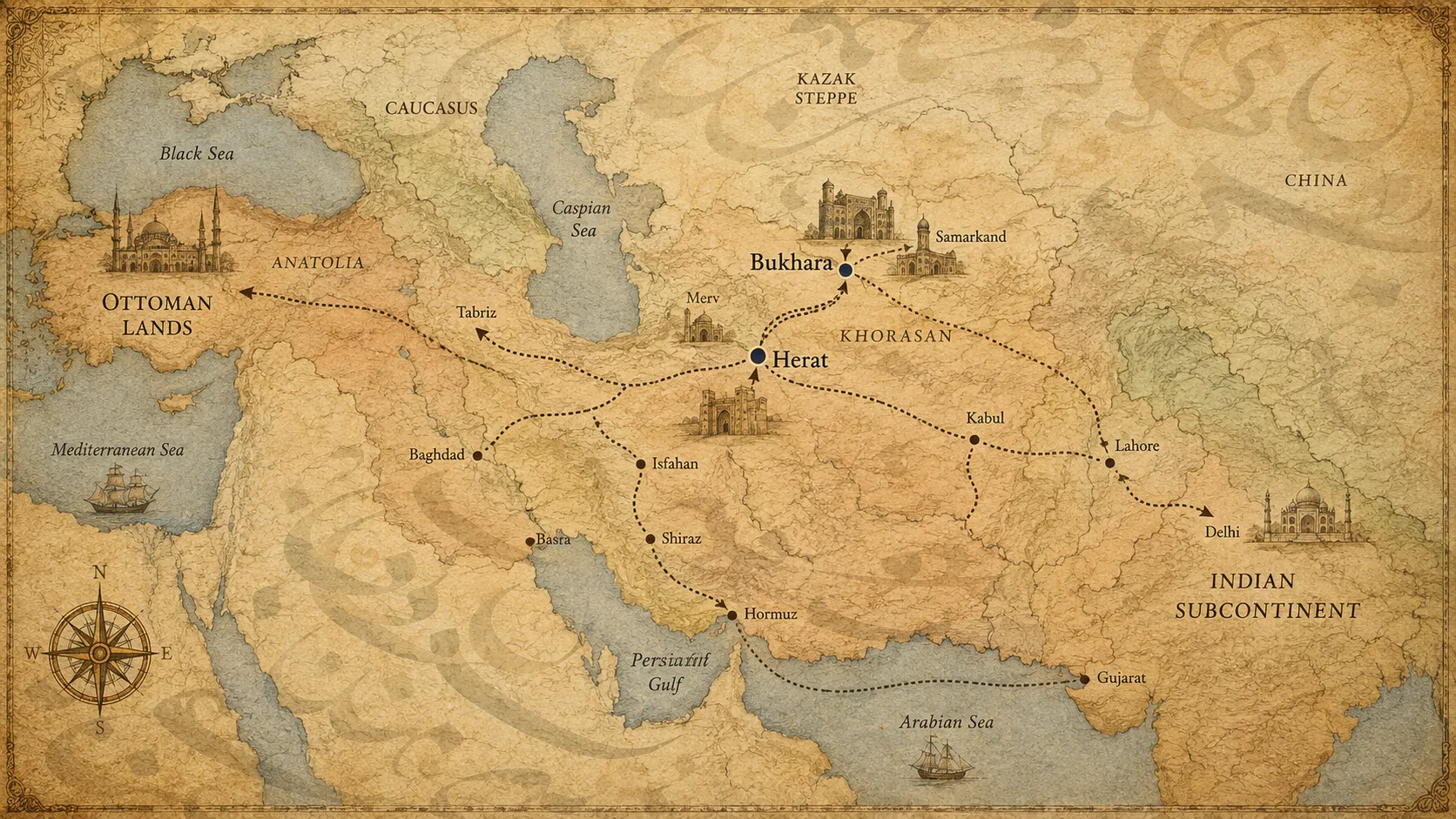
Nastaliq took shape within the historical and cultural environment of Iran and developed a deep connection with Persian language and literature. Shiraz and Tabriz were important in its early stages, while Timurid Herat later became one of the major centres for teaching, the arts of the book, and the consolidation of the style. But the story of Nastaliq did not stop within this geography. Bukhara, Central Asia, Mughal India, the Urdu tradition, and even the Ottoman realm also became part of its later history.
So when Nastaliq is called “Iranian,” it is better to be clear that we are referring to its origins and historical tradition, not to exclusive ownership.
First, We Need to Clarify What “Iranian Script” Means
The Persian word khat has several meanings. It can refer to the system used to write a language, to an individual’s handwriting, or to an artistic style of writing.
When we speak of khat-e Nastaliq, or the Nastaliq script, we mean the third sense.
Nastaliq is neither a language nor an alphabet. It is a calligraphic style in which letterforms, connections, proportions, the movement of the line, and the relationship between writing and the space of the page are shaped according to established traditions and rules.
Persian and Nastaliq should therefore not be treated as the same thing. Persian can also be written in other styles, such as Naskh. Ta'liq was likewise one of the historical styles used for copying texts and administrative purposes in Iran, and it is important when considering the background from which Nastaliq developed.
The same applies to the expression “Persian script.” The phrase is sometimes used for the writing system of the Persian language and sometimes for Nastaliq itself. In historical discussion, it is always better to specify whether we are talking about a language, an alphabet or writing system, or a calligraphic style.
Nastaliq also belongs within the broader field commonly called “Islamic calligraphy.” This term refers to a diverse range of calligraphic traditions in Islamic societies, most of them based on the Arabic writing system. But Islamic calligraphy and Arabic calligraphy are not the same thing, and Iranian, Ottoman, Central Asian, and South Asian traditions should not be assumed to be identical simply because they are grouped under one label.
Present-Day Iran or Historical Iran?
One of the difficulties in discussing art history is our tendency to project today’s political map onto the past without realising it.
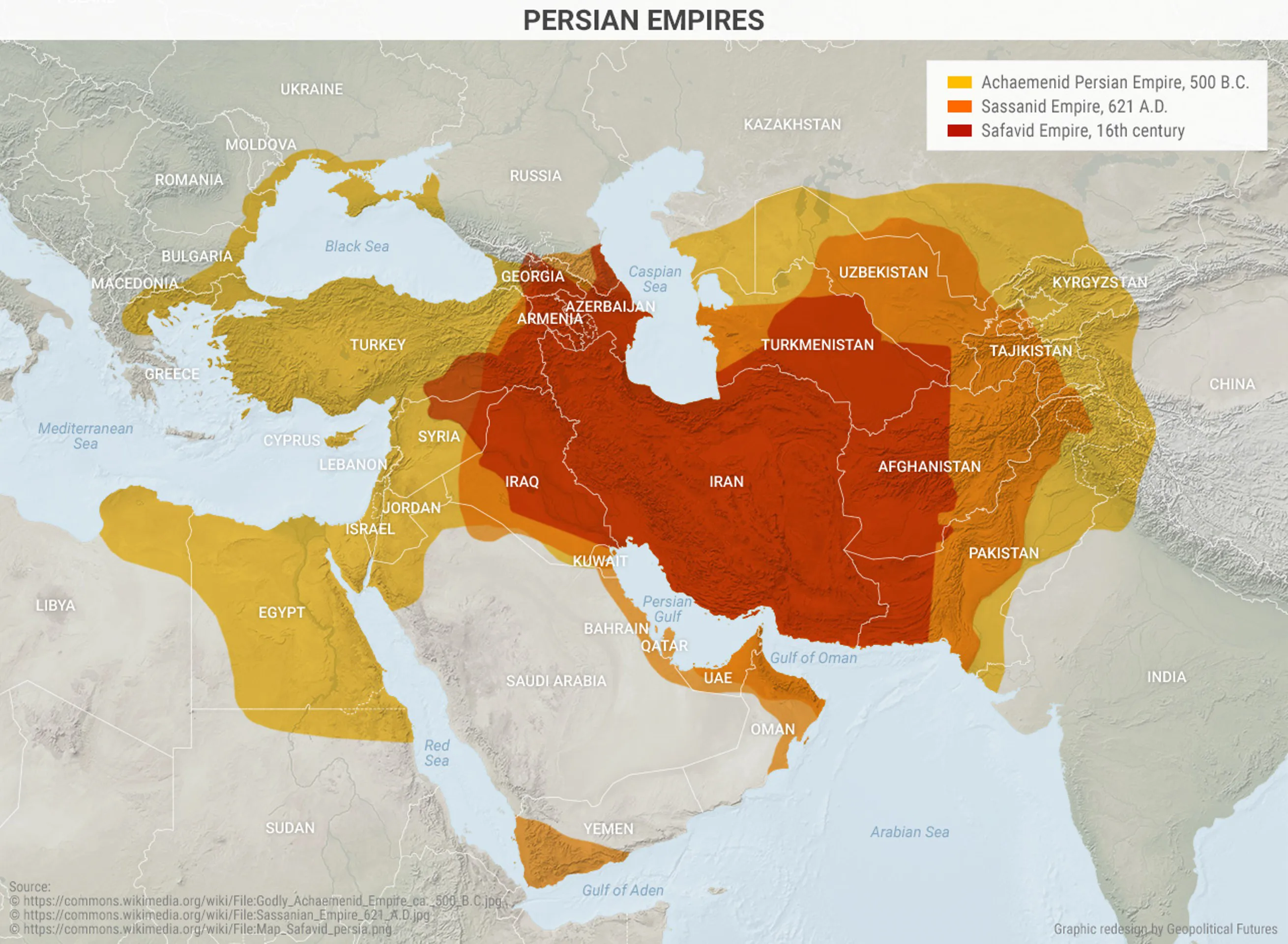
In the eighth and ninth centuries AH, when Nastaliq was taking shape, borders and political powers were not what we know today. Artists travelled, manuscripts moved between cities and courts, and teaching traditions passed from one centre to another.
For this reason, when “historical Iran” is mentioned here, it does not mean a country with today’s fixed borders. Each centre is better understood within the context of its own time, such as eighth-century AH Shiraz, Jalayirid Tabriz, or Timurid Herat.
The “Iranian cultural sphere” was also more than a geographical territory. It was a network of courts, libraries, bookmaking workshops, educational traditions, literature, and artistic practices that could extend beyond the borders of any single state.
That is why the fact that Herat is now in Afghanistan and Bukhara in Uzbekistan does not tell us everything we need to know about the historical position of these cities.
Timurid Herat was one of the major centres of Persian written culture, the arts of the book, and Nastaliq training. Bukhara later also contributed to the production of Persian manuscripts and the continuation of this tradition. Their present geographical locations are clear, but their cultural histories cannot be explained solely through contemporary borders.
The Persian-Speaking World and the Persianate World
Another distinction can help us understand the subject.
The “Persian-speaking world” refers to environments in which Persian, Dari, or Tajik has been an important spoken, literary, or administrative language.
The term “Persianate,” however, covers a broader sphere. In such environments, Persian might not have been the main language of the population, but Persian language and literature, written culture, or related artistic and courtly models could still exercise considerable influence.
This distinction matters greatly in the history of Nastaliq because the spread of the style did not always coincide exactly with the boundaries of Persian-speaking communities.
How Did Nastaliq Develop?
A gradual process, not a sudden invention
Historical and manuscript-based research generally places the emergence of Nastaliq as a recognisable style in the second half of the eighth century AH, corresponding to the late fourteenth century CE, within the cultural environment of Iran.
The surviving evidence, however, does not point to a single moment that can be identified as the “invention” of Nastaliq.
Some earlier examples contain features that resemble later forms of Nastaliq. These examples suggest that what we are dealing with was probably a gradual process in which certain forms and ways of writing slowly developed into a more clearly defined structure.
Some historical sources use the term “Naskh-Ta'liq” for transitional forms. The name may remind us of Nastaliq’s historical relationship with Naskh and Ta'liq, but it should not be understood to mean that Nastaliq was mechanically created at a single moment by combining these two styles.
Even the boundaries between late Ta'liq, transitional examples, and the earliest forms of Nastaliq are not defined in exactly the same way by all researchers.
For the question addressed in this article, it is not necessary to resolve all of these disagreements. What can be said with greater confidence is that Nastaliq acquired a distinct form during a gradual process in the historical and cultural environment of Iran in the late fourteenth century.
Shiraz or Tabriz?
Tabriz occupies a particularly prominent place in accounts of Nastaliq’s origins, especially because of the name of Mir Ali Tabrizi.
Alongside this, research and surviving examples also emphasise the importance of Shiraz and the manuscript tradition of Fars during the early stages.
There is sufficient evidence to recognise the importance of both centres, but naming either one, without qualification or acknowledgement of disagreement, as the definitive “birthplace of Nastaliq” simplifies the history.
It is better to see the earliest formation of Nastaliq within a network of active centres of book production and manuscript culture. Shiraz and Tabriz both contributed to this development, and the connections between such centres were themselves part of the background to the transformation of the script.
This view does not diminish Nastaliq’s Iranian origins. On the contrary, it shows that those origins were themselves the result of activity across several lively artistic centres.
Mir Ali Tabrizi: Founder or Inventor?
Traditional sources on calligraphy generally describe Mir Ali Tabrizi as the vazi', or founder, of Nastaliq.
The meaning of vazi', however, should not automatically be equated with the modern idea of an “inventor.” In older texts the term may refer to a founder, a figure who established rules, or an authoritative master.
The traditional account remains important because it shows the position that later generations of calligraphers gave to Mir Ali.
More recent research, however, considers the attribution of the entire emergence of the style to one individual more cautiously, particularly in light of examples showing Nastaliq-like features before his period.
A role that can be attributed to Mir Ali with greater confidence is the organisation, standardisation, and consolidation of a style that had already passed through earlier stages of formation.
The two accounts therefore do not necessarily cancel each other out. The traditional narrative reflects Mir Ali’s place in the professional memory of calligraphers, while modern historical research also seeks to reconstruct the developments that preceded him.
Herat and the Consolidation of a Tradition
After the earliest stages, Timurid Herat became one of the major centres for teaching Nastaliq, producing manuscripts, and transmitting its standards.
The presence of calligraphers, bookmaking workshops, and networks of masters and students helped consolidate and continue the style.
There is, however, one overly simple way of describing Herat that should be avoided: saying that Nastaliq “left Iran” and reached Herat.
Such a statement is based more on today’s map than on the historical reality of the period. Within the Timurid cultural sphere, Herat was one of the principal centres of Persian written culture, and its place in the history of Nastaliq must be understood within that context.
In later periods, Safavid centres and masters such as Mir Emad also contributed to the development of influential standards in Nastaliq.
What Role Did Persian Language and Literature Play?
Geographical origin is not the only reason Nastaliq is regarded as Iranian.
One of the most important foundations of its historical identity is its long relationship with Persian language and literature.
Numerous manuscripts and calligraphic pieces containing works by Nizami, Saadi, Hafez, and other Persian-language poets were written in Nastaliq. Over time, Nastaliq became one of the principal styles used for writing Persian poetry and literature.
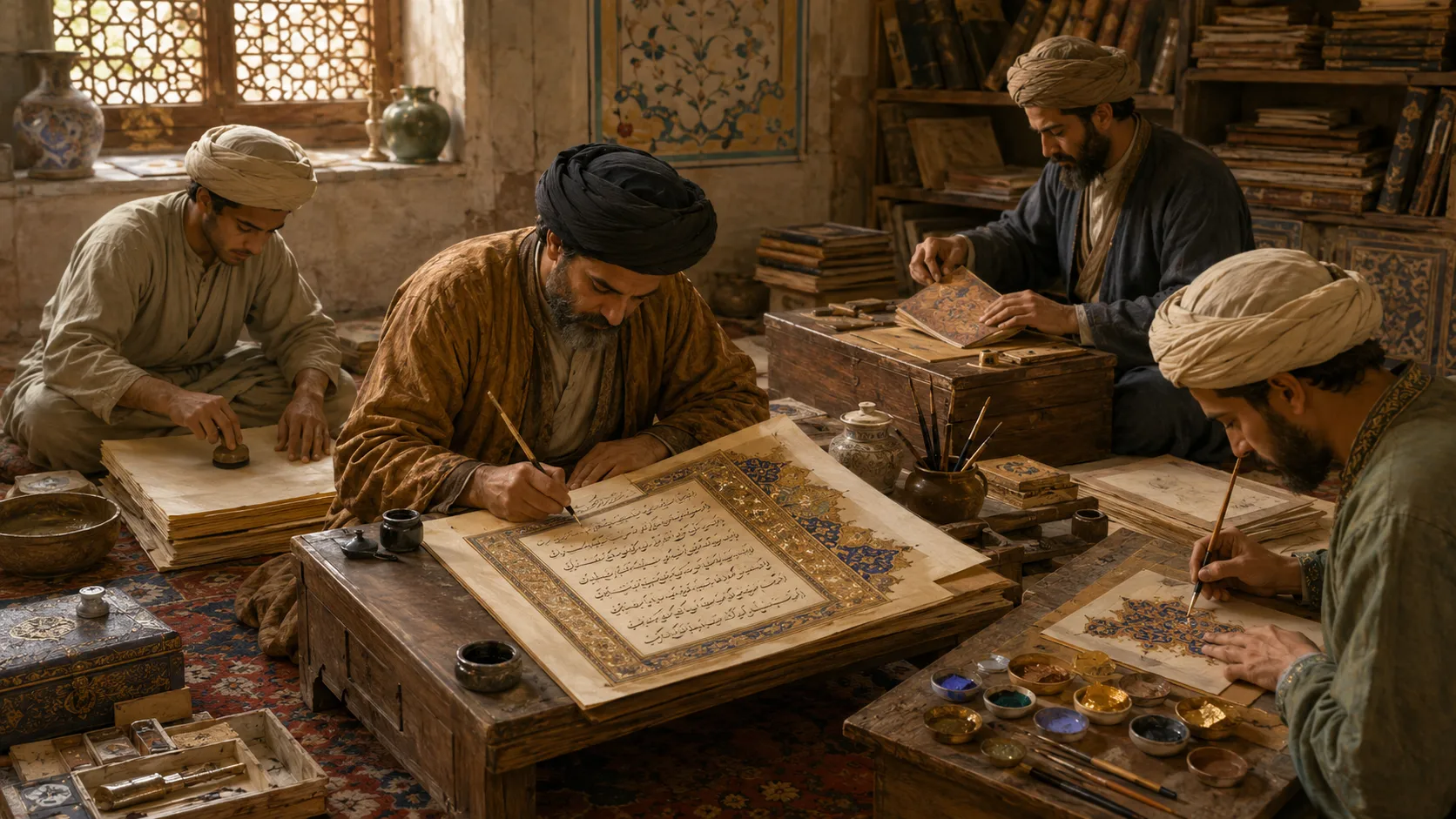
Here, ketabat refers to the continuous copying of a text in a manuscript. The arts of the book include the various processes involved in making and arranging a book, from copying the text to illumination, illustration, and binding.
Within this tradition, a text was not merely a collection of words. The way it was written, the scale of the lines, the spacing, the arrangement of the page, and the relationship between writing, illumination, and image were all part of the book’s final form.
The large number of literary manuscripts and calligraphic pieces shows that Persian literature played a fundamental role in establishing the cultural position of Nastaliq.
This relationship, however, should not be turned into a mythical or essentialist claim. Historical evidence shows a long and institutional relationship between Nastaliq and Persian language and literature, not that the form of the style was the inevitable result of something called the “spirit of the Persian language.”
The connection with Persian is deep, but not exclusive.
Persian was the most important language for a large part of Nastaliq’s history, but it was not its only language.
Chagatai examples from the cultural environment of Herat and the extensive use of Nastaliq for Urdu show that the style also became established in other linguistic settings.
This does not diminish the importance of its relationship with Persian.
It is more accurate to say that Nastaliq has an exceptionally extensive, distinguished, and historical connection with Persian language and literature, rather than saying that it inherently belongs only to Persian.
When Nastaliq Moved Beyond One Region
Artistic traditions do not move from place to place like sealed, unchanging objects.
Artists travel, manuscripts circulate, and methods of teaching reach new regions. In return, every new environment also affects how a tradition is used and continued.
The later history of Nastaliq should be seen in the same way: as a history of transmission, continuity, and the emergence of regional forms.
Historical Khorasan and Central Asia
Herat was one of the major centres in the consolidation of Nastaliq, while Bukhara and other Central Asian centres later contributed to manuscript production and to the continuation of the tradition.
The existence of works produced in Bukhara shows that the city was not merely a place where Nastaliq was preserved or passed through. It was itself part of the active geography in which the style was produced.
Once again, today’s map can be misleading. Bukhara is now in Uzbekistan, but part of its artistic production in that period developed within a broader network of Persian literature and the arts of the book.
For this reason, even the phrase “Nastaliq outside Iran” is not always simple or precise when discussing premodern periods.
Mughal India
The migration of calligraphers and the movement of works were important routes through which Nastaliq entered and expanded across the Indian subcontinent. Mughal courts also supported calligraphers and assembled important collections of their work.
Mughal India, however, should not be imagined merely as a consumer or recipient of a fully completed style imported from elsewhere.
Calligraphers worked in this environment, new works were produced and collected, and Nastaliq continued within a new cultural setting. This process is itself part of the history of Nastaliq, not a footnote to its Iranian history.
Nastaliq and Urdu
Nastaliq also acquired a very important position in Urdu and became one of the principal ways in which the language has been visually represented in writing.
This history may be one of the clearest examples of how a tradition can have a specific origin and yet, over time, enter another culture and develop an independent life within it.
The history of printing, typesetting, and the technical characteristics of Nastaliq in Urdu is a separate subject in its own right.
The Ottoman Realm
Nastaliq was also known and adopted in the Ottoman realm, where it later developed distinctive regional forms.
A terminological point is important here. The Ottoman term taʿlik should not, without explanation, be treated as precisely identical to historical Iranian Ta'liq. The naming and classification of scripts have not always followed the same system across different traditions.
For the present discussion, it is enough to recognise that Nastaliq’s presence in the Ottoman tradition forms another part of its transregional history.
So Is “Iranian Script” an Accurate Description?
If the term is used to explain the origins and early development of Nastaliq, then yes.
Important stages of its formation took place within the historical and cultural environment of Iran. Manuscript-production centres, educational networks, and masters in this sphere helped consolidate it, while its extensive relationship with Persian language and literature became an important part of its historical identity.
In this sense, Nastaliq can be regarded as one of the distinctive traditions of Iranian calligraphy.
There is no need to claim superiority or make value comparisons with other traditions in order to express this position. The historical record and surviving works are clear enough.
The description becomes misleading, however, if “Iranian” is taken to mean that every stage of Nastaliq’s history occurred within the borders of present-day Iran, that the style was used only for Persian, that one city or one individual created it single-handedly, or that other regions were merely passive recipients.
None of these interpretations gives a complete picture of its history.
Herat, Bukhara, Mughal India, Urdu, and the Ottoman realm are all genuine parts of Nastaliq’s history. Recognising this wider history does not diminish the role of Iranian centres or Persian culture.
Both dimensions can be understood together.
Iranian in Origin, Transregional in History
So why is Nastaliq called an Iranian script?
Because its gradual formation and early consolidation took place within a network of historical and cultural centres of Iran, and because its deep relationship with the arts of the book, Persian language, and Persian literature helped shape its historical identity.
But this was only the beginning of its journey.
Historical Iran is not identical to the modern state of Iran with its present borders. Persian is not the only language ever written in Nastaliq, and historical origin does not imply exclusive ownership.
Over the centuries Nastaliq moved from city to city and from one cultural setting to another. It continued in Herat and Bukhara, acquired a new life in the Indian subcontinent, became deeply connected with Urdu, and also found a place within the Ottoman tradition.
Perhaps the most precise short description of its position is therefore this:
Nastaliq is Iranian in origin and transregional in history.
Sources
Yousefi, “Calligraphy”; Blair, Islamic Calligraphy; National Museum of Asian Art, Nastaʿlīq: The Genius of Persian Calligraphy.
Blair, Islamic Calligraphy, especially the sections on regional traditions.
Sedaghat Jabbari, “The Formation and Development of Nastaliq Script in the Eighth and Ninth Centuries AH,” pp. 77–84.
Kardar-Tehran and Hamidreza Gholichkhani, “A Study of the Formation of Disconnected Letters in Nastaliq Based on the Bayaz of Taj al-Din Ahmad Vazir,” pp. 59–68.
Soucek, “ʿAli Tabrizi”; Yousefi, “Calligraphy.”
Official records of the Metropolitan Museum of Art and the National Museum of Asian Art concerning works copied in Herat.
Official record of the Divan of Ali-Shir Nava'i; “Urdu,” Encyclopaedia Iranica.
Yousefi, “Calligraphy”; official records of works produced in Mughal India and collections of the Metropolitan Museum of Art.
“Urdu,” Encyclopaedia Iranica; Library of Congress, The History of the Urdu Language.
Discussion · article
0