Mir Emad: How Did His Name and Style Become a Classical Model in Nastaliq?
Mir Emad Hassani is one of the best-known names in the history of Nastaliq. Yet that very fame makes identifying his works somewhat difficult.
The more prestigious an artist’s name becomes in later periods, the greater the chance that more works will be attributed to them. In Mir Emad’s case, we are confronted today with several different groups of works: pieces bearing his date or signature, works museums describe as “attributed to” Mir Emad, examples later remounted in albums and new borders, and works written only in his style.
So before asking, “What were the characteristics of Mir Emad’s style?”, we need to ask a simpler question:
Which works can we discuss with greater confidence?
This question is especially important in Mir Emad’s case because, over several centuries, his name ceased to be merely the name of a calligrapher. It became a standard for comparison, imitation, teaching, and collecting.
When this article refers to Mir Emad as one of the classical models of Nastaliq, it does not mean that he represented the “final stage” or “ultimate perfection” of Nastaliq. It means that later generations repeatedly turned to his works and manner, and that his name acquired the status of a reference.
To understand how this happened, three things need to be considered together: the works themselves, Mir Emad’s reputation during his lifetime, and the history of his works and name after his death.
Before Discussing Style, We Need to Be Sure About the Works Themselves
In calligraphy, the presence of a master’s name on paper does not always prove conclusively that the work is in that master’s hand.
A raqam is the name, title, or phrase a calligrapher usually writes at the end or in a corner of a work. A raqam can be important evidence for attribution, but it is itself part of a historical object and may have been added or altered in another period.
For this reason, three expressions need to be distinguished:
Signed with the name of Mir Emad
Attributed to Mir Emad
and In the style of Mir Emad
These three expressions do not carry the same degree of certainty.
An interesting example is preserved at the Library of Congress. A page of Persian and Chaghatay verses was assembled from several cut pieces and remounted together. A small signature with the name Mir Emad appears on one panel, while his name was also added later to the decorative section of the page during remounting.
This example reminds us that Mir Emad’s name can sometimes be part of the later history of a work, rather than necessarily part of the moment when it was first created.
This distinction is crucial when trying to understand his style.
If we begin by assuming that every work bearing Mir Emad’s name is actually by him, then call their shared features “Mir Emad’s style,” and finally use those same features to prove attribution, we are simply reasoning in a circle.
For this reason, when examining form, it is better to give greater weight to works whose date, signature, museum history, and historical information point in the same direction.
One such example is a piece in the Metropolitan Museum of Art dated 1017 AH / 1608–1609 CE.
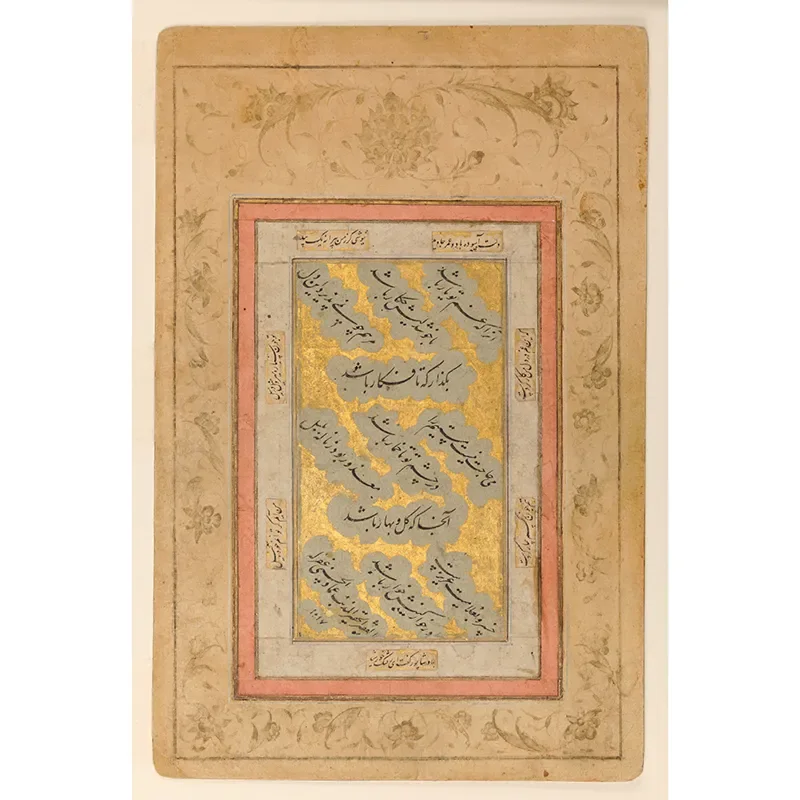
Works of this kind provide a more reliable basis for studying Mir Emad’s manner than examples described only as “attributed to” him.
What Can We See in Mir Emad’s Works?
When describing a calligraphic style, adjectives such as “delicate,” “balanced,” or “flawless” are not especially useful.
How are the lines arranged?
Where does the stroke become thin and where does it become broad?
How do elongated strokes relate to the surrounding space?
How do words sit on the kursi?
Where does the composition become denser, and where is open space left?
Kursi, elongated strokes, and stroke width
The kursi is the imaginary path on which letters and words are positioned within a line.
In Nastaliq, this path is not necessarily straight or horizontal. Words can rise and fall, and these changes in height contribute to the character of the line.
Elongated strokes are not simply used to fill empty space either.
Within a piece, an elongated stroke can regulate the distance between two parts of the writing, reinforce the direction of a line, or connect a dense area with an open space.
These, of course, are visual observations based on the work itself. A museum record can provide the date, materials, and identification, but the relationship between elongated strokes, density, and empty space must be seen on the page itself.
Another piece at the Library of Congress, containing a quatrain by Kamal al-Din Isma'il, has four diagonal lines of Nastaliq on a golden ground, and the name Emad al-Hassani appears in its record.
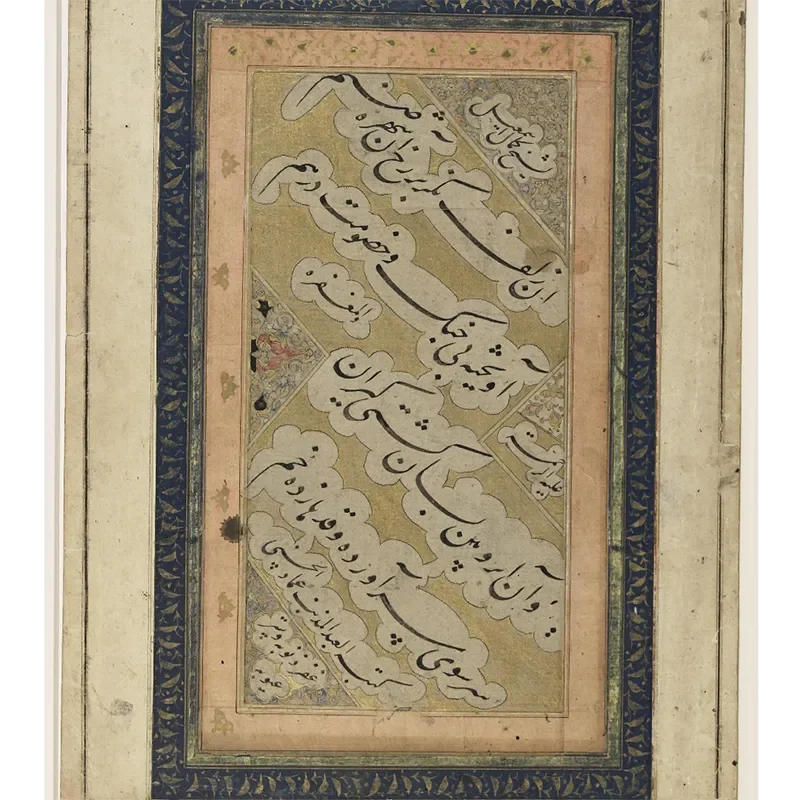
Quatrain of Kamal al-Din Isma‘il, early seventeenth century, Library of Congress.
Looking at several reliable examples side by side allows recurring patterns to emerge.
But this does not mean that Mir Emad possessed some “hidden sign” or fixed formula by which every unknown work can immediately be attributed to him.
Style is a set of recurring habits and choices, not a simple visual fingerprint.
Mir Emad Did Not Write the Same Way in Manuscript Copying, Qit'a, and Siyah Mashq
One of the common mistakes in comparing calligraphic works is to ignore the format of the work.
An independent qit'a, a manuscript page, and a siyah mashq do not impose the same demands.
The colophon page of Haydar Khwarazmi’s Makhzan al-Asrar is an example of Mir Emad’s manuscript copying. On this page, he signed as “Emad al-Molk al-Hassani,” and the date 1023 AH / 1614 CE is recorded.
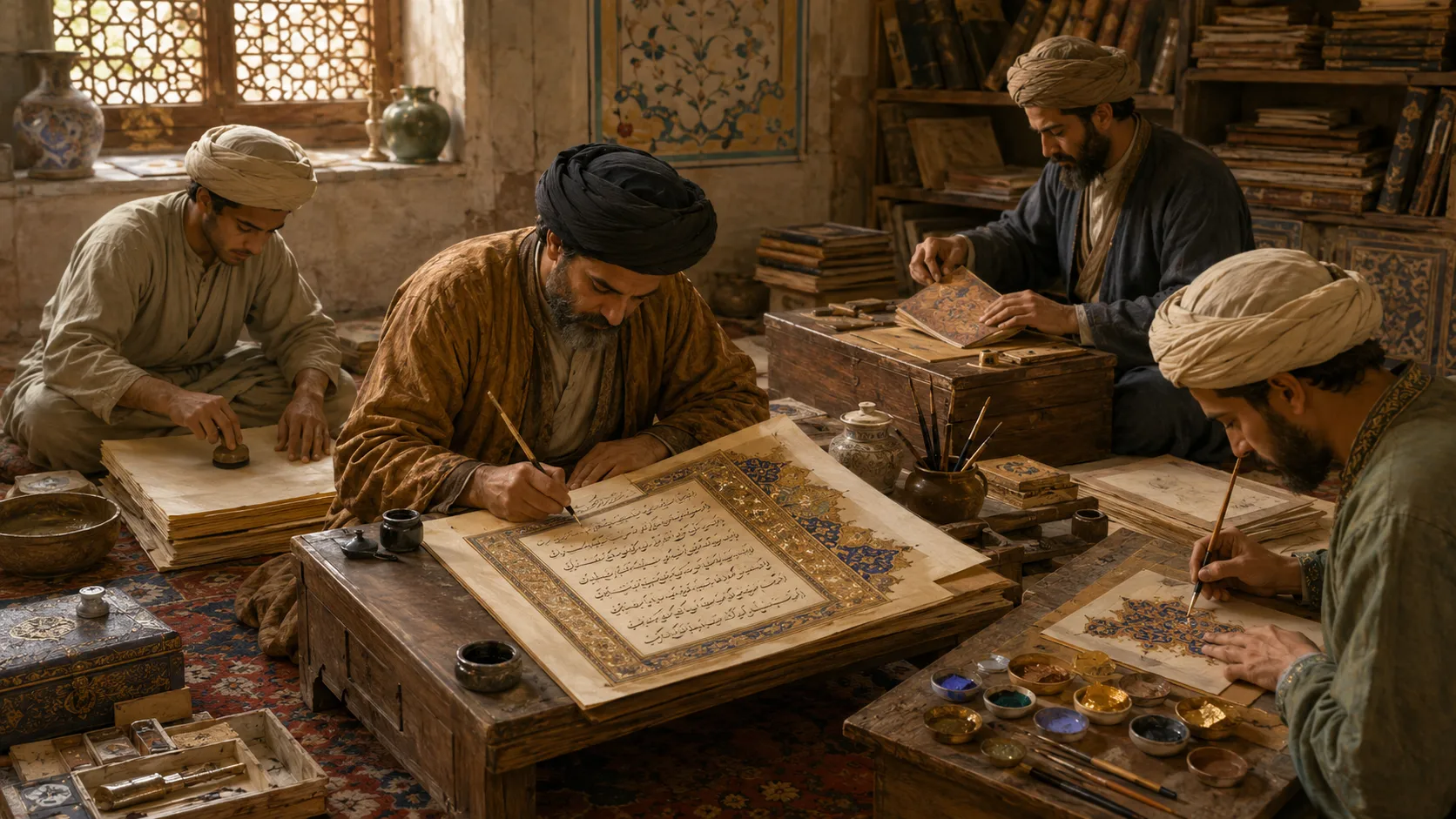
In manuscript copying, the calligrapher works with a continuous text. Many lines and pages must be carried forward according to an established order. Pen size, density, and spacing are also shaped by this function.
So if Mir Emad’s small-scale manuscript hand differs from a large four-line qit'a, we cannot immediately conclude that one belongs to a “more mature stage” of his style.
The format has changed, and with it the nature of the problem. Siyah mashq differs even more.
Siyah mashq is built around repetition, practice, and density, and the relationship between writing and empty space changes substantially.
These differences between formats show that understanding a calligrapher requires looking at more than one type of work.
Style does not mean mechanical repetition. A master’s style is a set of relatively stable tendencies and proportions, not the exact repetition of every letter or combination in precisely the same way each time.
Calligraphy is a living practice, and even in the hand of a single person, text, scale, format, and writing circumstances can affect the final result.
What Truly Belongs to Mir Emad, and What Belongs to Nastaliq Itself?
Some characteristics now associated with Mir Emad’s works already existed in Nastaliq before him.
Slanting lines, elongated strokes, changes in stroke width, and the regulation of spacing were also used by earlier masters.
From Mir Ali Tabrizi and Sultan Ali Mashhadi to Mir Ali Haravi, Nastaliq had already passed through a long history before Mir Emad.
So Mir Emad’s importance should not be explained by claiming that he created every familiar feature of Nastaliq.
A more precise question is:
How did he bring these existing possibilities together in his works, and why did his execution later acquire such authority?
This question concerns both the script itself and the history that followed.
Can Mir Emad’s works be divided into “youth” and “maturity”?
With the evidence currently available, caution is necessary.
Sources report examples from earlier years of his life as well, but the surviving body of dated and comparable works is not equally consistent across every stage of his artistic career.
For this reason, it is not possible to draw a complete and secure trajectory from “youth” to “peak” based only on a few surviving works.
Nor does a later date automatically mean that a work is more mature or better.
Such narratives may be appealing, but when the evidence is insufficient, they create stories out of art history rather than explaining it.
Mir Emad’s Reputation Had Already Formed Before His Death
Mir Emad’s life is sometimes told so much through the story of his murder that it can seem as though his fame was created only afterward. Evidence closer to his lifetime, however, gives a different picture.
Qazi Ahmad Qumi, in Golestan-e Honar, wrote about Mir Emad’s skill in small-scale writing years before his death and compared him with Mir Ali.
The significance of this account lies not merely in its praise. More importantly, it shows that Mir Emad already enjoyed considerable prestige among artists before his death.
Mir Emad was born around 961 AH / 1554 CE in Qazvin, into a family of Hassani Sayyids.
Accounts of his teachers are not consistent. Names such as Isa Beg Rangkar, Malik Daylami, and Mohammad Hossein Tabrizi appear in later sources, but contemporary sources do not independently confirm all of these relationships. It is therefore better to say that these connections “have been reported” rather than treat his educational lineage as certain.
In 1004 AH / 1595–1596 CE, Mir Emad was active in the library of Farhad Khan Qaramanlu in Semnan. Alireza Abbasi was also present in the same environment.
After Farhad Khan was killed in 1007 AH / 1598 CE, Mir Emad’s path took him to Qazvin and then Isfahan, and in later years his name appears in the court environment of Shah Abbas alongside Alireza Abbasi.
This position gave him opportunities to be seen, receive commissions, and connect with a broader network of artists and collectors. But several centuries of authority cannot be explained by court presence alone. We need to see what happened after him.
How Did Mir Emad’s Style Pass from One Generation to Another?
When we speak of a master’s “influence,” it is useful to ask how exactly that influence was transmitted.
One of the clearest routes is through students and close associates.
The lists of Mir Emad’s students in later sources are very long, and not all names carry equal weight. Similarity to Mir Emad’s hand alone does not prove direct study with him. But for some figures, the evidence is clearer.
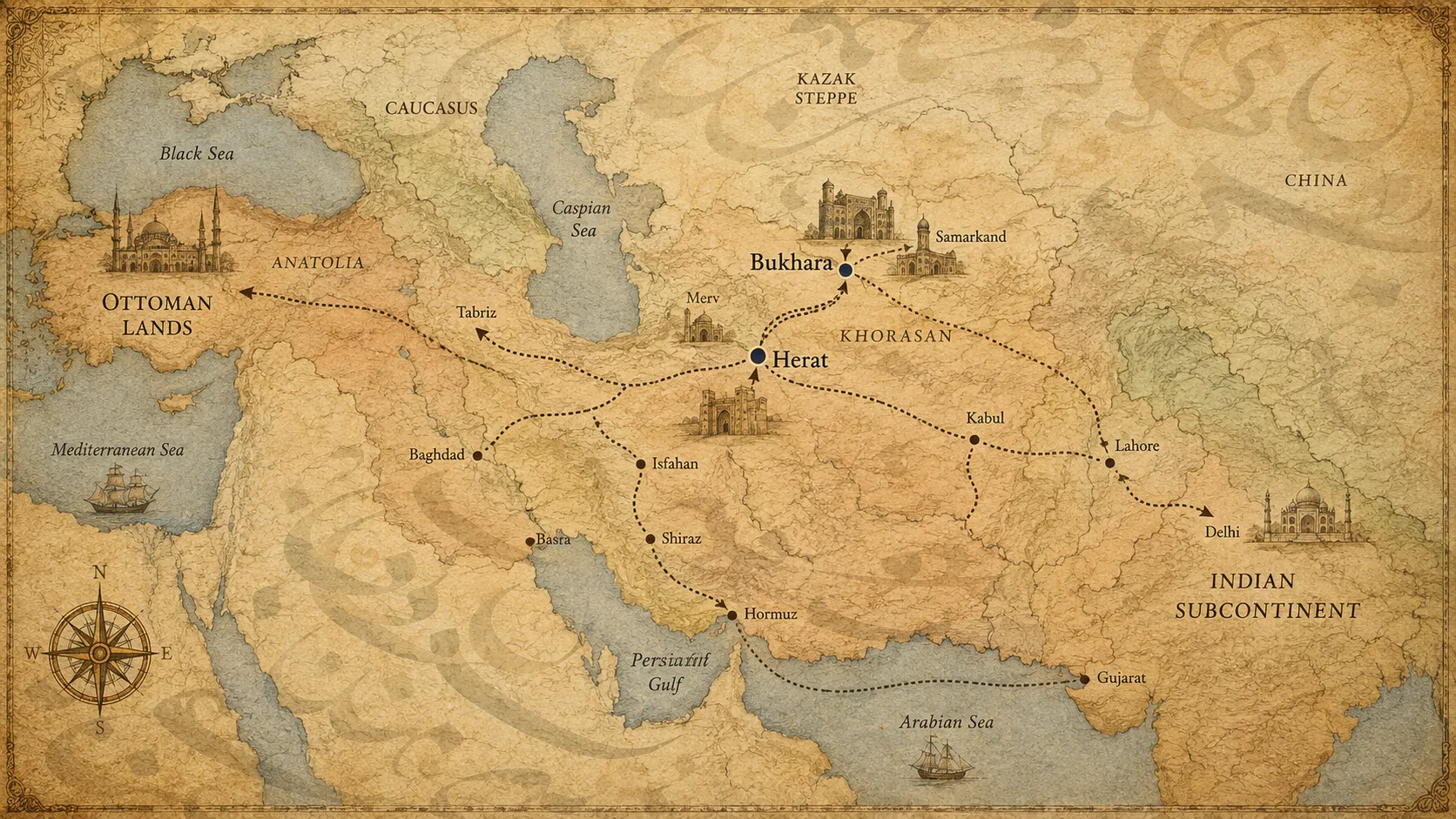
Abd al-Rashid Daylami is one of them. Sources describe him as an Iranian calligrapher who went to India, worked at the court of Shah Jahan, and had both a family and instructional relationship with Mir Emad.
This example matters because the style did not reach India only through a travelling piece of calligraphy. A person who had learned the tradition also taught it in a new environment.
A more specific route is also documented in the Ottoman world.
Dervish Abdi Bukhari studied in Isfahan under Mir Emad and later went to Istanbul. Ottoman sources regard him as one of the early links in transmitting Mir Emad’s manner into a tradition in which Nastaliq was commonly called ta‘lik.
In such cases, we are no longer dealing with the vague word “influence.” We can see who studied, where they went, and how knowledge travelled with them.
Sometimes the Works Travel Farther Than the Artist
A master’s manner is not transmitted only through students. The works themselves also travel.
Calligraphy is particularly suited to this kind of movement. A piece can be separated from its border, sold or given away, inserted into a new muraqqa', and several generations later framed again in another land. Mir Emad’s works experienced such histories as well.
The British Royal Collection preserves a Mughal album of 33 folios compiled around 1730–1750, more than a century after Mir Emad’s death.
Several pieces associated with his name appear in this album. The time gap is highly significant.
Such works do not prove that Mir Emad wrote them for a Mughal court. What they show is something else:
Around a century later, possessing a work by Mir Emad, or one attributed to him, still carried value within a royal collection.
That is itself part of the history of his reputation.
A page in the Library of Congress likewise contains several calligraphic panels cut from earlier settings and remounted together on a new page. Mir Emad’s name was also added later to part of the frame as an attribution.
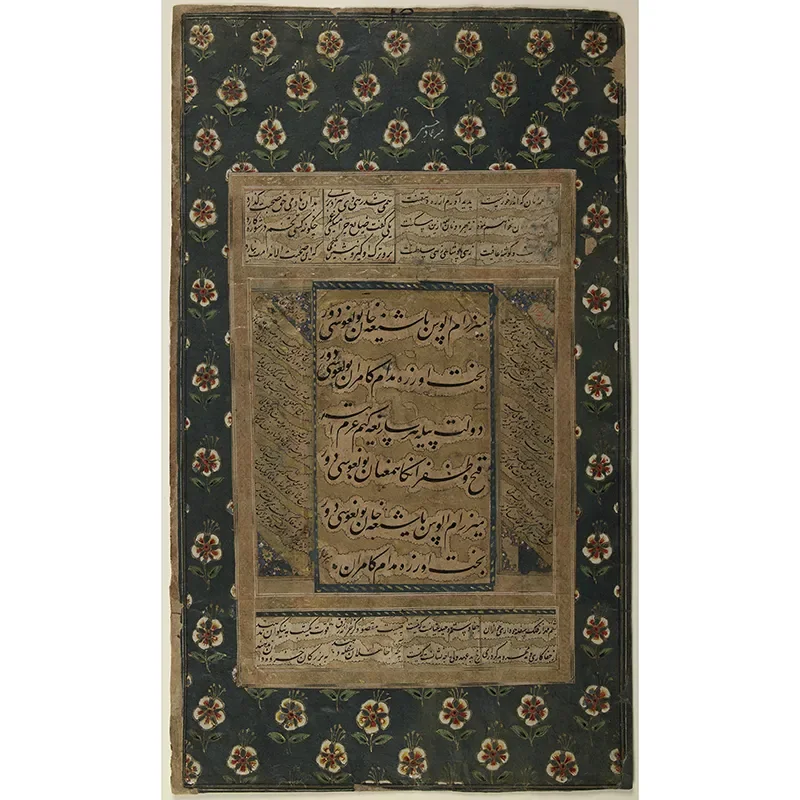
Verses in Persian and Chaghatay, a group of remounted calligraphic pieces, Library of Congress.
This page is a good example of how a calligraphic work can acquire a “second life.”
The Murder of Mir Emad: Historical Fact and Later Narratives
Mir Emad was killed on 30 Rajab 1024 AH, corresponding to 15 August 1615 CE.
The event itself and its date have relatively clear historical support.
But the question of who ordered the killing and what the precise motive was is much more uncertain.
Later biographical anthologies strongly emphasised the rivalry between Mir Emad and Alireza Abbasi, and some even implicated Alireza in the killing.
Modern research, however, has not provided tangible evidence of his direct involvement.
We can therefore speak of professional rivalry between two major calligraphers in the environment of Shah Abbas, but turning that rivalry into a definite murder plot goes beyond the available evidence.
There are also accounts of severe tension between Shah Abbas and Mir Emad, or of the court’s satisfaction with his removal, but this is not the same as possessing clear evidence of a direct order to kill him.
Another narrative connects the murder to Mir Emad’s religious affiliation. This account appears in later Ottoman sources, but the chronological distance and lack of independent evidence do not allow us to present it as the definite cause.
Although these narratives are weak as evidence for reconstructing the murder, they are not entirely without value.
They show how Mir Emad was remembered in later periods.
His killing gradually became part of the tragic image of his life.
But because his professional reputation is documented before 1615, his tragic death cannot be regarded as the primary cause of his artistic prestige.
Why Did Mir Emad Become a Classical Model?
We can now return to the main question.
Why did Mir Emad become such an important reference in the history of Nastaliq?
The answer does not lie in a single formal characteristic. In his more securely documented works, we can see controlled changes in stroke width, the movement of words in relation to the kursi, measured use of elongated strokes, and a precise relationship between density and open space.
But these characteristics are not the whole story, and many of them already existed in the Nastaliq tradition before Mir Emad.
His reputation had already taken shape during his lifetime.
His students and followers continued his manner, and some carried it into other environments such as India and the Ottoman world.
His works, or works attributed to him, moved from one collection to another and entered new muraqqa's.
And eventually the name Mir Emad itself became a reference.
Later generations compared works against his name, practised from his manner, collected his pieces, and at times even added his name to works whose attribution today requires closer examination.
Taken together, this evidence allows us to say that Mir Emad became one of the classical standards of Nastaliq.
But it is better not to say that “he perfected Nastaliq.”
Nastaliq already had a long history before Mir Emad, and it continued to develop after him.
An artist becomes classical not only because of what they put on paper during their lifetime.
Part of that status is created in the future: through what students continue, collectors preserve, later generations imitate, and art history repeatedly returns to.
Mir Emad exists both in his works and in the history built after him.
Perhaps it is these two histories together that have kept his place in Nastaliq alive to this day.
Sources
Qazi Ahmad Qumi. Calligraphers and Painters: A Treatise by Qadi Ahmad, Son of Mir-Munshi. Translated by Vladimir Minorsky. Freer Gallery of Art, 1959.
Eslami, Kambiz. “ʿEmād Ḥasanī, Mīr, ʿEmād-al-Molk.” Encyclopaedia Iranica.
The Metropolitan Museum of Art. “Folio with Verses in Nastaʿlīq Script.” Mir ʿImad al-Hasani, 1017 AH/1608–9 CE, 46.126.3.
National Museum of Asian Art. Nastaʿlīq: The Genius of Persian Calligraphy; section on Mir Emad Hassani and related records.
Library of Congress. “Verses in Persian and Chaghatay,” LCCN 2019714581.
Library of Congress. “Quatrain of Kamal al-Din Isma'il,” LCCN 2019714662.
Library of Congress. “Letter Exercises,” LCCN 2019714598.
Encyclopaedia Iranica. “Farhād Khan Qarāmānlū, Rokn-al-Salṭana.”
Soucek, Priscilla. “ʿAlī-Reżā ʿAbbāsī.” Encyclopaedia Iranica.
Los Angeles County Museum of Art. “‘Abd al-Rashid, Calligraphy from an Album with Eighteenth-Century Borders.”
Derman, M. Uğur. “Derviş Abdî-i Mevlevî.” TDV İslâm Ansiklopedisi.
Royal Collection Trust. “A Late Mughal Album of Calligraphy and Paintings” and “Calligraphy by Mir ‘Imad and Portrait of a Mughal Lady.”
The Walters Art Museum. “Album of Persian and Indian Calligraphy and Paintings,” W.668.
Library of Congress. “Verses on Hidden Love,” LCCN 2019714634.

Discussion · article
0