The Journey of Nastaliq: From Herat and Bukhara to India and the Ottoman World
The history of Nastaliq begins within the cultural world of Iran, but it does not remain confined there.
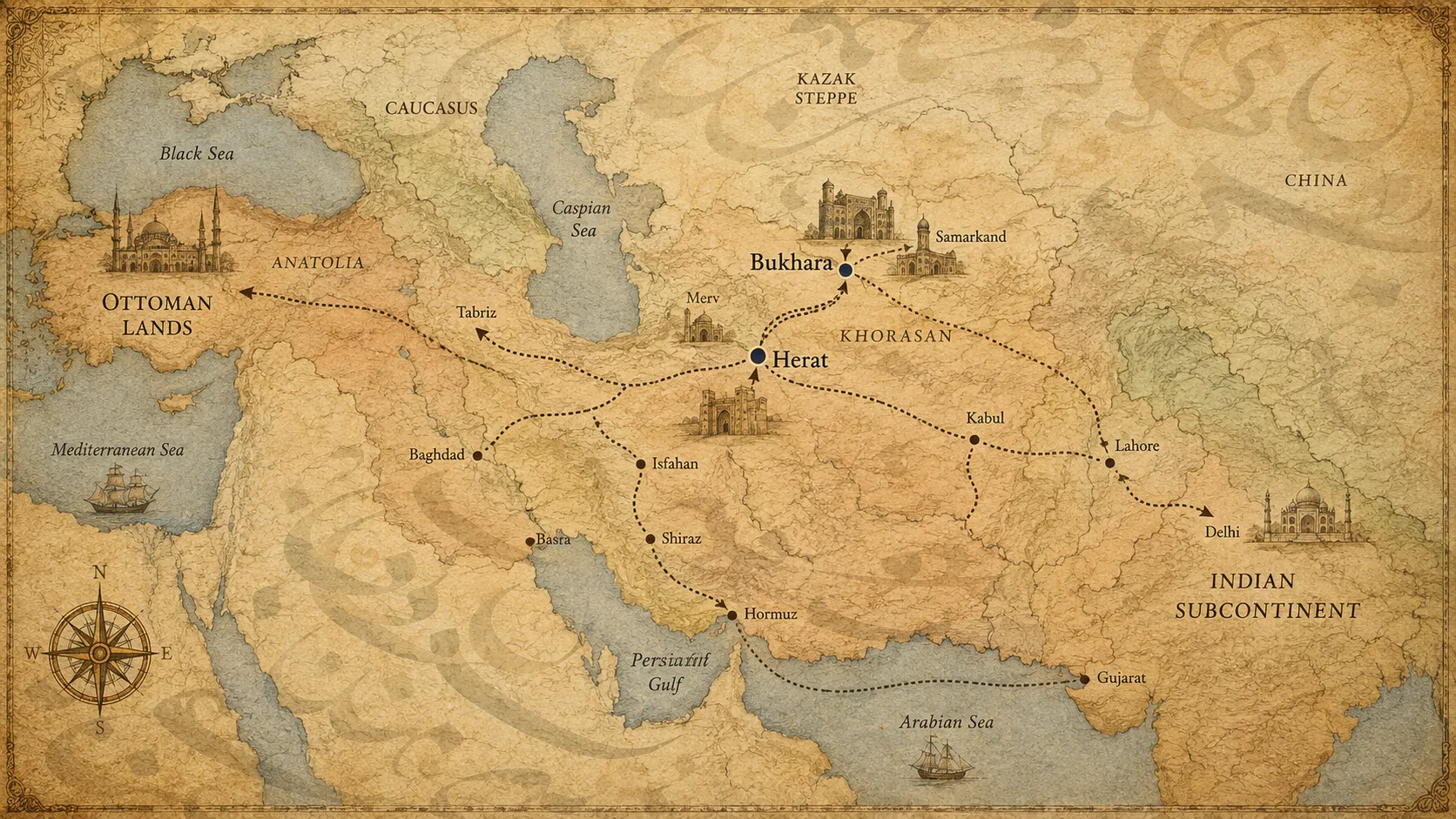
From the fifteenth century onward, calligraphers travelled, manuscripts changed hands, calligraphic pieces entered new collections, and methods of instruction moved from one city to another. Along these routes, Nastaliq extended from Khurasan and Transoxiana to Mughal India and the Ottoman realm, encountering new conditions in each environment.
Persian language and literature played a central role in this expansion, but they were not the whole story. Nastaliq was also used for Arabic, Chagatai, and Urdu. Conversely, wherever Persian was present, Nastaliq was not necessarily the principal style of writing.
For this reason, it is better to understand the spread of Nastaliq not as the story of “exporting a script,” but as the movement of people, works, teaching, and artistic prestige.
When an artistic tradition moves from one place to another, it is not transferred like a sealed object that remains unchanged. Part of it is preserved, part of it changes, and the new environment adds something of its own.
Before the Journey: Herat
Herat is an important point from which to follow this history.
In the late fifteenth century, Herat was one of the principal centres of Timurid bookmaking and calligraphy. If we look at this period through today’s political map, we may misunderstand the city’s historical position. Herat is now in Afghanistan, but at the time it was one of the major centres of historical Khurasan and of Timurid Persian and Turkic literary culture.
In Timurid court workshops, scribes, painters, illuminators, and binders collaborated in the production of manuscripts. This environment was not only a place where works were made; it was also one of the settings in which artistic knowledge and methods were transmitted.
Ja'far Tabrizi is one figure whose movement between different centres reveals part of this network. A work by him is recorded in Yazd in 820 AH, and several years later, in 824 AH, we find him in Herat with the epithet Baysunghuri. The time interval supports the fact of his movement, although the precise route of his journey cannot be reconstructed from this evidence.
In the next generation, Sultan Ali Mashhadi worked in Herat and became one of the major masters of Nastaliq.
For our discussion, however, one fact about his works is especially important: not everything he wrote in Nastaliq was in Persian.
The deep relationship between Nastaliq and Persian never meant that Nastaliq belonged exclusively to the Persian language.
How Does a Script Travel?
When we say that a calligraphic style “spread,” what exactly moved?
This question matters more than it may first appear.
Sometimes the calligrapher moves.
A calligrapher may travel at the invitation of a court, be forced to migrate because of war or political change, or move to another city in search of a new patron.
Sometimes the work moves.
A manuscript or calligraphic piece may reach another city decades after the death of its calligrapher. It may even be removed from its original structure and inserted into a new muraqqa'.
A muraqqa' is an album of calligraphic pieces and images. It is important to remember that its components were not necessarily made at the same time or in the same place. A piece written in Bukhara might be bordered years later in India and mounted in a new album.
Another form of transmission is teaching.
A master trains a student, the student moves to another centre, and the method of writing continues there. This differs from the movement of a physical object because it allows a tradition to continue within a new environment.
And sometimes what travels is the prestige of a master.
A calligrapher may never have visited a particular region, yet his works and reputation may become so influential there that later generations follow his method.
Mir Emad is an important example of this situation.
To understand the journey of Nastaliq, these routes must be distinguished from one another. The presence of a piece in India does not mean that its calligrapher travelled to India, just as the migration of one master does not automatically prove the formation of a lasting local tradition.
From Herat to Bukhara: When the Calligrapher Travels
The life of Mir Ali Haravi is one of the clearest examples of human movement in the history of Nastaliq.
He was trained and worked in Herat. After the Uzbek conquest of Herat in 1528, he was taken to Bukhara and entered the service of the Shaybanid court.
Here, we are no longer speaking simply about similarities between styles or possible influence: the movement of the calligrapher himself is documented.
But Bukhara was not merely the place where Mir Ali arrived.
He continued to work there and produced further works. Calligraphers and students also continued the tradition. Bukhara therefore cannot be understood merely as a place that received or preserved Nastaliq; it became one of its active centres of production.
When the Work Travels, Not the Calligrapher
The history of some works by Mir Ali Haravi extends even beyond his own life.
Pieces written in Bukhara or Herat later entered collections in Mughal India.
One well-known example is a piece by Mir Ali probably written around 1540 in Bukhara and later incorporated into the structure of a Mughal album in India.
Such an object does not have a single history. The calligraphy itself was produced at one time and place; its borders and album mounting were added later in another environment.
A single page before us today can therefore contain several historical lives.
The precise routes of these pieces are not always known. We do not know how every work travelled, through whose hands, or exactly when it reached India. But the presence of Bukhara and Herat pieces in Mughal albums is documented.
Several Centres, Not One Centre and Its Margins
Looking at the fifteenth and sixteenth centuries, Herat, Bukhara, Tabriz, Qazvin, and later Isfahan cannot simply be arranged into a model of one “main centre” surrounded by secondary regions.
The political and artistic importance of cities changed, and artists and commissions moved with those changes.
The conquest of Herat took Mir Ali to Bukhara. Elsewhere in the region, the Safavid state established new court centres.
These states might have been political rivals, but political borders could not stop the movement of language, books, and art.
Nastaliq also continued to develop within the Safavid environment.
In the early seventeenth century, Mir Emad Hassani was one of the masters whose work gained great prestige. His dated pieces show the continuation and refinement of Nastaliq in the Safavid context.
For our purposes, however, an even more important point is that Mir Emad’s reputation did not remain within the boundaries of that environment.
His works and method later attracted attention in India and the Ottoman world, even though he himself did not need to travel there.
This is the transmission of prestige.
Did Persian Literature Carry Nastaliq with It?
To a considerable extent, yes, but not always and not by itself.
Persian was an important language of poetry, history, correspondence, and written culture in many Timurid, Shaybanid, Safavid, and Mughal courts and cultural centres.
Where more Persian books and calligraphic pieces were produced, there were naturally more opportunities for Nastaliq to be used.
Its connection with Persian poetry and book arts is deep and well documented.
But if we turn this relationship into a rule, we oversimplify the history.
Persian had been written in other styles, including Naskh and Ta'liq, before the spread of Nastaliq. Even after Nastaliq became established, not every Persian text was copied in it.
At the same time, Nastaliq itself moved beyond Persian.
Two important Herat manuscripts in the hand of Sultan Ali Mashhadi demonstrate this clearly: the Divan of Sultan Husayn Bayqara and the collected poetry of Ali-Shir Nava'i, both in Chagatai.
A more accurate formulation may therefore be:
Persian literary culture was one of the most important environments in which Nastaliq grew and spread, but Nastaliq never remained imprisoned within the Persian language.
Mughal India: Beyond the “Arrival of an Iranian Script”
A common explanation of Nastaliq in India is that Iranian calligraphers migrated there and brought the script with them.
That movement was important, but it is not the whole story.
If we stop there, the Mughal environment appears to be merely a recipient, whereas the evidence presents a more complex picture.
The Mughal court was multilingual, and Persian held an important administrative and literary position within it. The courts of Akbar and his successors also invested heavily in book production, artistic patronage, and the formation of collections.
Within such an environment, Nastaliq was not only imported from elsewhere; it was also produced locally.
Muhammad Husayn Kashmiri, known as Zarrin Qalam, is an important example. He worked in India and achieved a high position at Akbar’s court. Pieces by him are recorded from the late sixteenth century.
Here we are no longer looking at an object imported from Iran.
The calligraphy itself was produced within the Mughal environment.
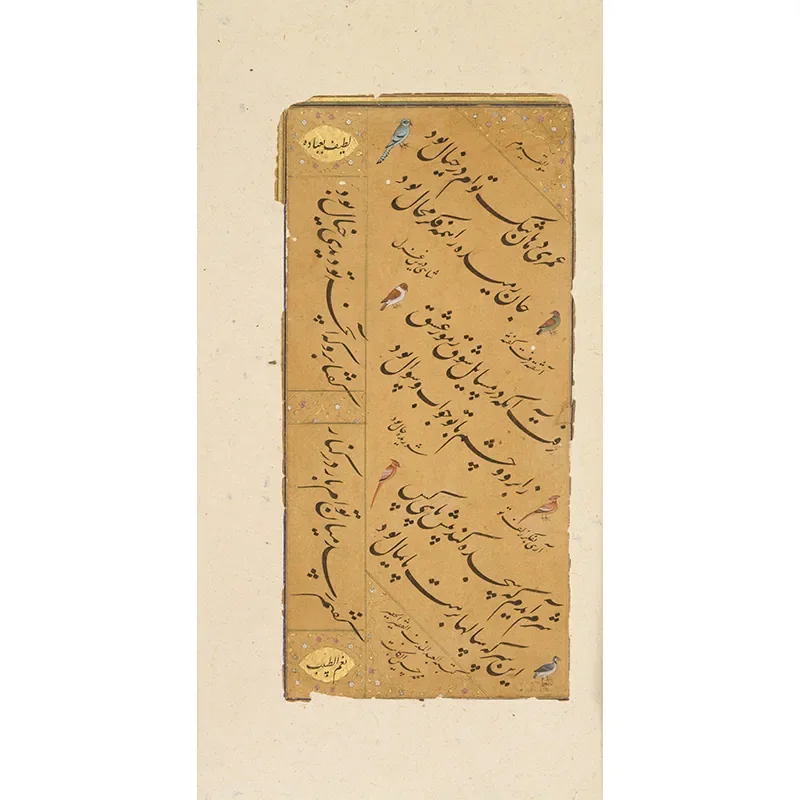
This is where it becomes useful to speak of localisation: when a style is no longer merely present as something foreign, but is written by local artists, commissioned, taught, and transmitted to subsequent generations.
Kashmir: When Regional Production Becomes Visible
South Asia was not only Agra, Delhi, and the central Mughal court.
Kashmir also offers an important example of regional Nastaliq production.
In 1658, Muhammad Ashraf Radhawi wrote a page of prayers and devotional texts in Kashmir. The Metropolitan Museum records Kashmir as the place of production and Arabic and Persian as the languages.
This example matters for several reasons.
First, the work was produced in Kashmir itself.
Second, Nastaliq was not limited to Persian poetry.
Third, even the language of the text alone does not determine the choice of calligraphic style.
Within a cultural environment, the type of work, religious tradition, bookmaking taste, and calligraphic education can all influence that choice.
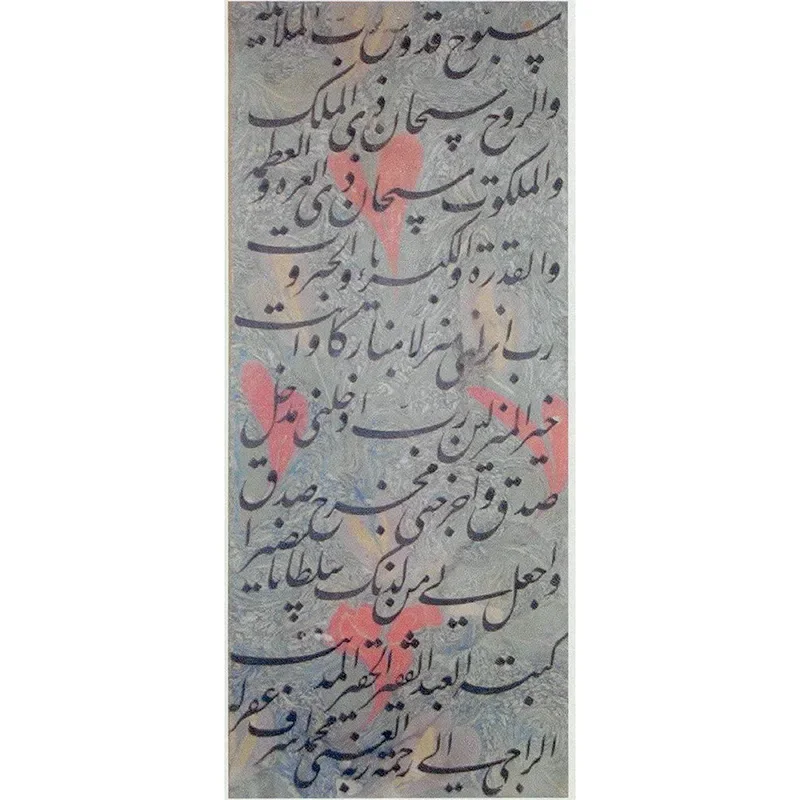
Another example from northern India is the Nad-e Ali piece signed by Muhammad Salih. It likewise shows the presence of Nastaliq in devotional texts and album structures.
This variety of uses helps prevent us from reducing Nastaliq to one familiar image: Persian poetry written on paper.
From Persian to Urdu
The relationship between Nastaliq and Urdu is one of the clearest examples of a tradition continuing its life within a new environment. But this development did not happen overnight.
The languages that later stabilised as Urdu developed in a multilingual setting. Persian was for centuries an important language of government, literature, and court culture in parts of India, and Urdu literature also formed under extensive Persian cultural influence.
As Urdu literature, manuscript culture, and later print developed, Nastaliq gradually became the principal visual form in which the language was written and presented.
This is highly significant for the history of Nastaliq.
We are no longer dealing simply with the preservation of an older tradition. A style that had formed in another cultural environment continued so deeply within a new language that it became part of that language’s visual identity.
This is perhaps one of the clearest forms of localisation.
The Ottoman World and an Important Confusion over “Ta'liq”
When we reach the history of Nastaliq in the Ottoman world, terminology becomes slightly more complicated.
In the Iranian tradition, Ta'liq is a historical calligraphic style distinct from Nastaliq. It existed before Nastaliq and had particular importance in correspondence and chancery writing.
But in many Ottoman sources, the term ta'lik was used for the style that Iranians called Nastaliq.
This difference in naming has sometimes caused two distinct traditions to be confused.
So whenever we encounter the word ta'lik in an Ottoman source, we first need to determine exactly which style is meant.
Examples of Nastaliq in the Ottoman realm are known from the period of Mehmed II. Sources also refer to the presence of Iranian and Azerbaijani calligraphers and the transfer of Nastaliq examples and methods to Istanbul.
In the seventeenth century, Dervish Abdi Bukhari, a student of Mir Emad, played a role in transmitting his master’s method to Istanbul. From that point onward, the story is no longer simply one of copying Iranian examples.
Ottoman masters taught the style and gradually developed their own local rules and preferences. In the eighteenth and nineteenth centuries, particularly with Yesari and Yesarizade Mustafa Izzet, more distinctive forms emerged.
So neither “an Ottoman copy of Iranian Nastaliq” nor the idea of an entirely unrelated Ottoman tradition accurately describes this history.
What happened was closer to:
reception, teaching, selection, and then the reconstruction of a tradition within a new environment.
When Does a Script Truly Become Local?
The mere presence of one manuscript in a city’s library does not mean that the city possessed a Nastaliq tradition.
To speak meaningfully of localisation, it is better to look for several signs together.
Were calligraphers active in that environment?
Did teaching and master-student relationships develop?
Was there local patronage and sustained production?
Did works continue across several generations?
Did Nastaliq enter local languages or local forms?
And did new preferences or rules emerge in that environment?
By these criteria, sixteenth-century Bukhara cannot simply be treated as the place of Mir Ali’s exile.
The Mughal environment had also moved beyond simple reception long before Nastaliq later became deeply established in Urdu.
And once local masters and teaching networks developed in the Ottoman realm, it too ceased to be merely a place where Iranian examples were present.
But if we find only a single Nastaliq piece in a collection and know nothing about its arrival or use, we can speak only of the presence of an object, not the existence of a local tradition.
Did Nastaliq Look Different in Every Region?
Yes, but these differences should be discussed cautiously.
It is easy to place a few examples side by side and construct a “national style” for each region. The problem is that the works may differ completely in date, pen size, language, or function.
Comparing a delicate Herat manuscript hand with a large Ottoman calligraphic panel and drawing conclusions about an “Iranian spirit” or “Ottoman spirit” is not particularly rigorous.
A proper comparison requires works that are close in date, scale, and function.
With the evidence currently available, we can say with greater confidence that the later Ottoman tradition developed recognisable formal preferences.
Local diversity and development are also visible in Mughal environments, but rather than constructing a definitive list of “Indian stylistic features,” it is more careful for now to speak of “works produced within the Mughal environment.”
That language may be less exciting, but history is unfortunately under no obligation to provide us with perfectly tidy categories.
A Multi-Centred History Does Not Mean Equal Movement in Every Direction
To say that the history of Nastaliq is multi-centred does not mean that equal flows existed between all regions.
For some routes, the evidence is very clear.
The movement of Mir Ali Haravi from Herat to Bukhara is documented.
The arrival of pieces from Herat and Bukhara in Mughal collections is documented.
The movement of Iranian or Khurasani masters and Nastaliq methods into the Ottoman realm also has historical support.
For other routes, the evidence is more limited.
For example, the information currently available does not allow us to speak of a broad and symmetrical movement of Nastaliq from Mughal India into the Safavid realm.
A multi-centred history does not arise from having the same number of arrows pointing in every direction on a map.
It arises from the fact that after transmission, Bukhara, Mughal India, and the Ottoman world were each able to produce new works, teach the style, and continue along their own paths.
Is “Iranian Influence” Still a Useful Expression?
Sometimes, yes, but by itself it explains very little.
If we know that a calligrapher moved from Tabriz or Qazvin to Istanbul and taught there, then we can reasonably speak of the influence of an Iranian tradition.
But simply saying “Iranian influence on the Ottoman world” hides the most important questions.
Who moved?
Was it the work or the master?
Did teaching take place, or was only an example seen?
Did local artists continue the same method, or did they change it?
The same problem exists in India.
If we say only that Nastaliq “entered India from Iran,” the role of Mughal workshops, collectors, Kashmiri calligraphers, devotional uses, and the later history of Urdu almost disappears.
More precise words produce a clearer picture:
migration, transfer of masters, circulation of works, teaching, patronage, collecting, adaptation, and stylistic emulation.
“Influence” names the result; these mechanisms show us what actually happened.
One Script, Several Histories
Nastaliq emerged from the cultural environment of Iran, and Persian language and literature were among the most important contexts of its growth.
That part of the history is clear.
But if we stop there, we miss a large part of Nastaliq’s life.
In Herat, it was written for both Persian and Chagatai. With Mir Ali Haravi, it moved from Herat to Bukhara, where production and teaching continued. Pieces from Herat and Bukhara later reached India and acquired new lives within Mughal albums.
Within India itself, calligraphers such as Muhammad Husayn Kashmiri produced new works. Kashmir developed its own local and multilingual examples. Nastaliq later became so closely associated with Urdu that it became part of that language’s visual identity.
In the Ottoman world, an imported tradition was gradually redefined within a new educational and aesthetic system.
None of these developments denies the Iranian origin of Nastaliq.
On the contrary, they show how a living tradition can have a specific origin without remaining the possession of a single border.
Perhaps the journey of Nastaliq can be summarised in a few words:
circulation, encounter, selection, teaching, local production, and adaptation.
But even this process did not unfold in exactly the same way everywhere.
Those differences are what make the history of Nastaliq more compelling.
Nastaliq does not have one single closed history; it has several interconnected histories.
Sources
Alam, Muzaffar. The Languages of Political Islam: India 1200–1800. University of Chicago Press, 2004.
Alparslan, Ali. “NESTA‘LİK.” TDV İslâm Ansiklopedisi, 2007.
Blair, Sheila S. Islamic Calligraphy. Edinburgh University Press, 2006.
Derman, M. Uğur. “TA‘LİK.” TDV İslâm Ansiklopedisi, 2010.
Hodgson, Marshall G. S. The Venture of Islam. Vol. 2. University of Chicago Press, 1974.
Matthews, David. “Urdu.” Encyclopaedia Iranica, 2005; updated 2014.
Roxburgh, David J. The Persian Album, 1400–1600: From Dispersal to Collection. Yale University Press, 2005.
Thackston, Wheeler M. Album Prefaces and Other Documents on the History of Calligraphers and Painters. Brill, 2001.
Welch, Stuart Cary, ed. The Emperors’ Album: Images of Mughal India. Metropolitan Museum of Art, 1987.
Yūsofī, Ḡolām-Ḥosayn. “Calligraphy.” Encyclopaedia Iranica.
National Museum of Asian Art. Nastaʿlīq: The Genius of Persian Calligraphy. Exhibition resources, 2014–2015.
Metropolitan Museum of Art. Collection records for Sultan ʿAli Mashhadi, Mir ʿAli Haravi, Mir ʿImad, Muhammad Husayn Kashmiri, Muhammad Ashraf al-Radhawi, and related Mughal album leaves.

Discussion · article
0