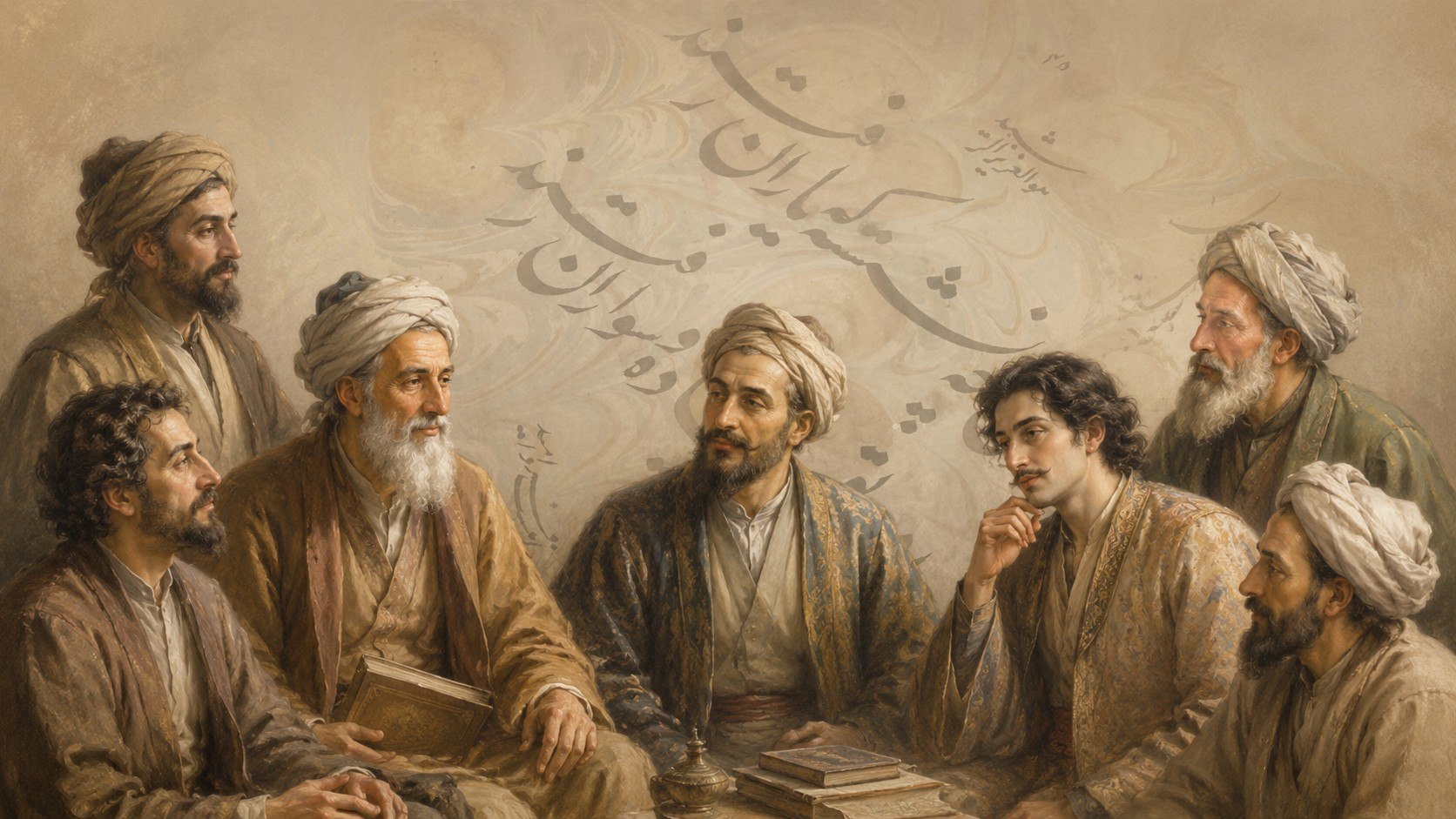
Nastaliq and Persian Poetry: How Did Calligraphy and Literature Shape Each Other?
When we see a Persian poem written in Nastaliq, we are not dealing with words alone.
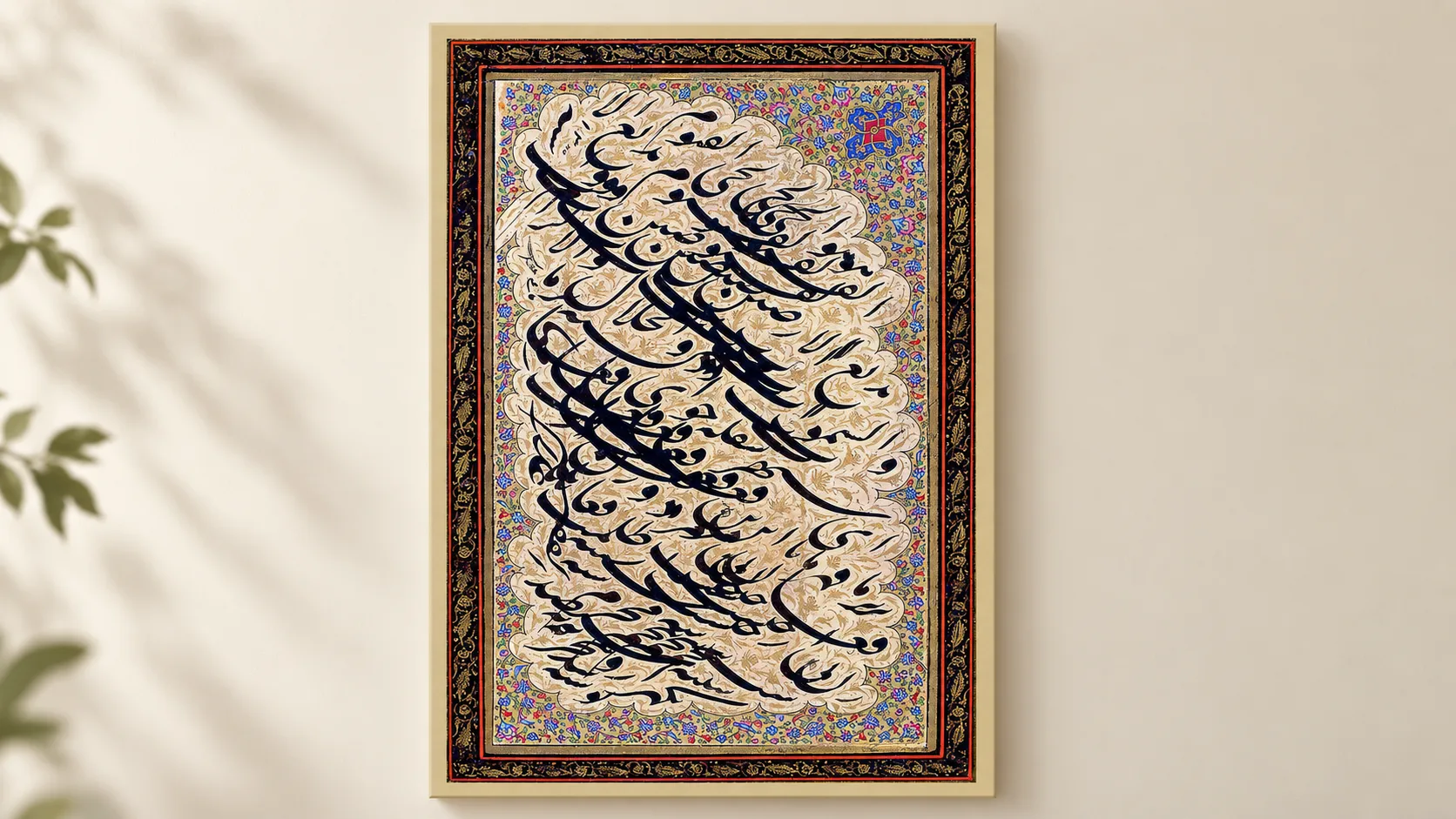
The height of words changes, elongated strokes extend across the page, lines sometimes incline, and areas of empty space remain between parts of the writing. The poem is read, but at the same time it also takes visual form.
This long association has led Nastaliq to be called the “script of Persian poetry” many times. Historically, the description is understandable: a large proportion of Persian divans, narrative poems, anthologies, and calligraphic pieces were written in Nastaliq.
But if we go a step further and claim that Nastaliq is inherently poetic, or that it was created from the outset for poetry, we move beyond what the historical evidence allows us to say.
The relationship between Nastaliq and Persian poetry was not the result of a single cause. Persian literature, libraries and courts, bookmaking workshops, scribes, book formats, calligraphic pieces, and later the muraqqa', or album, all contributed to the formation of this relationship.
For this reason, instead of asking “Why is Nastaliq the script of poetry?”, it may be better to ask:
How Did Persian Poetry and Nastaliq Give Each Other New Possibilities Over Time?
A Historical Relationship, Not an Inherent Quality
Nastaliq gradually took shape in the second half of the eighth century AH, corresponding to the fourteenth century CE, in several centres of manuscript production within historical Iran.
The surviving evidence does not point to a single moment when the script was “invented.” Earlier manuscripts also contain features close to later forms of Nastaliq, and manuscript-based research supports the importance of centres such as Shiraz and Tabriz in this process.
In traditional accounts of calligraphy, Mir Ali Tabrizi is usually described as the vazi', or founder, of Nastaliq.
This description reflects his important position in the professional memory of calligraphers, but it does not necessarily mean that Nastaliq came into being at one moment through the work of a single person.
It is therefore more precise to understand Mir Ali’s role in the organisation and consolidation of Nastaliq, rather than as the sudden creation of the script from nothing.
During the same period, Shiraz was also an active centre of manuscript production.
These works show an early relationship between Nastaliq and poetry, but they do not allow us to conclude that poetry itself was the principal cause behind the emergence of the script.
Persian had been written in other scripts before Nastaliq. Nastaliq, in turn, later remained neither limited to poetry nor even exclusively to Persian.
The relationship between poetry and Nastaliq was deep, but it was not exclusive.
Poetry in the World of the Book
To understand why Nastaliq developed such a strong relationship with Persian poetry, we need to move slightly away from the letters themselves and look at the world in which these works were produced.
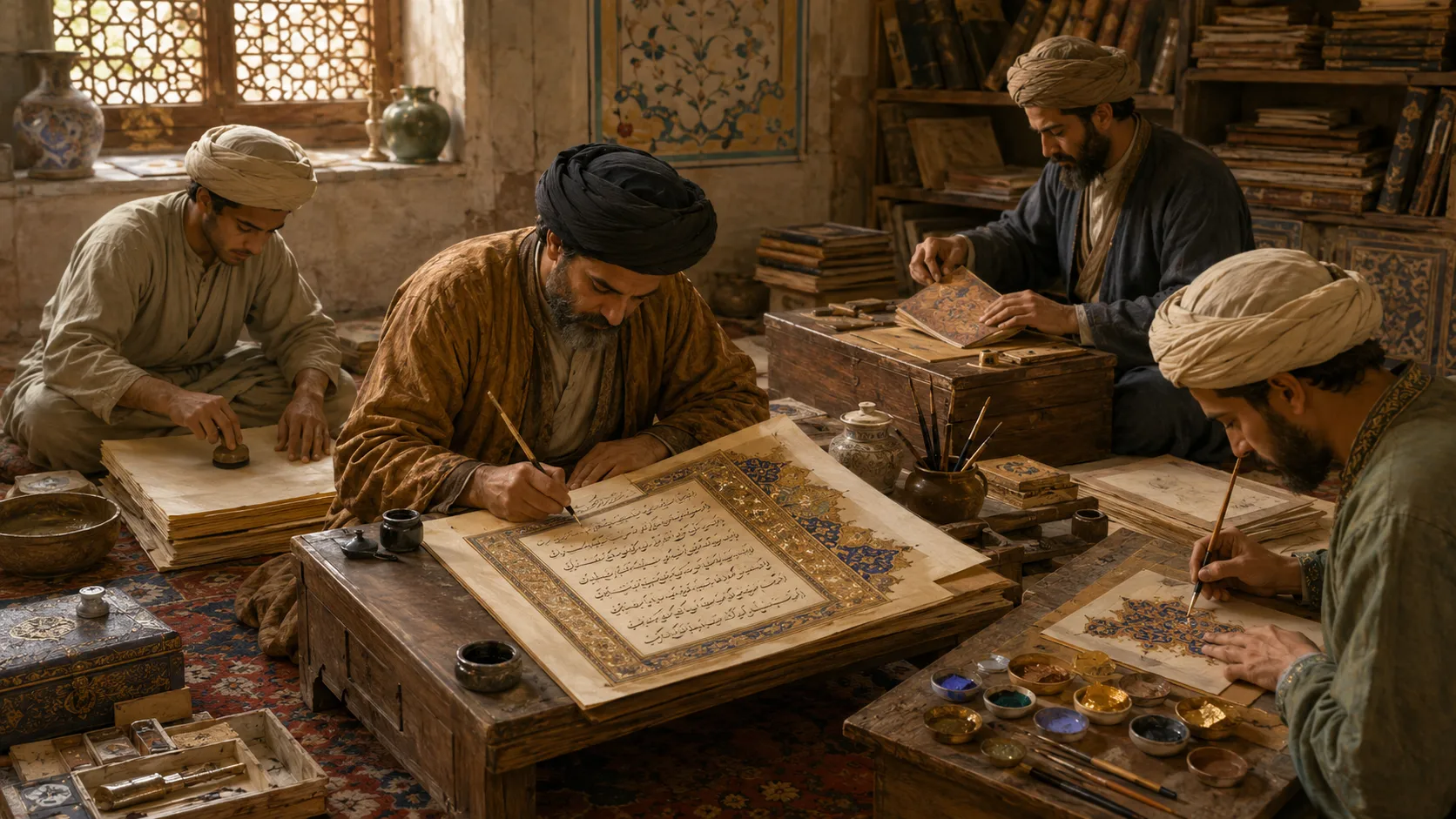
A fine manuscript was usually not the work of one person.
The scribe wrote the text, but an illuminator, painter, ruler, binder, and other artists could also participate. The combined processes are generally described as the arts of the book.
Courts, royal libraries, and other patrons also made it possible to commission manuscripts, obtain materials, and bring artists together.
For this reason, the spread of Nastaliq cannot be explained simply by saying that “its form suited poetry.”
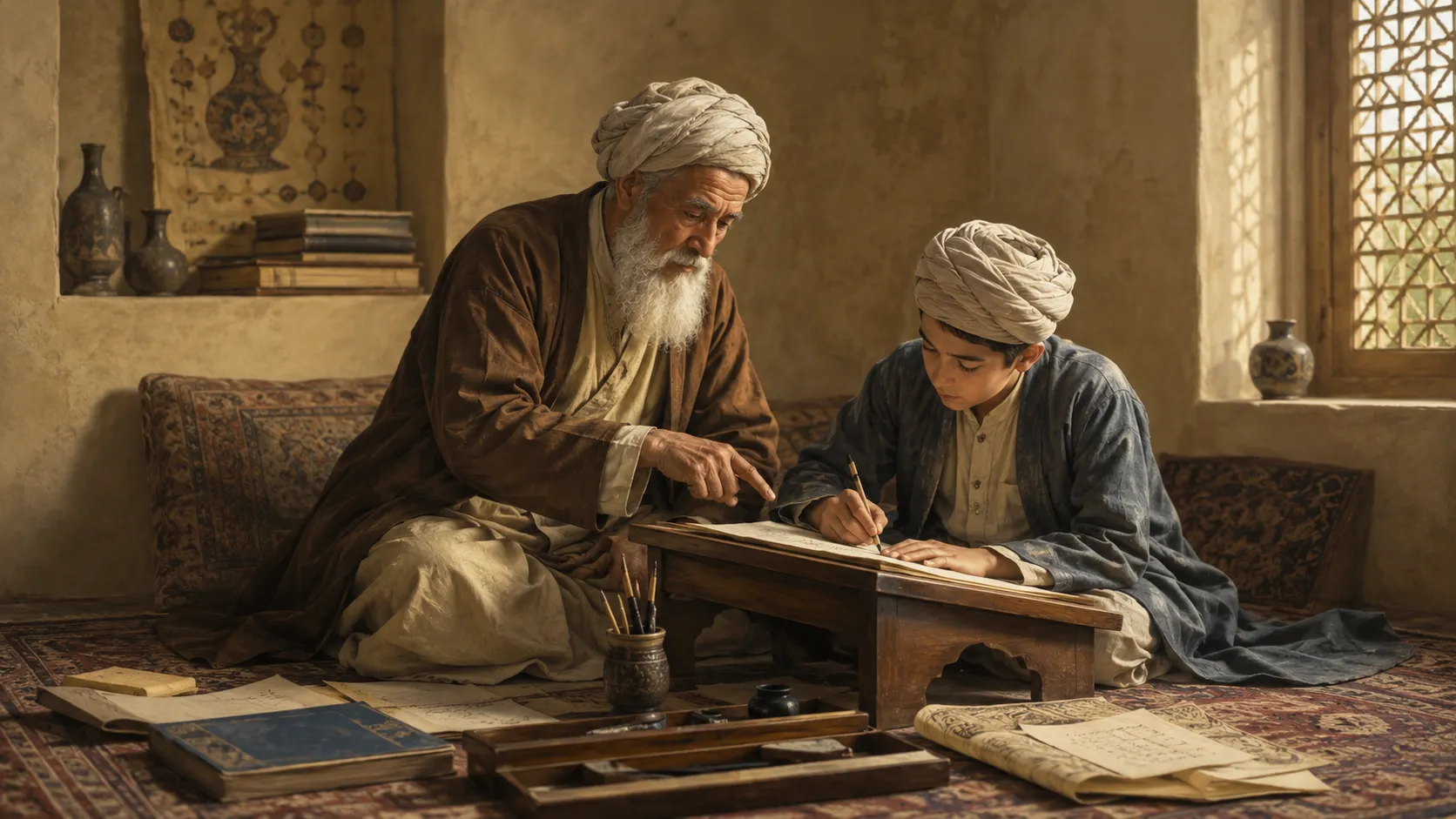
Before anything else, a book had to be commissioned, a scribe had to be trained, a text had to be available, and a manuscript had to be produced for reading, preservation, or presentation as a gift.
These social and material structures are also part of the history of the script.
Even the Shape of the Book Affected the Poetry
The size and format of a manuscript also influenced the way poetry was arranged on the page.
The Anthology of Persian Poetry in the hand of Sultan Muhammad Nur, copied in 905 AH / 1499–1500 CE, is an interesting example.
The manuscript has a narrow, elongated format and contains selections of short ghazals by several poets on a range of coloured and decorated papers.
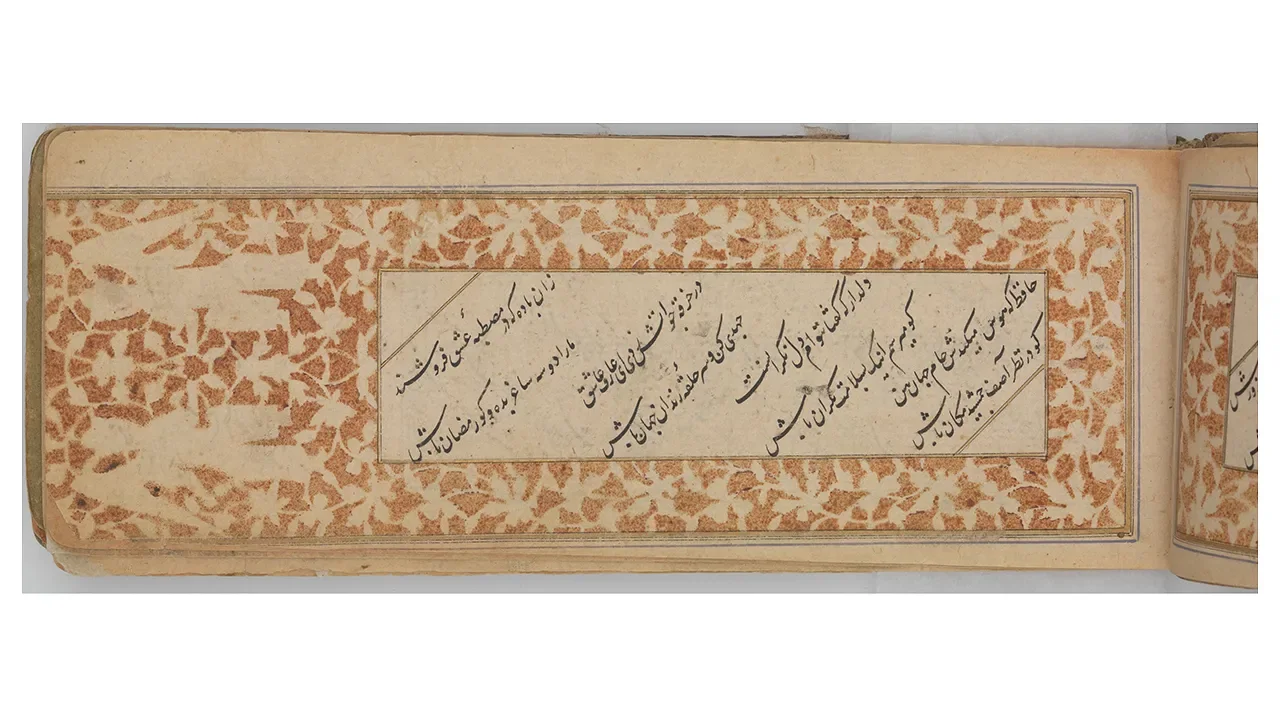
The elongated format changes the length of the lines and the way the poetry is placed on the page.
So when we discuss the relationship between poetry and Nastaliq, the forms of the letters are not the only factor. The dimensions of the paper and the construction of the book itself also affect the result.
At the same time, we cannot conclude from the different colours of the pages, without supporting evidence, that each colour was selected for a particular meaning within the ghazal. Here it is better to keep a distance between what we can see and the meaning we might be tempted to assign to it.
From Manuscript to Calligraphic Piece
In a manuscript, poetry forms part of a larger text.
One verse follows another, and a page also acquires meaning through its relation to the pages before and after it.
But when several verses are written as an independent calligraphic piece, the conditions change.
A piece can exist as an independent unit of calligraphy or later be removed from another context and placed in a new muraqqa'.
A muraqqa' is an album that brings together calligraphic pieces and images, sometimes from different periods and places.
This shift from manuscript to independent piece had important consequences for poetry.
In a book, the scribe had to accommodate hundreds or thousands of lines with sustained regularity.
In a calligraphic piece, a limited number of verses could be given far more space.
The scale of the pen could change, the lines could become diagonal, and broader spaces could emerge between different parts of the writing.
A piece by Mir Emad dated 1017 AH / 1608–1609 CE clearly illustrates this possibility.
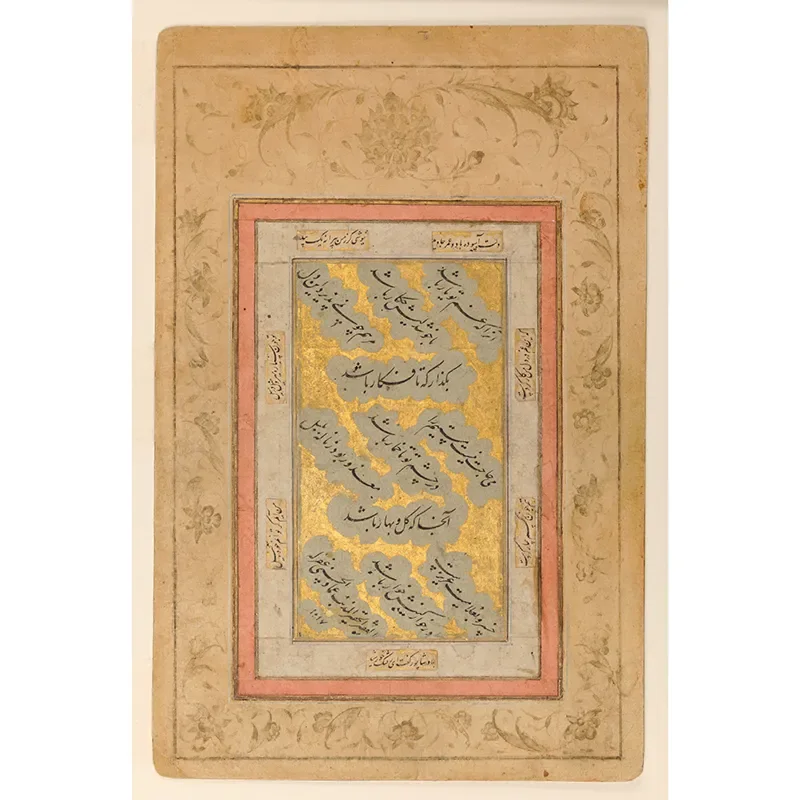
On this page, the lines are not all the same size, their directions change, and empty space becomes an active part of the composition.
The page is no longer simply a container for the continuation of a long text.
The few verses themselves have become the subject of an independent composition.
This change should not be called the “completion” of Nastaliq. It is more precise to say that it reveals another of the script’s possibilities.
How Does Poetry Take Shape on the Page?
Several calligraphic terms are useful for looking at this relationship more closely.
A Persian beyt, or verse, usually consists of two mesra', or hemistichs. But in calligraphy, a mesra' does not necessarily correspond to a complete visual line.
Depending on the size of the page, the length of words, and the pen, the scribe or calligrapher can arrange the hemistichs in different ways.
The kursi is the notional path along which letters and words sit within a line.
In Nastaliq, this path is not necessarily horizontal. Words may sit at different heights, and the line can acquire an inclined or shifting movement.
A kashida, or elongated stroke, is the extended form of certain letters or connections.
It may regulate the distance between two areas of writing, extend the length of a line, or create a visual connection between a dense group of letters and empty space.
But one important point should not be forgotten:
A kashida does not necessarily correspond to a pause or semantic emphasis in the poem.
The form of the word itself, the rules of calligraphy, and the composition of the page also contribute to such decisions.
The same applies to savad and bayaz.
Savad is the written, dark area of the page; bayaz is the empty space between and around it.
Bayaz is not unused space. It allows the writing to be seen and regulates the relationship between different parts of the composition.
Can the Metre of Poetry Be Seen in the Form of the Script?
The question is tempting.
We may see the rhythm of repeated letters, elongated strokes, and spaces and be tempted to connect it directly to the metrical rhythm of the poem.
But such a direct relationship has not been established by the available evidence.
Poetic metre is formed through sequences of syllables and the structure of language.
The visual rhythm of the page is formed through repetition, spacing, thickness, and direction.
The two may be experienced together while reading, but one is not a direct translation of the other.
The same caution is necessary when interpreting the meanings of individual words.
If a calligrapher writes one word with a longer extension, that form may stand out within the composition. But without supporting evidence, we cannot say that the calligrapher intended to express the meaning of that specific word pictorially.
How Does Calligraphy Change the Experience of Poetry?
Calligraphy does not change the lexical meaning of a poem.
But it can change the way we encounter it.
A larger section may be noticed first.
Empty space around a line can separate it from the rest.
A long extension may keep the eye moving across the page or create a connection between two areas.
In a manuscript, regular lines usually support continuous reading.
In an independent calligraphic piece, the order of looking can be freer. We might first notice a larger line or a darker area and only then begin reading the poem.
Poetry in such a piece therefore acquires a spatial presence in addition to its linguistic sequence.
But this distinction should not be made absolute.
A manuscript is not made only to be “read,” and an independent piece is not made only to be “looked at.”
What Remains If We Cannot Read Persian?
A viewer who cannot read Persian can still see many things.
The direction of the lines, pen size, density, empty space, elongated strokes, and the relationship between the text and margins all remain visible.
But an important part of the work remains inaccessible.
Metre, metaphor, the poet’s identity, literary references, and the precise meaning of the text cannot be recovered from the shape of the script alone.
For this reason, translation and the introduction of the text are especially important when presenting such works to audiences who do not read Persian.
Otherwise, there is a risk that poetry will be reduced to a beautiful visual form without its identity.
What Possibilities Did Poetry Give Nastaliq?
So far, we have mostly discussed how calligraphy affected the presentation of poetry.
But the relationship also worked in the other direction.
Poetry provided calligraphers with highly flexible material.
A single verse, a quatrain, or several selected lines could remain relatively independent without requiring the copying of an entire divan.
This made the production of independent calligraphic pieces easier.
The calligrapher could select a few verses and make new decisions about pen size, number of lines, direction of the composition, and amount of empty space.
The structure of the words themselves also created new problems to solve.
One verse might contain long words, numerous elongated strokes, or repeated forms, while another could be completely different.
Each time, the calligrapher faced a new problem of organising the page.
In this sense, poetry was not simply content transferred onto a surface.
The structure of the words in a poem also shaped the calligrapher’s choices.
When the Names of Poet and Calligrapher Appear Together
Another relationship developed in the calligraphic piece and the muraqqa'.
The text could draw literary prestige from the poet’s name, while the calligraphic work acquired another kind of value through the name and signature of the calligrapher.
Over time, pieces could be detached from their original contexts, given new borders, and placed beside other works.
In this situation, poetry also became part of a culture of collecting.
A few verses by Hafez, Saadi, or another poet could be selected as an independent unit and acquire a life separate from the complete divan.
This shift was highly significant for the relationship between poetry and Nastaliq.
Poetry left the book and reached the independent page.
Nastaliq Was Not Used Only for Persian Poetry
If we take the relationship between Nastaliq and Persian poetry seriously, we must also recognise its limits.
The Divan of Mir Ali-Shir Nava'i, copied by Sultan Ali Mashhadi in Herat in 1499–1500, is written in Chagatai, one of the literary languages of Eastern Turkic.
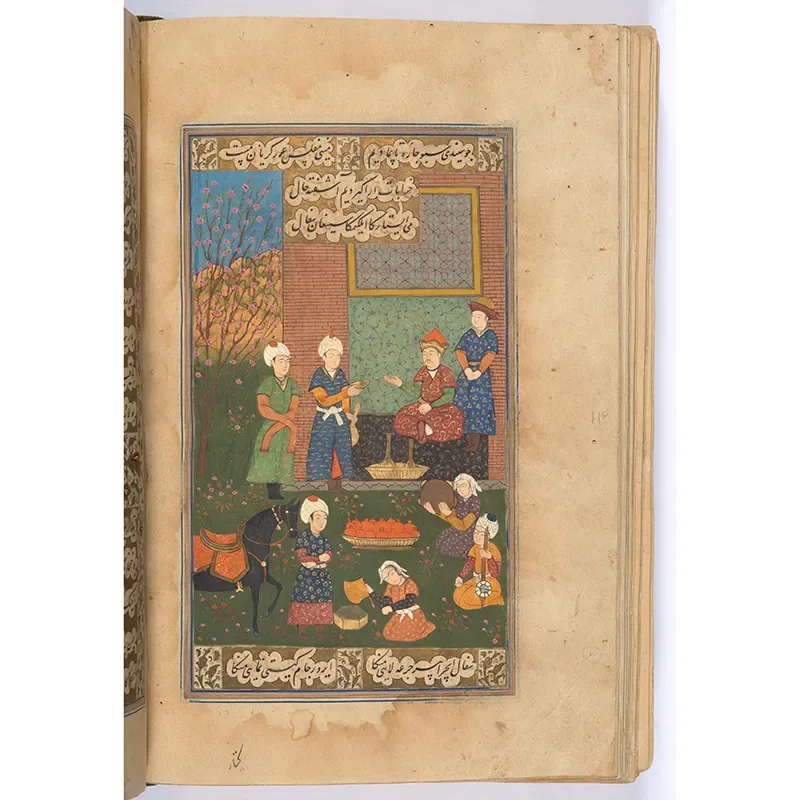
The work shows that the same Nastaliq that developed such a deep relationship with Persian poetry was also being used in the same cultural environment for poetry in another language.
Many works containing Qur'anic verses and hadith texts also make the same point.
This fact does not diminish the importance of Persian. It simply prevents us from treating the relationship as inherent and exclusive.
From Herat and Bukhara to India
The history of Nastaliq also continued in Central Asia.
Mir Ali Haravi worked in Herat, Mashhad, and Bukhara, and works by him and other masters of this tradition were later collected in Mughal India.
But India was not merely a place where pieces arriving from Iran or Central Asia were preserved.
Calligraphers also worked within the Mughal environment itself and produced new works.
Muhammad Husayn Katib is one example. A late-sixteenth-century piece by him presents verses by Amir Shahi diagonally across a decorated page.
This is no longer simply the “transfer of an Iranian work.”
Nastaliq was being produced within a new environment.
The expansion of Nastaliq in the subcontinent therefore cannot be explained only through a general idea of “Iranian influence.”
Migration of artists, teaching, court patronage, circulation of works, local production, and collecting traditions all played a role.
A Relationship That Continues
With the spread of printing and digital media, calligraphy is no longer the only means of reproducing poetry.
Yet the relationship between Nastaliq and Persian poetry continues.
Today, a single verse may appear in a calligraphic piece, on a book cover, in a poster, in an exhibition work, or in a digital image.
In many of these contexts, several selected lines have replaced the copying of an entire divan.
New media have also changed the nature of the audience.
A work once seen primarily within Persian-speaking environments may now appear within seconds before someone who does not know the language of the poem.
In these circumstances, presenting the poem properly becomes even more important.
The poet’s name, the original Persian text, and a clear translation can help ensure that the viewer encounters not only the form but also understands what text is being seen.
Persian poetry and Nastaliq: a relationship built over time
Nastaliq became one of the most important ways of writing and presenting Persian poetry, but not because of any mysterious or inherent quality.
Several histories came together to create this relationship.
The growth and prestige of Persian literature, the production of poetic manuscripts, support from libraries and courts, the training of scribes, the work of bookmaking workshops, and later the spread of independent pieces and muraqqa' albums all created the conditions for this association to continue.
The script itself also offered useful possibilities for organising poetry: changing the height of words, elongated strokes, differences in scale, and the relationship between savad and bayaz.
But these qualities were not direct translations of the metre or meaning of the poem.
In the other direction, poetry also gave Nastaliq opportunities for experimentation.
Selected verses and pieces, different words, and different literary forms repeatedly created new problems involving pen size, spacing, lines, and page composition.
In the hands of the calligrapher, poetry was not merely written; it was reorganised in space.
And Nastaliq did not merely make poetry more beautiful; it created another way of seeing and encountering it.
Perhaps that is why this association has continued for centuries.
Not because script and poetry were made for one another from the beginning, but because throughout history they repeatedly gave each other new possibilities.
Sources
Blair, Sheila S. Islamic Calligraphy. Edinburgh University Press.
Eslami, Kambiz. “ʿEmād Ḥasani, Mir.” Encyclopaedia Iranica.
Roxburgh, David J. The Persian Album, 1400–1600: From Dispersal to Collection. Yale University Press, 2005.
Soucek, Priscilla P. “ʿAli Tabrizi.” Encyclopaedia Iranica.
Subtelny, Maria Eva. “Socioeconomic Bases of Cultural Patronage under the Later Timurids.” International Journal of Middle East Studies 20, no. 4, 1988.
Thackston, Wheeler M., ed. and trans. Album Prefaces and Other Documents on the History of Calligraphers and Painters. Brill, 2001.
Wright, Elaine. The Look of the Book: Manuscript Production in Shiraz, 1303–1452. University of Washington Press.
Yusofi, Gholam-Hosayn. “Calligraphy.” Encyclopaedia Iranica.
Metropolitan Museum of Art. Collection records for Anthology of Persian Poetry, Page of Calligraphy from a Mantiq al-Tayr, Anthology of Persian Poetry in Oblong Format (Safina), Folio with Verses in Nastaʿlīq Script, Divan of Mir ʿAli Shir Nava’i, and Calligraphic Folio with Persian Verses.
National Museum of Asian Art. Collection records for Folios of Calligraphy F1931.20 and F1942.15b.
Discussion · article
0